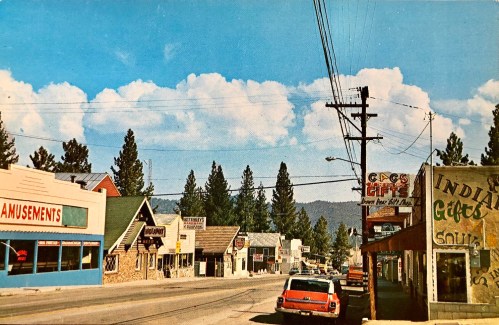
Big Bear, CA
La Fierabrosa: A Lyndy Martinez Story, Part-12
Link to Part-1: La Fierabrosa Part-1
Lyndy Life Tip #165: When exploring a desert ghost town on foot, never leave a plastic water jug unattended, especially if you spot a raven. They have a habit of poking a hole near the bottom edge, allowing all your water to escape, only to take a brief sip and bolt.
The Spitfire flung her hat at the large black bird. “Hey, cut that out!” she shouted, violently shoeing him off. She could tell where he’d been pecking his sharp beak on her igloo cooler. He watched her with one beady eye, waiting until she was near striking distance, before nonchalantly spreading his wings and leaping from the roll bar. With two efficient flaps—graceful as a fairytale dragon—he was soaring high on a thermal.
She could hear his inner monologue: “Nice try, loser...”
Arriving at the Jeep, Lyndy rested her elbows atop the half-door, catching her breath. Evidently, she and corvus-corax were the only creatures loco enough to be active at the worst time of the day; no other feet on the ground, no wings in the air. All the rational species were sheltering underground in burrows, awaiting dusk. It was a tempting idea. And you know those creepy apocalypse movies where for some reason you’re the only human alive on earth but your hair still looks fabulous? This town was like that.
Lyndy gazed at the faded beer sign, perpetually twisting up and down in the wind. Then after five breaths, she slid the shaven-down key in the ignition slot, pushed in the clutch and set the Jeep in gear. Traveling northeast on Kelso-Cima road, her route paralleled the Union Pacific mainline.
In this world feelings of solitude don’t last forever. The Spitfire soon became aware of rumblings at her back, comparable to a herd of buffalo charging across a prairie. She turned her head to see. In the side mirror, above the warning about objects being closer than they appear, she spotted a train approaching, daytime running lamps marking the snout of the golden yellow locomotive. A shallow drainage ditch and copious amounts of rock ballast separated the steel rails from the paved roadbed.
Some people say 75 percent of the stuff they teach in school you’ll never use. But now for a question of physics and momentum: Could a little jeep outrun the goliath freight train—a diesel consist—weighing over half a million pounds? Lyndy shifted out of overdrive and floored it, just as the engineer yanked his mighty air horn.
They were battling the same foe: hot stagnant air, like running sprints with a sandwich board taped in front of your body. One vehicle harnessed a few thousand horsepower and the other perhaps 50—being optimistic; not nearly enough. That horn echoed like a trumpet from Revelations, almost as jarring to the eardrums.
Leaning forward, checking the speedo and the tach redline—she knew those two were a joke, yet she monitored them anyway. The trainman was surely taunting her, arms out the window, dipping a pin-striped hat in the air stream, flicking it up and down. Maybe he did it because he knew she was a pretty girl, or else he was bored and did this to everybody.
The Spitfire let her hair out, pitching the tie to the passenger floor. She ran her fingers through to make it wave like a flag in the wind.
If Chan or Lovelace would crack open the wallet a little, purchase a GT350, she would run away easily. Instead she was losing ground. That’s the way it goes some days. The train clattered on by, caboose gradually merging into the vanishing point. As the cacophony of railroad noise subsided, she could once again hear herself think, plus the din of an AM radio announcer. It was a live news broadcast, and the host was discussing a record breaking Southern California heat wave, warning people to stay indoors, check on elderly neighbors and so forth.
You don’t say?
The next dirt-crossing intersected a trail aiming to the mouth of Globe Canyon. It was one of her planned waypoints, and Lyndy engine braked. Cattle guards—essentially rusty metal grates—had been positioned on both sides to prevent wandering cows from turning into train kabobs. Lyndy rolled across the tracks, pausing on the far side to take her bearings. The map indicated actively used JBR corrals, and a spring or guzzler up slope from here.
Reaching behind the passenger seat, Lyndy tilted the lid and dipped her fingers in the plastic ice chest. The ice inside was already turning to slush water. She fished for a slippery can of pop, not knowing which container was which, but expecting Tab cola. Beholding the prize, she discovered it was grape soda, a leftover of some long-forgotten camping trip.
“Grape? Seriously, what sober individual buys grape soda?”
She stared at it, pondering whether she was really thirsty enough to swallow a grape flavored soft drink, and questioning her decision-making ability in all areas of life. Something about it tasted so much like purple cough medicine. She ran the moist exterior over her flush cheeks and forehead. Then she hopped to the stable ground.
Pointing the lid well away from her midsection, Lyndy tore off the foil tab. The pressurized contents ejected a fountain of foam, like cheap champagne. Then she raised it to her lips. Liquid infused with too many air bubbles ran down her chin as she gulped as much as possible. It smelled like pure cane sugar.
Lyndy Life Tip #164: No matter how handsome or charming, never date a guy who collects antique train whistles. Personal experience.
When the can was finished Lyndy crushed it with her boot heel. A lone honey bee was fast hovering over the muddy ground, giddy with excitement. She wiped her forearm across her lips, then sought out a clean rag to do a better job; she didn’t want to be sticky all afternoon.
The Spitfire set her arms and elbows across the rear fender, this time lowering her head and kicking at the soft dirt. The tips of her black hair dangled across her chest. Every so often she could hear the train faintly, a squeaking of steel against rail, receding in the distance.
That relatively cool night in Amboy had given false hope for relief, yet was simply an intermission. Already she could feel a headache coming on, beginning as a tightness around the temples. It was likely the first indication of heat stroke. But if she had to give this headache a name, it would be Dale Keynes. What a cad.
Like her pal the raven, it was routine for him to take advantage of any vulnerable situation. The worst: when she was nineteen, naively she’d informed the whole town—at least everybody at the Vanishing Point on a Thursday night—of their intentions to wed. I mean sure, they had talked about it.
The sting of embarrassment was evergreen, still making it difficult to breath whenever the memory crossed her mind. You know how small towns get. And then he comes back from Nevada married to Miranda. He’d taken her pride and smashed it to smithereens. Lyndy was so ashamed she could barely leave the house. Rather than show her face, she’d drive to Victorville or points west to buy groceries and avoid everybody. Maybe that was when she started resenting Catherine. The reason? Cathy had never made a fool of herself in the same way The Spitfire did.
Lyndy reached for the wrinkled map. She set her finger upon the circles marking wells at Government Holes. It wasn’t going to be easy informing Chan of her failures. She’d wasted a week of time with no result.
Speaking of the elderly, somebody should check on that crazy sweater lady. She probably had a house full of cats and no AC.
Lyndy shook her head. “Somehow, I manage to achieve new lows in career and love life simultaneously,” she muttered, glancing at her dusty boots.
Then she spotted tire marks, deep and crisp. Some other fool had been here—exactly the same spot—even stopped.
Wait, wait, wait. In this weather? Somebody else had been here … today?
Folding it in half, she threw the map back on the passenger seat. There hadn’t been another car since before Granite Pass.
Lyndy circled around the Jeep, head pointed down, hands in her back pockets, eyes studying every inch of the lines. She lowered to a crouch, resting on her heals. With just the nail of her finger she touched the highest points, places where a tread void had rolled. The tracks were firm, created by a heavy vehicle that was also wider than normal. From this angle she could see and compare to the maroon Jeep. Separation between wheel centers was so broad it dwarfed the Jeep’s axles, greater than any she could recall from a civilian truck.
But the most striking feature was a common sense rule the owner failed to obey: he or she wasn’t running the same make of tire on all four wheels. At first, Lyndy assumed they’d been pulling a trailer, but no. Two on the left were matching, but the third and fourth, while being equivalent width, were completely different tread.
The pattern ran both directions, into and out of Globe Canyon.
What kind of Frankenstein car is this? Somebody own a dump truck around here?
Lyndy placed a finger on her chin and squinted at the sun. About the only thing rascal Dale had mentioned about Government Holes was the lack of any recognizable patterns, due to heavy rains.
Reaching in the cargo bed for the tools, The Spitfire retrieved a coiled cloth tape measure. She stretched it over the marks in the road, bending down to keep it tight. Once black numbers were so faded you could only read every other digit. But it worked: 79 inches edge to edge.
Next, Lyndy went for her camera. Shaking it from its leather case under the passenger seat, she walked a suitable distance to frame a better picture. As she did this she configured the aperture for exceptionally bright conditions.
Once upon a time in the west, you could track a person by his or her boot print, or the gate of their horse. Nowadays, well, you had to make-do.
Knowing these shots might come in handy, Lyndy took several snaps, then stowed the camera. Taking one last look around, she combed the horizon for wisps of dust, possibly indicating trucks on dirt roads. None were present, not even a whirlwind. She decided it was time to get a move on.
It made logical sense for tourists to want to visit the iconic Mojave. It was known around the globe, enjoying particular acclaim in Europe. But when the radio is squawking about record breaking heat waves, who the hell wants to suffer out here versus relaxing indoors at some posh Vegas casino? The whole week had been like that: quiet. Plus, what sucker rents a car with non-matching tires?
“I gotta find that vehicle,” thought Lyndy, accelerating onto the pavement.
20 minutes later …
Ten miles deeper in, at an intersection with Cedar Canyon Road, Lyndy pulled to the side. Conditions were getting worse. She left the engine idling so the mechanical fan would spin and pump continue circulating water. There hadn’t been any motorists along the previous stretch. Not surprising.
Her thighs were sticking to the seats. They made that burping noise as she slid out to survey the land, her headache becoming more and more intense. The Spitfire cupped a hand over her eyes to shield from glare. With the other arm she braced on the windshield support pillar. Hallucinations would be next.
According to AAA, there ought to be direct access to the Mojave Road from here, but it required locating hundred-year-old wagon ruts comprising what remained of the trail. Not an easy task.
After all this, Mr. Crawford better not skip town or something.
She reached for the pack of cigarettes and cheap lighter. With the plastic bic she touched one Newport to flame, but could have pressed it to the pavement with the same result. Gripping it between two knuckles she trekked across the road.
Even the county-maintained road was in deplorable condition. Its charcoal gray surface crumbled beneath the soles of her shoes, each gap drowned in about 5 layers of tar, and filled in with blowing sand. On the far side was a dry watercourse. Where the drainage had been spanned by a barbed wire fence, intermittent runoff flowed at a westward slanting angle, 30 degrees to the road.
Near to this ephemeral stream, a primitive scrap wire and wood gate caught her attention. It was part of the fence line for the cattle range. The closure mechanism was simply a loop of wire—thick as a coat hanger—stretched over top of a sturdy post. At the base of the post, a hearty nolina plant had taken root.
Lyndy had to wrestle the wire gate, using her shoulder to reduce tension. Then she pried it loose with her fingertips, scuffing up carefully painted nails in the process. The crude gate collapsed in a heap on the ground, defeated. She felt ready to do the same.
But there were narrow ruts here, and protruding in the gaps, fragments of rusty iron, parts of horseshoes left behind by mules a hundred years ago.
This then, must be the road in question—Russ’s road. Lyndy crushed out her cigarette. Then she saw tire marks, same as before. She knelt down for a closer inspection. Indeed, whomever had been at Globe Canyon, had also passed this way, except only one time. They were traveling west, into the range.
Hastily returning to the jeep, she gave each of her front hubs a quarter turn, setting them to the “lock” position. From the stretch she could see, and what Russ had described, driving the Mojave Road would be like riding one of those 15-cent kiddie rides outside a supermarket, except twice the number of jolts and never ending.
She muscled the transfer case into low range.
Who needs a gym workout when you drive a CJ-5?
There were rules of etiquette in backcountry travel. Nothing could be more irritating to a rancher than a gate left open by careless off-roaders. So, it was interesting then, that the driver of the Frankenstein car had enough sense to force the gate back on. They paid no attention to tire safety but cared enough to practice the cattle rancher’s code. She was even more determined to visit the JBR, first to check every one of their vehicles. Somehow, she knew ahead of time none would match.
Westward ho. After rolling through the gate, Lyndy stopped briefly to secure it. If the map were to be believed, this segment should connect to Marl Springs, an oasis with plentiful water and animal guzzlers. But it was a long haul, ten or more miles.
Despite the comically slow pace, crawling in low range four-wheel-drive was pleasing to the human soul. The surface was so uneven anyway, it would be impossible to travel at any normal speed in two-wheel-drive. First you were listing at 25 degrees to the right, giving an unnerving feeling you might tip over with the leaf-sprung suspension. Then a hundred feet more you were tilted 25 degrees the opposite way, and the cycle kept repeating itself. Occasionally you were nose down at the same angle.
“I seriously need a massage after this,” The Spitfire whispered.
In the span of a handful of miles, the desert transformed itself. Unexpectedly she was engulfed by a forest of mature Joshua trees. Their shaggy limbs hung across the road like ancient oaks in the south.
Despite cartoon depictions, it was often said of saguaro cacti that you’d never find two individuals even remotely alike. The same could be said of Joshua trees, and that was the remarkable thing about them. The plants twisted overhead like art sculptures. Some were in full bloom, adding an aroma of pollen in the air. The dagger-like green leaves were tender, but near impossible to access given the texture of the trunk.
It could have been fun being out here, pretending you were pulled by a team of ornery mules, riding in a covered wagon. That is, if her entire brain wasn’t throbbing.
Up ahead the road dipped in a sandy wash. New openness created by the wash provided a view to the mountains. Lyndy noted towering cumulous starting to rocket up. The white cotton forms contrasted sharply with blue sky. High humidity, combined with triple digit temps were a recipe for storms. The troposphere had limit switches; it could only get so hot before something had to give.
To keep up momentum, Lyndy doubled her speed. She didn’t dare risk getting stuck until she was safely to the other side of the wash.
Out in front there was some unidentified life form coming into view, strange black masses moving horizontally on the alluvial plain. They were cows with watermelon shaped bodies and bulbous heads, appearing to hover over the ground. The skinny toothpick legs of cattle were completely blurred by heat waves.
The Rawhide television theme intruded into her mind: Don’t try to understand em, just rope, throw and brand em… sage advice.
Cresting a small rise—remains of a fossil sand bar in the watercourse—she came upon additional cows. These were standing in the road. Her reflexes taxed, The Spitfire could hardly react quick enough, slamming on drum brakes to avoid plowing into the nearest one. The Jeep went into a slide, coming to rest with fender twelve inches away. The startled beast let out a distressed moo, causing the rest of the herd to scatter into the brush.
“Running into one of those behemoths would have been bad ugly,” thought Lyndy.
But when she eased the shifter back into gear and tried to drive forward, her tires began to spin. Lyndy attempted to compensate by revving the engine higher, but it was no use. She threw it into reverse, but it wouldn’t go backward either. In the soft soil, all-terrain tires were no bueno. Everything she tried only made things worse.
Lyndy craned her neck to the side. Looking at the rear axle, her heart sank. It was buried up to the diff case. She smacked her palms three times against the wheel. Lyndy still hadn’t purchased a CB radio.
In hindsight, she should have left a note, or mentioned to Chan where she was going. She’d told no one of her plan, and was on one of the least traveled, loneliest stretches of trail in the desert. This wasn’t a game anymore.
“Crapola.”
Lyndy reached in the igloo cooler for a sandwich; they were floating on the surface now, probably soaked. Meanwhile she eyed the green army shovel. It had been strapped to the roll cage ever since she could remember. Hector had needed it once or twice, probably to get out of the same situation. But never had The Spitfire dug herself loose; she was the pretty one. She was the charming one. And that was the worst thing about Hector’s passing—she had to do the digging by herself. But wasn’t it the same thing Chan complained about? He had to be the bounty hunter now and she was the private investigator. It took both of them to replace the first Martinez.
“You know, if I die out here, I’m coming back as a ghost and totally going to haunt the shit out of Ted Crawford.”
 Aiden S Clarke, author
Pingback: Links to La Fierabrosa Chapters | Aiden S Clarke, author