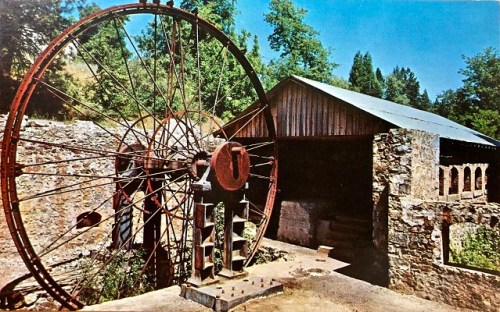
Pelton Wheel, Grass Valley, CA
La Fierabrosa: A Lyndy Martinez Story, Part-13
Link to Part-1: La Fierabrosa Part-1
Chemehuevi Indians inhabited this region of the Mojave for centuries. To thrive in such an unforgiving environment, tribe members roamed over tens of miles, harvesting seeds and nuts along the way, or trapping small game, such as birds and rabbits. They succeeded where other tribes failed, making a home, in a destination most Americans considered intolerable, by adopting lifestyles in harmony and balance with the land. They didn’t have concrete dams, electrical transmission towers, an interstate highway system, or viaducts and Byzantine irrigation canals to depend on. Though it wouldn’t support a large population, the desert provided for nearly all their needs. And what they didn’t possess, they bartered for with other tribes.
Feeble and wilted against the tailgate, The Spitfire was wishing she could trade in her bag of tricks for theirs. She knew she would never be as confident as them, traveling alone and on foot in a place where virtually all God’s creatures wanted to poke, bite or sting you.
An ordinary settler lacking proper provisions didn’t stand a snowball’s chance. Thus, when the army came through in the 1850s, they set in place an elaborate and expensive supply chain, transporting goods by mule and wagon train all the way from Drum Barracks at the Port of Los Angeles. Later still, pioneers in Lanfair Valley depended upon the support of a now defunct Barnwell Branch railroad. A history lesson like this made you wonder about anyone who claimed to be living “off-grid” in the East Mojave; fat chance.
Unfortunately, the little burgundy Jeep wasn’t going to free itself anytime soon. When a vehicle has ordinary open differentials, four-wheel-drive is just another form of two-wheel-drive. The flashy chrome badge featuring “4-WD” was a marketing gimmick.
The bovine that put her in this predicament was still within sight, chewing cud and occasionally lifting his head to sniff the air in her direction. Decorating his bony flank, she could see a hint of a dark patch, probably the JBR brand. Every couple minutes one or the other of the cows would let out a moo; god only knew where they were obtaining water.
Lyndy exhaled, then started rolling up the sleeves of her cowgirl shirt. She undid every pearl snap save one, making it into more of a protective covering for virgin skin on her back. The mocha skin on her chest and shoulders could tolerate hours of direct exposure, but the areas of her back and hips not so much.
Lyndy Life Tip #166: If you own a shitty car that breaks down a lot—and believe me, AMC branded models break down a lot—go get yourself a decent pair of those red mechanic’s gloves and store em in the glove box at all times.
The Spitfire frisbeed her ball cap to the front seat. Lifting the cooler above her forehead, she allowed cold water to dribble over her face and neck, delighting in the sensation. Lines of dirt became evident on her arms. Between that and her newly modified outfit, she figured she could pass for an inebriated groupie at a summer music festival. And maybe later she’d regret wasting water, but these were desperate times.
At first the sand trap situation appeared hopeless. Her right rear tire had buried itself in a twelve-inch rut. Peeking under the bumper, she couldn’t see light nor slip a pinky beneath the axle tubes. The sand reached halfway up the diff cover, which was supporting the lion’s share of weight. Ironically, given its faults, the Jeep was mechanically sound. But from the look of things, it may take the remainder of the afternoon to un-stuck herself. Lyndy wanted to slam her head into a bumper.
Her nose felt itchy from all the dust and Joshua tree pollen. Lyndy stretched an arm up to the cargo bed, seizing on a wad of loose napkins to blow it. As she did this, she glanced to the roll cage and army shovel. The last time somebody used that shovel was because they needed to take a number-2 in the backcountry. Hector had cemented in her mind a healthy fear of getting stranded out here, alone and exhausted with no one coming to the rescue. The same fate befell him on a few occasions, nearly costing his life.
Miserable, yet determined, The Spitfire began undoing the pin-buckle leather straps securing the shovel. She took a seat on the ground, legs folded in front of her, and commenced the process of scraping soil away from the axle.
Sometimes all it took was a familiar smell, or texture of an otherwise simple object, to conjure experiences with her late brother. Hector’s ghost was that way, intruding whenever you were least prepared. She could still hear his voice, imagine the things he would say, pronouncing every syllable in her head as he would. He had a macho way of speaking.
Lyndy continued scraping harder, faster, moving more dirt and filling in the ruts.
She remembered watching Hector. She was 17 years old, standing outside the trailer in the blistering sun. She had on cutoff shorts and a men’s undershirt, her abdomen partly uncovered. It must have been mid-afternoon, home early from school and she was chewing bubble gum, intermittently popping bubbles loudly with her tongue.
Hector was wearing black jeans and a denim shirt. One by one, he pressed bullets into a set of magazines for the Beretta. A brand of cowboy cigarette hung from his lips, and he removed it to speak. He gestured to his homemade targets.
“Listen to me Spitfire. There are big lies told in movies or books, make you expect you’ll be good at everything the first time you try. But that’s not how life works. You will not be good at everything the first time you try. You must be educated. You must practice. You must humbly learn from others, train, adapt and repeat.”
At the conclusion of his lecture, she knew he would ask her to shoot. But this day, like many others, she refused. His way was not hers.
Several hours later …
As soon as she got the Jeep rolling again, The Spitfire didn’t ever want to stop, even upon reaching solid ground. To heck with those suspicious tracks. She needed to execute a six-point turn just to get back headed the right direction.
Once her tires hit hot pavement, she shifted into fourth gear and punched it.
While driving with one fist on the wheel, The Spitfire applied balm to her cracking lips. Powdered sand had coated every inch of the dash, giving it a silvery sheen; the same could be said of Lyndy’s skin. For the most part her headache had subsided, but freshly taking its place were stomach cramps. Thoughts of those peanut butter sandwiches made her want to hurl.
It was such a straight shot between the twin ghost towns of Lanfair and Goffs, Lyndy could easily have driven with the steering wheel roped in place. Whereas Lanfair comprised nothing more than a few odd cement foundations, Goffs was marked by a stately abandoned relic, positioned south of the roadway. As with the depot at Kelso, the building had been architected in a mission style, with spacious covered porches, arched external supports and tan stucco walls.
It was the red clay tile roof which really made it stand out, because the walls were the color of adobe. Where its roof had started caving in, one could see arches, two small ones on either side plus a large one for the door. They sheltered what remained of the porches. By some miracle, generations of vandals and overnight campers had left the structure relatively untouched.
Someone, probably Dale, had once told Lyndy the crumbling building had been a regional schoolhouse, serving youths from both Lanfair and Goffs.
As Lyndy approached from the west, she spotted a familiar yellow rig stopped at the roadside. The “harmless” operator was nowhere to be seen though.
This chance meeting was both good and bad luck simultaneously, since Lyndy had been noodling how to actually confront Russ; she had yet to come up with a decisive plan.
Ever get that feeling somebody is trying a little too hard to act innocent?
You can’t ask someone straight-up if they’re involved in thievery. If Russ were just a common citizen, then accusing her of a crime would cause offense and ruin the relationship. And if anything, Lyndy needed more friends.
It was the first time stopping since getting stuck. Lyndy decided to stow the maroon Jeep on the opposite side of the road, leaving an eighth of a mile separating hers and Russ’s rig. With a new starter in place, getting going quickly shouldn’t be an issue; maintaining highway speed still would be.
Lyndy kept the tranny in gear. Before departing she slid the loaded Beretta in her purse.
Neglected gardens around the perimeter of the school had become overgrown with fern bushes and prickly cat claw. She had to choose a path carefully, pausing multiple times to free herself from stubborn thorns.
At the south end of the building, someone attempted to patch all the open window holes with plywood. Whoever they were, they cared enough to try to preserve this place. So much time had passed though, most of the wood had deteriorated and was falling away.
Through a knothole Lyndy peered inside. She could see a human figure standing in shadow, near the center of the room, while high narrow windows created shafts of light. The light highlighted strands of spider silk and dust flakes floating in the air.
Lyndy let her eyes adjust to the conditions. She still had the element of surprise. Julia Russell was concentrating, head down with one eye squinted shut and the other gazing in the top of an old-fashioned reporter’s camera. It was the twin-lens style popularized by Rollei, with the ground glass where the image formed.
Standing there in her floppy straw hat and faded overalls, she looked to Lyndy like one of those quirky ladies who make a living selling repainted Adirondack chairs at a county fair, and probably think raising alpacas on the side is a profitable hobby. Russ cradled the camera close against her chest as if it were a tiny hand puppet, and she was preparing to make it tell jokes. In summary, discovering Russ was the mastermind of a Mojave Desert cattle theft ring would be just the kind of plot twist this case needed.
Russ got off one snap of the shutter, and as she wound the lever for the next exposure a massive barn owl—Lyndy had not seen the thing she was photographing—decided it would tolerate the intrusion no longer. It took off in a flurry of dust and white down feathers, exiting through one of the larger gaps in the failing roof.
In this chaotic moment, Lyndy raised one corner of the plywood board to reveal herself.
“Lyndy!” Russ exclaimed, lowering her camera to waist level. “I didn’t hear you drive up.”
Strangely, she didn’t seem as caught off guard as Lyndy was expecting.
“Let me help you with that,” declared Russ, while rushing across the room.
“Sorry I startled your owl,” said Lyndy.
Russ shook her head. “I think it was the shutter snap that frightened it.”
“It’s funny. I don’t think I’ve ever worked so hard to get into a school,” remarked Lyndy.
Russ supported the rotting board, keeping it out of the way while Lyndy twisted her hair and ducked through the busted-out frame.
“Say, is your Jeep still running like a top?”
“Affirmative. And that’s the irritating part,” replied Lyndy with a frown. “It was more fun when I got to complain about it.” Once clear of all the broken glass, she started dusting off her jeans. “Groovy camera ya got there,” Lyndy added.
“Thanks.” Russ chuckled while looking Lyndy up and down. “I appreciate the unconventional look, but why no heels today?”
“Truth is, pretty only gets you so far in life—and that definitely applies to shoes,” said Lyndy with a shrug. “In the meantime, I’ve been having an unproductive few days to say the least. Noticed your parked car and thought I would come see what you’re up to.”
“Only my usual shenanigans,” said Russ, with a welcoming smile.
Lyndy grinned, folding her arms. “Same here. Dropped in on some white supremacists yesterday and got needlessly threatened with an acid attack. First time for that actually, so it was a milestone.”
Russ raised her eyebrows. “How on earth did that come up?”
Lyndy adjusted her purse and started exploring the empty classroom, extending her arms to swat away floating debris, likely containing asbestos. Tired floors creaked endlessly as she moved. At the same time, she related her encounter with Wallach in Lester’s bar. She was still peeved about it, which explained why she was spilling her guts to Russ again.
“That Neanderthal was probably bluffing,” commented Russ, while crouching to snap additional interior shots of the building. At one point, the camera field of view encompassed the spot Lyndy was occupying—and she knew her picture was being taken. She had not given Russ permission.
Lyndy was in the midst of rebuttoning her cowgirl shirt. “Darn it, I think my shirt has either bird or bat guano on it. And I planned to meet a cute boy later; very bad timing.” Lyndy continued to brush at the shirt, while Russ took pictures. “Thing is, I assumed Wallach was bluffing too. But what makes you say that?” Lyndy was curious. “I haven’t given you cause to believe that, have I?”
By twisting the elegant green metal knobs on her camera, Russ adjusted settings, then turned the lens back on The Spitfire. She hesitated, then crouched to take a different picture, ostensibly of floorboards. “Well, recall my husband was in the Navy. Don’t tell one of them to their face, but the Marines are like a sub-branch of the Navy. There are no combat medics in the Marines, because the Marines rely on medics from the Navy—and anyway they’re called Corpsmen not medics. Think he’d know that if he was in the Marines.”
Lyndy had another good idea. “Hey, can I show you a sketch of something?” she asked, removing the folded art paper from the front pocket of her purse. “It’s a bit of a Rorschach test: Just tell me the first thing that comes to mind.”
“My pleasure,” offered Russ. “I won’t charge you for opinions neither.” Russ slipped her camera back in its leather case as Lyndy passed her the paper.
It took only a momentary glance before Russ nodded. “I think it’s a hubcap from an International Scout model 80. I would guess a 65 or 66 model from the look of it. Those were one hell of a truck I’ll tell you. I drove one like that over Schofield Pass road in Colorado. It’s one of the most dangerous trails in the Rockies.”
“Damn,” said Lyndy. She kicked the floor.
“What’s a matter?” asked Russ.
“I saw an older International Scout yesterday, outside the bar. Except I don’t remember if it was missing a hubcap or not,” replied Lyndy.
Her and Russ were eye to eye.
“Do you remember what kind of front grill it had? Maybe try and picture it in your mind. Did it have the shiny chrome accents, like toaster slots, or was it an ordinary mesh style grill?”
Lyndy put her thumb on her chin and squinted. “I think it was plain, charcoal in color.”
“So that’s an early Scout. It fits. But I bet there’s a lot of Scouts out there, and most are missing a hubcap or two.”
Russ’s encyclopedic knowledge was impressive, and her kindly demeaner still didn’t seem like a façade. But it was time to skip to tough questions. The Spitfire pushed the hair from her cheeks and wiped beads of sweat from her forehead. She needed to observe Russ’s body language carefully.
Sometimes there’s simply no way to prevent a situation from turning awkward: like running into an old acquaintance in the grocery store, exchanging words, saying goodbye, and then running into them five minutes later in a different aisle.
“So Russ, I have an automotive riddle for you. What sort of vehicle has a 79-inch wheel base?” There followed an extended silence. Like a wide-eyed toddler, Lyndy tracked every subtle move Russ made, stopping only to blink. When it seemed time to fill the audible void, she tacked on, “For example, I measured 52 inches on my Jeep.”
Russ shifted her gaze up to the decaying ceiling and inhaled. “Only really heavy-duty commercial or farm machinery; could be a 1-ton Ford or GMC work truck fitted with custom axles. Or possibly a dump truck. I’m pretty vague on all those—I don’t sit around and memorize vehicle track widths in my spare time.”
“It’s a hobby of mine, but I don’t get to do it enough,” joked Lyndy.
“Where did you see that? You certainly seem determined today.”
“I’d rather not elaborate. I just need to find the driver, so I can ask them a few questions. I’ll leave it at that.”
“Fair enough,” said Russ. “Listen, I gotta change out a roll of film.” She indicated she needed to return to her vehicle, but it would be alright for Lyndy to follow.
Lyndy trailed Russ out to her yellow Jeep. Russ had a big white ice chest strapped in the back. “Want a cold beer?” she asked. She held up a bottle in offering, water beads dripping on the ground.
Never in Lyndy’s life had a domestic brew seemed so tempting. She was reaching for it when she noticed a colorful letter-size piece of paper stuffed between the spare tire and the frame. Something made her snatch it to check what it was. Once unrolled, she felt certain she had stumbled upon a clue.
Lyndy crinkled her nose. “Hey Russ, why the heck do you have a flier for the Maricopa County Feed and Livestock Show?” She held it up with both hands for Russ to see.
 Aiden S Clarke, author
Pingback: Links to La Fierabrosa Chapters | Aiden S Clarke, author