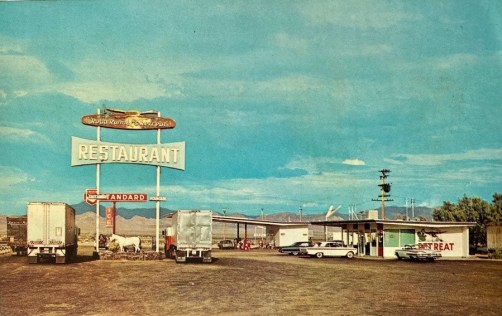
Long abandoned Roadrunner Retreat near Amboy, CA
Jackrabbit Homesteader: A Lyndy Martinez Story, Part-3
Link to Part-1: Jackrabbit Homesteader Part-1
Next morning …
To survive he’d need a miracle. Tortoise was in trouble; upside down in the relentless sun, all four feet struggling useless in air, and panic setting in.
It started as simple jockeying for territory with another male. Somehow he’d been flipped, left teetering on his domed shell. The other tortoise soon split the scene—thanks for nothing. Now a group of turkey vultures were circling lower and lower, with two of eight brave enough to land.
Turtle soup was on the menu.
Some people assumed these dinosaur-like birds waited for death to take its course. Not always true, frequently they helped move things along.
All at once the vultures began forming an undivided circle, called a wake. Silently they closed in, only sounds of folding wings and sharpening of beaks against claws. The hideous birds rocked their featherless and bald red heads—each having the skin complexion of burn victims—preparing to peck him to death.
But something gave them pause, an unexpected sound of boots crunching in the desert, footsteps of a small human approaching the scene.
Of course the birds knew mankind as weak willed, possessing technology incomprehensible, putting them at an apex, but when threatened humans were known to back down from confrontation. Even an aggressive goose running amok at a waterpark could scare them. They were afraid of large birds. Weak.
Into view stepped the dark haired female, with the purple colored lips, black fingernails and shaded eyes.
“Little help over here,” thought the tortoise.
The birds had no plans of moving unless charged. And even then, they’d return within minutes. By tradition they moved away from roadkill at the absolute last second.
One by one they craned their necks, eyeing her as if to say: “Move it along woman, this is no business of yours.”
She came closer, at a distance they could smell her breath, menthol. This human had been smoking the cancer sticks.
With a snapping noise she unveiled a black firearm, the rest of her purse falling to the ground. She raised her arm hip level, a swift motion followed by a clap of thunder and whiff of smoke. The nearest bird to her exploded in a cloud of black feathers, falling to ground in a tidy pile, like fresh raked leaves from an autumn-turned maple. It was as if the animal had ingested a lit fire-cracker.
The startled birds looked at the remains of their feathered friend, then each other. All at once wings were out and the massive creatures were taking to flight. “You know what, on second thought we’ll just move it along.”
It was the other kind of human.
The Spitfire smiled as the birds soared out of sight. Then she looked down at tortoise. “Now if you try and snap at my fingers I’m going to be angry,” she warned.
1 hour later ….
An intense Mojave sun shone all its glory on a Chevy Nova with faded paint, pitted chrome trim and sagging doors. It retained the factory five-spoke wheels, but tall weeds were growing around flat tires signaling the length of time it had been stored in Darrel Ward’s backyard. Next to it sat a Dodge Dart on blocks, with bullet holes in the windshield, raccoon poop peppering the seats and a torn, sunken headliner. And next to that junker was a yellow Plymouth satellite in equally clapped out, ready for the salvage yard condition. To somewhat protect them Darrel had laid old scraps of carpet across sensitive areas where water may be prone to enter, such as drip rails. In aisles between the cars Darrel was hording other male stashes like old visible gas pumps, railroad lanterns and the hulks of neon signs, all rusted and decaying too.
Gazing at the pitiful selection—not to mention a revolting 71 Chevy Vega behind them—The Spitfire redid the waist knot of her tie-in-front blouse. The ample airflow on these was a lifesaver for the torso on mid-summer afternoons.
Wisps of cirrus decorated the skies over Barstow, but otherwise it was a fair day with clear views to the distant mountains. Whilst shielding her eyes from glare Lyndy hastily dabbed on lipstick, then smacked her lips together, depositing the plastic cylinder in a rear pocket of her denim shorts.
“Any of these beauties strike yer fancy Miss Martinez?” asked Darrel cheerfully, bending down to pet a slobbery rottweiler with bad gas and horrific breath. The beast panted as Darrel scratched behind one ear.
Lyndy Life Tip #181: You might be a redneck if your new car search begins in people’s junky backyards.
Darrel was the mechanically gifted husband of Tammy Ward, a gossipy character who ran the A-frame taco stand on Main Street. As fate would have it, Darrel was somehow hooked in with The Lovelace Corporation, restoring antique cars or building new race vehicles for them.
Darrel had come of age in the fifties, and still dressed the exact same way he did in high school; white t-shirts and classic blue jeans were his uniform. The only things that had changed were his waistline, bigger in circumference, his hairline, now receding and vision, presbyopic; he sported bifocal glasses with thick brown frames.
Obviously, Darrel was attempting to subtly nudge her toward cars at the lower end of the price spectrum.
The Spitfire sighed. “Sorry Mr. Ward, these old hoopties are totally boring, especially since I just drove a brand new Corvette. Where’s all the sexy stuff at? I know you can do better.”
Lyndy adjusted her purse strap, pulling it higher on her exposed shoulder. She cleared her throat and thrust a hand in her back pocket, as she swaggered up the next row.
Darrel jumped up, suddenly energetic and waddling to keep ahead of her. Lyndy pointed fingers at one of the car covers, moth eaten and coated with dust, but mostly intact.
“Alrighty, whatcha got hidin under this hot mess?” The white cotton cover outlined the curvaceous body of a two-seater coupe.
“Nope. No way not any day. That one isn’t for sale, Lyndy.” Darrel slipped in front of her, blocking her hand from lifting the cover. “If your budget is Robin Hood beer, this here is like Dom Perignon.”
Lyndy crinkled her nose. “But what is it?”
Darrel cupped both hands around his mouth, in a move designed to prevent any nosy neighbors from overhearing—as if anyone cared. “A Maserati 3500 for a special client.”
Special client probably meant miss Rita Lovelace.
Lyndy pointed to a stain on the ground. “This little beauty appears to be leaking fluids.”
“Hmm.” Squatting down, Darrel dabbed his index finger in the puddle of greenish goo. Then he stuck the same digit in his mouth and closed his eyes. “No trouble. Just needs an oil pan gasket,” he declared.
Yum.
He stood up, hiking his pants by pulling on the belt loops. “Come to think of it, I do have somethin else I can offer ya,” he suggested, re-directing The Spitfire to the southern end of his property. “Won it at the auction two weeks ago. I need to warn ya, she’s in pretty rough shape.”
Darrel had a fair point regarding budget—she couldn’t hope to drive away in a fancy European sports car. Not even charm could make that deal happen. But she at least needed something demonstrably more reliable than her current hand-me-down Jeep.
“Does it turn over?” she sighed, not yet knowing what “it” was.
“Of course it does,” answered Darrel, clearing a Frosty-the-Snowman sized tumbleweed away from their path. “And keep it down, Mrs. Ward doesn’t know I bought this yet.”
The dog followed Darrel, and Lyndy followed the dog, squeezing their way between a 57 Chevy with no motor or hood, and an Impala which appeared to have wrapped itself around a telephone pole.
She slapped at her exposed knees and ankles, weary of numerous holes in the ground. “Dang, it feels like I’m about ta get snakebit back in here.”
“Don’t you worry Miss Martinez. It’s near the middle of the day. All my snakes are takin a siesta.”
“Well there’s a comfort.”
Seconds later, they arrived at an American wreck hidden under a blue tarp. The Spitfire already had a hunch what it was from the outline, and also because the lower half of the vintage wheels were ones she recognized. As soon as Darrel whipped away the tarp, her suspicions were confirmed.
“A mustang,” she said, noticeable lack of enthusiasm in her voice. The buildup had not been quite equal to the reveal. Still, it was a fastback. Sidling up to the passenger window she inquired, “How much you pay for it?” Through the opening she observed something in the desirable category, a four speed shifter.
“Five hundred bucks,” he replied, through grinning teeth. “Can’t you just see her now though, cruising down the highway to the beach?”
The hood release lever was conveniently undone, or broken. Swinging her purse around to her back, she hooked both hands under the hood lip near the grill, lifting it high as it would go, accompanied by a massive creak of the hinges.
“It’s a V-8,” she remarked. With her fingernail she scraped at white fender paint, turned chalky with age.
“Yes ma’am it is. And lookie here,” announced Darrel, sliding his finger across the VIN stamping. “It’s a K-code, Lyndy. This is the 289 with the four barrel. Don’t see hardly any of these at a junk auction.”
Don’t make it any less junk.
Squatting down, he pointed to two eighth-inch holes. “I think the 289 badge busted off.”
She smiled back at Darrel, wanting to share in his excitement. Yet from Lyndy’s up-close view, all the hoses were rotted, the air cleaner was missing, sand had penetrated the intakes and the block was coated in black oil.
“Oh Lord. Well, it aint as bad as I imagined it would be,” she said, undoing her wallet. “What do you want for it? And I mean fixed up.”
Darrel held up both hands, seeming embarrassed. “Look … uh, there’s somethin else I was gonna tell you. I already had a talk with Mr. Lovelace about this … car problem. He gave me a budget and we agreed.”
“Wait? Seriously!” she was floored.
Across town …
The initial thrill of striking out on one’s own in the heat of the moment, and the reality of being stranded in a strange place, exhausted without your rolling house, no friends and no vehicle, were two very different things. A small part of Jack Decklin considered giving up on his ill-conceived mission, but the defiant side of him knew he could never live with himself if he did. He had to keep going.
He suffered the early morning hours at the Barstow sheriff’s sub-station, insisting to everyone time was of the essence. Filling out paperwork with a low-on-the-totem-pole deputy was a fruitless endeavor, and as each hour clicked by, the trail was going cold. In the meantime, the Fireball continued on to Union Station in Los Angeles, minus a few hundred thousand.
The standard process of the county sheriff was to document each stolen item in nauseating detail. Aside from the cash and stock certificates, Jack couldn’t recall half the things which were stowed in the safe; many having been put there by Violet alone. As chief inspector for the railroad, he was supposed to be better organized. But of course the RPO safe had never been breached in the hundred year history of the railroad, and really it had only one weakness: if somebody gave out the darn combo.
Eventually they got around to asking about the suspects and their getaway: “So describe for me again this military vehicle…” And all the while Jack was day dreaming how he would hunt the thieves down himself, delivering his own justice, free of law enforcement meddling. Being that he was seated in a police station, he said nothing of his vigilante plan.
By the time he left the substation, it was mid-afternoon. The skies were becoming hazy. Jack was hungry, in a bad mood, impatiently hoofing it down 66 as cars were whizzing past.
Surrounded by desert on all sides, he soon remembered why hitchhiking was never his style. Jack wasn’t really sure how to do it. According to movies, you stuck out your thumb and people stopped. But after testing this method a few times, he found that no-one stopped for a six-foot-tall adult male with crew cut hair.
Racking up seven dusty blocks, shoes and dress pants turning ash gray with silt, he came to a used car lot—symbol of working class America. Prominently displayed on a chest-high lift, in their best corner position, was a black and gold Trans Am.
Around this out-of-place peacock Jack began to circle, hands shoved in pockets staring upward. It was the coveted high output model, with newish tires and straight flow muffler exhaust. And while he noted a few faults here and there—it was used after all—he could live with those. Of course, someone would need to get it down off this mechanical lift.
Several minutes later a chain-smoking salesman shuffled out of the single-wide trailer serving as his office. He arrived panting from just the short distance, fanning himself with a straw cowboy hat.
“Appreciate fast cars do ya, young man?” said the salesman, thinking Jack was a hobo with empty pockets. “This bird here’s the quickest we’ve ever had on our lot. She’ll do 165 flat out.”
“Fat chance,” thought Jack.
“Wanna take it for a spin?” the salesman added, speaking rhetorically.
Jack did his best job of smiling in agreement. “No time for that. I want to purchase it. Do you folks take American Express?”
As expected, this set off a belly laugh reaction in the salesman, followed by a fit of coughing.
“Seriously,” added Jack. He offered the salesman a business card, pointing out the phone number for his bank. The fellow went back to his air conditioned office, while Jack had a seat on the curb outside, gazing at the activity on Route-66.
Ten minutes elapsed and the car salesman returned to the scene, now with a completely renewed attitude. He used the word “sir” when addressing jack. And while they did not in fact take credit cards, they greedily accepted wire transfers, which could be delivered via the western union service. Only took a half-hour.
In the meantime, Jack set to work with a hand-crank winch contraption needed to the lower the car to ground level. It took about a hundred turns on each side, and he was the only man in good enough condition to handle the exertion.
Later …
Lyndy Life Observation: Driving on a two-lane byway, there was a sign beside the road that said boldy: “Dirt Now!” and a phone number. Who the hell buys dirt? Now?
As a courtesy to employees, the railroad provided overnight rooms for the crew, located inside the depot. While secure and clean, these accommodations were spartan, on par with a military barracks. He opted for a newer motel instead. They had free long distance, limited to the first five calls.
Once cooled by AC and settled into a room—he really had nothing to unpack—Jack set about the real business of tracking. His first major task: get in touch with the secretary Miss Jameson before she went home for the day. She could FedEx his favorite gun, money, some clothes, and a few other critical supplies to the hotel. Thankfully, she was in.
Next he made contact with an Army buddy employed at Fort Irwin. Through his many connections, they were able to get in touch with a man who worked in records at the armory. One good thing about the US Army, when it came to records they were unmatched, and just as Jack surmised, they had a list of every buyer at the government surplus auctions, including names and addresses. He could come by and pick up a photocopy in the morning. Mission accomplished. Jack was feeling increasingly confident about the outcome of this whole fiasco. Whomever rammed that gun into his midsection was going to suffer the same fate in return, several times over.
At last, Jack’s thoughts turned to his bruised empty stomach. He hadn’t eaten for near 24 hours; an A-frame taco stand on the other side of the street was calling his name.
 Aiden S Clarke, author