Category Archives: Jackrabbit

Jackrabbit Homesteader Part-11

IMG_2971sml

Jackrabbit Homesteader: A Lyndy Martinez Story, Part-11

Link to Part-1: Jackrabbit Homesteader Part-1

Lyndy Life Observation: The older I get, the more I realize Mr. Spock did all the legit hard work and scientific heavy lifting, while Captain Kirk mostly handled the public relations side of the house.

Their VP table had been packed with tins of boysenberry pie, accordion style chili-cheese fries and red baskets of fried chicken. By now everyone in the room was gawking, even if pretending not to.

“Where the heck do they get all this sawdust for the floors?” Jack wondered.

As if their condition weren’t weird enough, Catherine had perched herself atop the seat backs, having her panty hose covered ankles and feet crossed, and resting on the cushion; at least she’d removed her heels for comfort. Already she’d eaten half their fries as she sipped from a beer bottle, same type as Jack. He’d changed to a position where his legs were straight out on the seat and his back rested against the window. Beers had lightened the mood. She, the perky one, was surprisingly calm.

All this and it was lunch rush.

“So wait, you’re telling me you’re both a model and a movie actress too?” he inquired.

Cathy shook her head. “No, technically I’m an actress only if you include all my non-speaking roles—you know the kind where I scream and thirty seconds later a zombie gores me. They don’t put you in the credits for those, and if they do, it’s: blonde chick who dies.”

Using a napkin, Lyndy wiped purple pie filling from the corners of her lips. “Cathy, do you know Jack here has his own personal train? He told me all about it.”

“You have your own train? Well, that’s … that’s … odd.”

“Train car,” Jack corrected. “It’s just one car. A Pullman sleeper; totally beautiful.”

“Okey-doke, so you have a rolling bedroom which can go to any part of North America that a train can?” Cathy summarized.

“Pretty much.”

“Sexy.”

“Trust me, it doesn’t impress the ladies as much as you’d think. Not like a forty-foot yacht or a San Francisco penthouse apartment.”

“We’re impressed,” said Cathy and Lyndy, near simultaneous. They chuckled.

“Yeah, can we see it. Can you take us?” Cathy begged.

“Well I would, definitely, but it left without me. It’s in Santa Barbara by now.”

“Sure. Likely story,” muttered Cathy. “You know it’s remarkable though. You aren’t really Lyndy’s normal type.”

“What’s my type,” complained Lyndy, kicking Cathy under the table.

“Ouch. Cowboys. It’s cowboys,” said Cathy, backing away.

“Now we’re getting somewhere,” he said, eagerly shoving a trio of fries in his mouth, eyes shifting between Cathy and Lyndy.

“No comment,” said Lyndy.

“See. This is what I’m talking about. You all know stuff about me, but I still know next to nothing about Lyndy,” he complained. He looked her in the eyes, with a seriousness.

“Nothin to know.”

“Bull crap,” he said.

“Fine. You wanna hear a classic Spitfire story?” she offered, grinning mischievously. “Bet you never heard this.”

“Damn right we do,” Cathy encouraged.

“This better not be about your cooking healthy at home,” Jack interjected.

“It involves cooking, tangentially.” Her thoughts drifting to El Sereno, she rested her chin on her fingers, gazing at their view of the parking lot and the town of Barstow beyond.

“I think it must have started cause I refused to go to confession on a Saturday, and the result was I couldn’t take communion at mass the next morning. So I’m sitting in the pews, cooling my heels, while my aunt is waiting in line for the priest. She was upset. But I mean, Aunt Rose believed I was possessed by a demon anyways. Probably still convinced of that.”

“Later in the same week it all comes to a boil. I can still see their house, the oak beams—one of those quaint old LA craftsmans with a tiny backyard—and the windows were open. I can hear crickets, a rumble of city noise, and see a sliver of car lights on the freeway. It’s seven-o-clock and we’re eating dinner at the table.”

“My aunt and uncle didn’t want us; they were reluctant godparents. My brother and I, and our two cousins are sitting at the dinner table. I didn’t want asparagus. Funny cause I like asparagus now. But for some reason I wasn’t feelin it. Aunt Rose starts in: you’re not leaving this table until you finish that. I mean it. I look at her. I look at the asparagus. I look at the clock and I’m like: well then I’m not leaving the table.” And I meant it.”

Lyndy reached for glass salt and pepper shakers, emblazoned with the VP logo, sliding them into opposite sides of a dirty pie tin. The pie plate represented the table. “Here we are, Aunt Rose is sitting straight across from me. I have my arms folded.”

“In the other room I hear the TV on, my uncle is watching Mexican sitcoms with my cousins. I hear them laughing. I see the flicker of lights on the freeway gradually diminish. I see my brother in the hallway, sneaking a peek at what his loco sister is up to. I hear talking on the phone.”

“Then it’s midnight. It’s become one of those Vegas poker tournaments that go on for 24 hours and nobody can leave the building. Aunt Rose probably had to work the next day. We both had to pee. She’s touching her rosary beads. Her eyes are moving between me and the clock, back and forth, not showing any emotion. But I know her ass is getting tired, cause I was getting real tired. I’m tempted to put my head down and rest on the table, but I couldn’t do that.  I just sit there, bound to my chair. I see stars through the window. It’s getting chilly, not cold, it’s never cold there, but a cool breeze is wafting in. Ideal for sleeping. My eyelids are getting heavy. Aunt Rose just sitting there. Her plate is empty. Mine still has seven dry asparagus spears, same as I was served.”

“Finally it’s 3 AM. Still neither of us have moved. We’ve been planted there for close to 8 hours. We have to get up in 3. Aunt Rose abruptly stands up, pushes back her chair, frowns at me with a grumble, nina terca, como tu madre, and storms off to bed. I believe I took my plate to the sink and scraped it off. I didn’t go to church for the next ten Sundays in a row.”


40 minutes later …

Lyndy Life Observation: Filling out a form at the doctor’s office and it asks, “Have you had any unexplained weight loss?” and all I can think is, “No, but I’m intrigued. Tell me more.”

Squeezing the trigger handle, pumping dinosaur bones, she observed the parade of cabover trucks and station wagons whizzing by on I-40. She chugged from a tab bottle.

These places used to be called service stations—some folks still used such antiquated terminology—but nowadays all they offered was a bathroom key on a janky ruler and a dude in baggy pants with 3 or 4 priors, ogling you.

Trust me, you did not want that fool anywhere near your gas tank. A clock-hand style thermometer suction cupped to the c-store window read 90 degrees.

Jack offered to pump for her, but as this was her ride, she took both driving privileges and responsibilities; plus, she knew how much extra top-off the tank could hold.

The Jeep was slow and monotonous, but eked out decent mileage.

Standing next to the burgundy colored CJ he was observing an intermodal freight train, snaking away from them on the main line. Listening close, one could hear that metallic squeal of metal on metal tension; a tremendous mass being tugged uphill.

He checked his Rolex explorer, having to pinch it by the top and bottom to get it to a suitable angle minimizing glare.

“Anyone you know?” she joked, referring to the train engineer.

He’d gotten quiet, either digesting a 2500 calorie meal or thinking again. From a gold and white box he shook out a camel. Holding it between his thumb and middle finger he lit it, soon exhaling a cloud of white.

Great time to light a cigarette is at the gas pumps.

He continued watching the train.

One thing was worrying her. So far Jack had yet to exhibit any legit fighting abilities against similarly sized adults. But if they truly had a chance of catching train robbers, then a fight may be in their future; she’d signed up for none of the heavy lifting. Should there be an altercation she was standing back.

“That stop in Hinkley was another waste,” declared Jack, reaching for the roll bar and stretching by pulling away from it.

“We’ll go back, when we know the truck is there.”

“I know. That’s my plan too.”

She needed him to practice patience, a critical skill out here.

“Jack, I know you’re frustrated. But you have to appreciate one thing, you’re standing in the biggest damn county in the US, twenty thousand square miles; something like ninety separate mountain ranges, most of which are rugged and seldom visited. That’s a whole lotta places to hide. You can’t get anywhere fast. Takes four hours to get to Vegas.”

“What if they left the state? I mean, maybe they flew off to god knows where.”

She shook her head. “Doubt it. It’s too soon. But eventually, yes, they’ll be gone, so we need to keep moving. Let’s try this one last place and if it’s another dead end we circle back to Bo’s workshop.”

A green sedan with the faux wood paneling lumbered on by. She could have sworn it was Miranda Keynes at the wheel with the twin girls in back. It didn’t make much sense but she got a chill. Be calm, she told herself. Likely it was a hallucination.

“What just happened?” he asked.

“Thought I saw someone,” Lyndy replied, without further explanation.

She turned her attention to the sun-damaged tires. She would have aired them down for improved traction, but wasn’t confident they’d be able to air them back up, or whether they’d be chased off and have to get out in a hurry.

Wiping his forehead on his elbow he remarked, “If I stay here long I’m going to have to start buying short sleeve shirts.” He puffed out a cloud of smoke. “So what’s the story between you and the crazy waitress at The Vanishing Point?”

“I’m not sure I understand the question.” Lyndy set the pump nozzle back in place on the lever, as the digits had hit eight dollars.

“She’s the only real friend of yours I’ve met. Most people are afraid to talk to you.”

“We’ve been competing since high school. We’re not friends in the usual sense, we’re frenemies. Know what that is?”

He nodded. “I got a few of those.”

“I can tell she thinks you’re hot. She doesn’t act that way with everyone.”

“Really?”

“Clearly. It’s just, she also thinks you’re off limits.” Lyndy sniffed, slipping on her glasses. She shoved the plastic plunger to reset the odometer. “I will say one thing. In a contest of who’s crazier, myself or Cathy, I guarantee you I would win.”


Minutes later …

Unpaved Crucero Road split the length of a sheltered and entirely undeveloped valley. On a normal day the views of this landscape were magnificent, stretching in three directions over regions with little or no human disturbance. Few trees grew here, just native dryland scrub. Only to the south could one discern the course of I-40 and a string of high tension lines.

The mining trail had been marked by a freshly re-done sign. Slathered in a whole can of whitewash paint, they’d bolstered it with a two-foot pile of volcanic stones. The sign was decorated by three indecipherable symbols. Below this in black were numbers matching the bill of sale: 2-2-3. Other than the gleaming sign, the trail was in sad shape, not having been graded in years if not decades.

This better not be a nudist resort,” she thought.

At the crossing, tire markings on Crucero Road indicated vehicles regularly came and went from here; some of them were fitted with large knobby tires.

Even in such poor shape people were using this driveway. Nothing could be seen from here except the outline of the road, places where it had been cut out of the hillside. Whatever waited up there was well hidden and likely to be inhabited. As with all desert wackos they may not be welcoming of visitors. Still, nothing said “No Trespassing”, unless the 3 symbols were the equivalent verbiage in an unfamiliar language.

Initially the rough road climbed through an alluvial fan dotted by coyote brush and creosote. Within the first few hundred yards the muscle car would have bottomed out on its oil pan. The tired jeep was already earning its keep. It rocked back and forth over ruts where water flowed, slipping now and again on rounded stones.

Nearing the ridges the grades became steeper; Jack was holding onto the roll cage with one arm and his side door with the other, as if fearful it would open spontaneously. The tires felt alive beneath them, clawing for traction, making it feel as though they were floating in an unsteady rowboat. Even where straight and wide the trail consisted of bad wash boards and loose rock.

Their path soon snaked up a narrow canyon with a dry sandy bottom, but then changed course, doubling back onto a hogback ridge. With a closer view one could see many places showing signs of white mine tailings, crushed quartz, where experimental shafts had been sunk in search of gold.

Having traveled 3.5 miles and gained nearly two-thousand feet of elevation, they had yet to encounter another car or any persons. They entered a more precipitous section of shelf road. Here the tire slips were unsettling, but the views rewarding. Shimmering below in a haze Lyndy spotted a portion of Broadwell Dry Lake. It was void of vegetation and colored a milky shade of red, like tomato soup, in comparison to the speckled terrain which surrounded.

Abruptly she put the trans in neutral gear and tugged on the parking break. Carried by momentum, Jack almost banged his forehead on the dash. Standing in her seat, she pointed to a soaring bird, circling from the cliffs. “Check it out.”

“What?”

“A golden eagle.”

He stood up too, unsure of the brakes holding, but wanting to know whether Lyndy had lost her mind. “How can you tell? It looks like a hawk to me.”

“The size! A hawk is nowhere near so large. That bird has like a seven foot wingspan.”

“There’s nothing to compare it to. You sure this isn’t like the time you saw Elvis at the Gas-n-Go?.” The raptor was spiraling upward, now and then adjusting its tail feathers but scarcely flapping a wing.

“No, Jack,” she huffed. “Dude, I’m telling you that’s an eagle.” Reaching behind her seat she fished out a beat up set of binoculars. She offered them to Mr. Decklin. “Take these and get your eyes checked.” Jack unlatched his door, stepping out toward the ledge. On steadier footing he tried the binoculars. “Looks like a hawk,” he said.

Lyndy frowned. “Get back here.”

He lowered the binoculars, flashing a smile. “Just pushing your buttons. I think you’re right.” As she thrust the jeep in gear, tires bouncing uphill again, Jack nudged Lyndy. “See, I learned something new about you.”

“What’s that,” she grumbled.

“You have an affinity for animals.”

Like it or not, she couldn’t disagree. “Certain animals,” she corrected.

Jackrabbit Homesteader Part-10

IMG_2949Sml

Jackrabbit Homesteader: A Lyndy Martinez Story, Part-10

Link to Part-1: Jackrabbit Homesteader Part-1

Lyndy Life Observation: Why is it every time there’s a big earthquake and you have to run out of a seventies stucco building like a maniac, there’s really only three possibilities for your state of dress: you’re either in a bathrobe, standing in ugly mis-matched underwear or buck naked.

Time and a never-ending supply of blowing sand had scoured the outside of most every metallic surface in camp, including a crude tubular flagpole. At its base, a few sprigs of desert verbena clung to a tenuous existence. Flapping atop this water-pipe assembly, a faded flag so sheer one could see through. Cotton rope slapped against the sides and twisted on itself in the breezes. Every now and then a CLINK, as the snap links collided with the pole.

The little cat had those jade eyes, with slit-like pupils in daylight. As it circled by, purring with the gusto of a motorboat, she ran her fingertips along its bulging sides. Her state of alarm was easing with each passing second, nerves calming.

The same unseen talent who’d created the Frankenstein mailbox had also fashioned the pitted flagpole. Only this item was twelve feet tall. Residual flecks of white exterior paint indicated it had at one time been protected from the elements. Now it was all stained in rust.

She moved to accompany Jack Decklin, who was keeping under the shade of the camo netting. Taking a seat at ground level, she folded her legs.

“So your name is Hartley? I’ve never heard such a name,” Lyndy remarked, playfully.

“Yes,” the skinny boy answered in a muffled, sincere tone. He was on his knees, in the midst of scooping arrows into a cylindrical quiver. “Sorry I shot your boot.”

“It’s alright.”

The bow resting within arm’s reach of Hartley was also homemade, but in spite of its primitive manufacture, appeared wickedly effective.

Still, she’d decided he really was a cute kid.

Lyndy smiled sweetly, leaning forward to make eye contact, arms braced on her thighs. “Why don’t we start over?” She held her fists against her cheeks.

Hartley interrupted what he was doing, wrapping his fingers around the bow, drawing it nearer to his knees.

“You have a great piece a land here little man,” Lyndy complemented. “Where are your parents today?” With her thumb she pointed to the trailers. “Are they in there?”

Rapidly Hartley shook his head back and forth.

“So you’re alone?”

Hartley didn’t speak, but she’d captured his undivided attention. He inched closer.

Putting a hand on her chest. “You seem to know who I am already. But that gentleman is my partner, Jack Decklin.” She looked at him and grinned. His shirt was unbuttoned. “Jack is the type of guy who if a shirt is supposed to be worn untucked, he’ll tuck it in, and if a shirt is supposed to be tucked in, he’ll tuck it out.”

Even at his own expense, Jack couldn’t help but laugh. “There you go again. This is how it starts ya know. Poor kid. Two decades from now he’ll be asking himself why the only women he’s attracted to are goth-dressing Latinas.”

“Oh, don’t listen to him,” Lyndy said to Hartley.

Hartley was staring quizzically, his gaze flashing between the both of them. He had sand in his brown hair. His lips were badly chapped, no doubt a result of the outdoor lifestyle.

She reached in her purse, pushing around items in search of the chapstick.

“Hartley, are you being quiet because you aren’t supposed to talk to outsiders?”

“Yes,” he admitted.

With her finger, she beckoned him closer. “We aren’t here to hurt you,” Lyndy assured. “Come closer to me.”

As soon as he was within reach she grasped his wrist, pulling him close. With the other hand Lyndy swiftly dabbed chapstick across his cracked lips. He shut his eyes and giggled, wiping across his forearm.

“No, no, don’t wipe it off you goof!” Lyndy scolded.

Jack had one arm folded over his chest, squeezing his side. Between the fingers of his free hand he was rolling the 17-inch shaft of an arrow; same one which had embedded itself in Lyndy’s boot. “Hartley, is your pop named Edward Brennik?”

“Yes.”

“You got a mom around too?” Jack probed.

“Nope.” Hartley rubbed his palms over his eyes, as though tired. “It’s just me and my dad. My mom lives in Hollywood.” Then with puppy dog eyes and a discouraged tone, Hartley added, “Please, please don’t report me to misses Morales.”

Jack and Lyndy exchanged confused glances.

“Who is misses Morales?” Lyndy inquired.

Hartley shrugged. “She forces you to go to school.”

Right. Cause today was a school day.

“You mean a nasty old truancy officer? Like in a cartoon?”

The boy nodded in reply.

“Nah. Don’t worry. We’re cool Hartley,” Lyndy reassured. She squeezed his hand again. “Me and Jack aren’t big fans of the education system either.”

Hartley was gazing inquisitively at Lyndy’s perm.

“What? Do I have something stuck in my hair?”

“He wants your sunglasses,” said Jack.

“Oh yeah. Here, go ahead and try em.” Disentangling them, she pushed the frames onto Hartley’s face. They were way too wide for his kid-sized head, but he held them against his temples, turning one-eighty, marveling at how all the world had attained a curious shade of magenta.

“Hartley, what does your father do for a living?” quizzed Jack.

“He’s a metal recycler. We collect scrap from all over the desert and resell it.”

“What time are you expecting him back?”

“Couple more days,” said Hartley casually, still entranced with the shades.

Jack exhaled in frustration.

“What’s with all these camo tents?”

Hartley pulled off the sunglasses, holding them out for Lyndy to grab. “My daddy hates black helicopters. He put up nets so the choppers can’t see what we’re doin.”

“Makes sense,” Lyndy commented.

“Hartley, does your dad have any prior arrests? I’m thinking in the category of burglary or armed robbery.”

Hartley sniffed, looking less afraid than he should have.

“Let me clarify. Yer dad ever take stuff without paying for it?” Jack glared at Hartley, expecting an answer.

“No sir,” he said to Jack, plainly.

“Oh come on Jack!” Lyndy admonished. “Give the kid a break.”

She pointed at the homemade bow, wanting a change of subject. “You’re a pretty decent shot with that aren’t ya?” She winked at Jack, surveying the landscape of discarded junk.

In the meantime Jack tilted his head and approached the other two, irritation fading from his appearance. Twirling the homemade arrow once more, he tossed it to Hartley, who caught it by clapping his palms.

Next Jack slid his fingers in his front pocket, recovering a tan leather billfold. From the main section he fanned out four greenbacks, too overlapping to see dollar amounts. His chin sank—he was hatching an idea. Then he removed a crisp bill, holding it between his fingers and thumb for Hartley to see. “I tell you what, here’s a new twenty dollar bill. Let’s have us a little Robin Hood contest, shall we.”

A twenty to this kid was like a hundred to her. And hell, she would have done a lot of things to have the smaller bill too.

“I can tag a rabbit from fifty feet away,” Hartley said excitedly.

“That’s the idea, but we’re going to make it a little more challenging than that.” Bending over, Jack retrieved a tin can—the size containing baked beans—from a heap of decade old kitchen garbage. Stacking another and another, none having readable labels, he commenced pacing off a distance from the shade canopies to the nearest row of Joshua trees.

“Eighty five,” he shouted from afar.

On a mound of sand pushed up four feet by the dozer, Jack set out the cans; a total of seven. In the interim Lyndy rose to her feet, smiling, watching the two boys.

“Twenty bucks if you can nail at least a couple of these,” Jack announced.

Thrilled, Hartley was already readying his shot, threading the twine into the slot.

“Wait, wait , wait. I’m not even out of the way yet,” Jack interrupted. “You can go first, but we each get only three attempts kid.”

The boy elevated the bow perpendicular to the ground, elbow level, an air of determination coming across him. He had a strong chest for a such a young boy, drawing it back skillfully. The taut string made a 60-degree angle with the shaft. Doubtless there was enough potential energy there to kill.

Jack returned to Lyndy’s side, unspeaking but vigilant. “By the way, I’m ready to adopt this kid,” whispered Lyndy, raising her eyebrows at Jack.

Both were observing Hartley, reckoning he could actually hit the targets. But they wanted to see how many tries he needed.

Hartley waited for a calm in the winds; the lot became as quiet as a putting green. Then ZING! Faster than the human eye could track, the first can went flying.

Seconds after, the next can went flying. Lyndy started clapping. Hartley turned to face them, beaming with pride.

“Back-to-back? This is ridiculous,” muttered Jack, pushing the rolled up twenty into Hartley’s waiting hand. Greedily he slipped it into his rear pocket.

“That ought to buy a lot of comic books,” said Jack bitterly, but half-joking.

“My turn!” announced Lyndy, grinning at Jack. She reached for Hartley’s bow.

“No,” Jack commanded, waving  a hand.

“What?”

“The pistol,” he answered.

“I’m not a circus act. But … uh… what do I win?” she asked seductively. “Do I get twenty dollars too?”

“How bout I buy you lunch?”

“Take me to The Vanishing Point?”

Jack shrugged. “Wherever.”

Sounded like a date, but on the other hand, they woulda had to eat lunch anyway.

“Works for me.” From her purse, she extracted the heavy black gun. Turning to Hartley she warned, “plug yer ears dude.” With her left hand she retracted the stiff slide.

Jack cupped his palms over his ears, squinting to the remaining five cans. Seeing the behavior of Jack, Hartley inserted his index fingers straight into his ear canals and grimaced in preparation.

Gripping at chest level by only her right, she pulled the trigger twice. Deftly, she passed the Beretta from right to left, yanking the trigger three more times, the whole duration being less than three seconds. Each of the rusty cans were either split into two or their remains launched out of view on parabolic trajectories. A final bullet zinged off in a ricochet, having hit something hard buried in the sand.

She smiled at Jack.

Fanning a hand over top of the 9-mm barrel she looked to Hartley and ruffled his hair once more. “Here’s an important tip. Don’t ever hold one of these bastards up to your eye to aim or you’ll have the worse black eye of your life.”

Jack chuckled. “Let’s just go.”

“Take care of yer cat,” chided Lyndy, following Jack on the trail leading out.

“I will,” said Hartley, waving to the two of them.

“Something tells me you can eat, too,” Jack muttered to Lyndy.

“Nonsense,” she replied, pulling it wide and stirring the contents of her purse to make room.


45 minutes later …

Lyndy Life Observation: One of the best James Bond movie zingers of all time has to be when Goldfinger has that cheesy red laser inching forward to slice Bond in half (it can project a spot on the moon) and Sean Connery goes “do you expect me to talk?”, to which Goldfinger replies, “No Mr. Bond, I expect you to die!” But of course Goldfinger, big dumb Bond villain that he is, doesn’t actually let his overly-elaborate killing mechanism succeed as  planned.

Ever active, the sounds and smells of The Vanishing Point were highly dependable: two-stroke diesel engines, steel-belted tires rolling heavy on gravel, selected deep tones of rock-n-roll music somehow transmitted from the inside. And fried-chicken. The kitchen always smelled like fried chicken.

From the outside it had the design of a northwest hunting lodge, with more than its share of hitching post and wagon wheel decorations. Nightly, the place lit up like a Fremont Street casino. Big-rig truckers came pouring in from the interstate, following long treks through the desert—and it was known across every state west of the Rockies.

Secretly, one of her favorite pleasures was introducing uninitiated newcomers to this glorious roadside circus. Something about Jack Decklin’s background and sensibilities made it even more thrilling. She knew the cult of sunshine, better known as Catherine Cookson would be there too. It was her turf. In some ways that could a plus or a big minus, depending.

Daylight fell across his face, revealing hints of faded freckles leftover from his youth. In his thirties now, he was handsome all around. Of course standing there, gazing at its wood-paneled exterior, she couldn’t tell whether he was delighted or thoroughly disappointed. Quickly, she fixed her hair in the mirror.

It was midafternoon; the parking lot was busy. “Trust me, you’ll like it,” Lyndy encouraged, slipping her arm over Jack’s elbow, ushering him to the entry.

Soon they were pushing their way through the double doors. They were third spot in line, waiting to be seated. It felt like a date.

As their eyes adjusted he could see in the back two pool tables—men playing under a yellow lamp—and a jukebox just to the side. Antlers hovered above.

He pointed upward to the ceiling. “What’s that song?”

She frowned, intently listening, trying to filter out room noise. “Oh, I believe that’s Me and You and dog named Boo.”

Already the blonde hostess was striding across the room, having locked onto Lyndy’s big hair like a sidewinder missile.

“Why is everyone staring at us?” Jack wondered.

“It’s cause you’re with me,” she whispered. “They want to know who the hot guy is hanging out with The Spitfire.”

The men who were playing pool had momentarily paused their game. One of them, taller and in blue coveralls marked with grease, was holding the pool cue, staring. They were track workers and machinists. The men were eyeing him, not in a welcome manner, but uneasily.

“Or maybe it’s cause they recognize me,” he said, shifting his gaze to the bar.

In an instant they were overrun by perky Catherine. “Lyndy E. Martinez? What a lovely surprise!” she exclaimed. “I adore those shoes. And you’ve brought a man friend today?” She had her fingers interlaced, standing on her tip toes—making her seem much taller—and she smiled charmingly. “Are you gonna introduce me or what?”

“Cut the bullshit Cath. We’re not on the Price is Right.”

But he held out a hand. “Jack Decklin, Santa Fe Railroad.”

“Cathy,” she replied, touching a finger to her plastic VP badge. She had ruby nails to match her lipstick. Mostly immune to Lyndy’s sarcasm, she continued, “I have a perfect booth for you two right up front,” and she herded them to one of the best tables.

“But aren’t we gonna need menus?” questioned Jack, looking back to the hostess stand. “How do they know what we want?”

Lyndy shook her head. “Not today. When the blonde is here she sorta just brings food out that she wants to eat.”

“What? That makes no sense.”

Using a white cloth Catherine quickly mopped up some spilled soda and a few crumbs. Jack and The Spitfire took seats on opposite sides, with Lyndy spreading her arms across the seatback. To his surprise, Cathy also scooted in the seat next to him, putting away her cleaning rag. Her unblinking attention and violation of customary personal space was making him uncomfortable.

“You’re the guy with the cool car.”

“Oh god, I’m selling it as soon as I leave. The paint job on that thing is embarrassing. But yes, I’m the unfortunate cad driving the Firebird.”

“I bet you’re one of those guys who says women are dream killers,” Cathy remarked.

Lyndy and Catherine both laughed aloud.

“Hey. Not fair. I told you I was married once,” Jack argued.

“Wow, good answer,” said Cathy, giving Lyndy a knowing glance. Jumping up abruptly, she added, “I’ll get some beers for us and a margarita for Lyn.”

Jack leaned across to voice a private question at Lyndy. “Is she a real waitress?”

“More like a character at a theme park

Jack shifted in his seat, leaning back to peek at the billiard tables. “Something tells me this is gonna be a pricey meal.”

As she’d hoped, he was relaxing some.


Jackrabbit Homesteader Part-9

IMG_2944_Sml_v2

Jackrabbit Homesteader: A Lyndy Martinez Story, Part-9

Link to Part-1: Jackrabbit Homesteader Part-1

Lyndy Life Tip #184: If you plan on using super-glue to make any kind of household repair, chances are virtually 100-percent you will at some point get your fingers stuck together.

Folks claimed to value the freedom and openness of the desert; one reason why it’s featured in all kinds of popular music. Despite this, the public had gotten used to treating the region as a vast …well … toxic waste dump. For reasons unclear, the behavior was prevalent at all levels of society, and cast-offs weren’t confined to drink cups and wax paper food wrappers beside a highway.

Yet isn’t the dryland ecosystem as fragile as any other?

And if one wouldn’t think of trashing a pristine beach in Big Sur, how was it acceptable to discard your old janky sectional sofa or refrigerator in the Mojave?

My natural environment and my personal life is a toxic waste dump.

She was pondering this as their dinosaur-like automobile raced across open range. Even with both front windows down the dark-colored Pontiac was becoming unbearable. Stitched leather seats were adding to the misery.

Her back felt moist, sticky, with beads of sweat accumulating on her chest.

Beside her, fingers gripping the wheel at 12 o’clock, Jack raised his elbow and squinted from glare; it was reflecting off the hood scoop, causing every little bug splatter and rock ding in the windshield to glitter. He’d been quiet, appearing moody as guys often did, and she was curious what he was thinking.

On the passenger side, Lyndy tapped some ashes in the tray. She unbuckled her watch strap, concentrating on the delicate process of hand-winding, while puffing steadily.

Gesturing to the treeless Calico peaks, Jack questioned, “so when was the last time it rained out here?”

“Not sure. It’s been a awhile,” she shouted back. “But you’d better believe we get some gully washers.” Cupping the watch close to her ear, she listened for a faint tick-tock indicating it was running again. Re-attaching it to her wrist, she reached down, putting one arm under her knees and pulling her legs closer to her chest.

“Jack, I got a question for ya. You ever wish you had a close group of friends about your same age—like on TV or in the movies—with whom you share all your life adventures? I live alone, but you know what I mean, a gang of pals you meet all the time at a coffee shop, or like, a roadhouse bar? What do they call it in Hollywood? Your entourage?” She snubbed out the Newport, then dabbed her forehead with her untucked shirt. “Sometimes I try to talk to Chan, but he’s like a hundred years old and hates me.”

Jack gazed at Lyndy as though she’d lost her damn mind. Still he answered, “I have that. It’s awful.”

“What do you mean?”

“An entourage as you say. We’re all about the same age, travel together days at a time. It’s me, my twin sister Violet, her soon-to-be husband Devon, their best friend Ellison and my secretary Illyria Jameson. We do everything together.”

“You mean, for example, you hang out on weekdays all the time? Meet up for lunch and dinner. Go on lavish ski vacations to the mountains.”

“Yes,” he nodded. “All of that.”

“That sounds awesome.”

“No it isn’t. We hate each other. Last time we were at the Grand Canyon, we’re staring at a magnificent sunset near the El Tovar and out of the quiet Devon goes: I expected it to be deeper.” Jack started chuckling. “And the whole of them depend on me for their living. It’s like having room mates who don’t do any chores or contribute to the rent payment.”

Lyndy started chuckling too. “Are you serious?”

“Yes. We can’t stand each other—probably we’d admit it if pressed. This is the first time in weeks I’ve had time to myself.” Jack grinned at Lyndy. “I kind of relish it. Maybe I’m never going back,” he joked.

“But you are going back?”

He didn’t answer, instead switching topics. “So what’s with you? Why are you so chatty all of a sudden? I seem to recall you saying you didn’t want to know anything about me.”

“Oops, you’re right,” said Lyndy, cupping a hand over her mouth. “Momentary lapse.” She turned back to the view out the passenger side.

“So where are we now, tortilla flats?” asked Jack. “I’m lost.”

Her eyes fell upon the blue map and pencil marks she’d scribbled earlier. Craning her neck and shielding her eyes, she glanced in the rearview. “Oh crap. Turn this car around. I think we missed the place.”

“Really? I didn’t see any house? It’s been nothing but empty lots for the last four-and-a half miles.”

“No, there’s some stuff back there. I wouldn’t call it a house, but … stuff.”

He shrugged.

“Just don’t do a stupid J-turn,” Lyndy scolded. “A normal turn okay.”

“Of course not. Wouldn’t dare.. .” Jack smirked, then executed an unnecessarily slow and controlled three point turn.


Minutes later …

Grill pointing south, Lyndy was on the side closest. The new address was hard to make sense of. In contrast to Bo’s extensive development and airport-like grounds, this 5-acre plot of land was built up more akin to a Hooverville. Zero chance these people were on the grid.

The property lacked in fencing and yet it was still protected. Near the road were eight  to ten foot high mounds of earth and gravel, scrap plywood, bricks, old discarded roofing materials and some railroad ties. Smoke trees, boulders and a succulent garden secured the areas between. It wouldn’t be possible to drive straight in with any normal civilian car.

Adjacent the road stood a mailbox, or well, something imitating one. Fashioned in a minimalist tubular style, an unskilled sculptor of the metal arts had booger-welded two fat water pipes together, with the larger one serving to hold the mail and having numbers finger-painted on the side. 6-1-2.

Hard to spot, at the nexus of the improvements were a pair of single-wide mobile homes disguised in brown camo netting and oriented 90 degrees to one another. No surprise they’d missed this dwelling the first time. The nets extended diagonally from the rooflines, making forty-five degree angles where they had been staked to the ground. Circus tent style.

A crop of baby Joshua trees were also dotting the lot. The way junk had accumulated it would prevent removing or even re-positioning the trailers.

A narrow footpath stemming from the roadside mailbox meandered to where the single wides were. Beside it, a spray painted sign on plywood warned: “Keep Out! Bobbi Traps!” Whomever created the sign badly misspelled booby traps.

Jack switched off the engine; it knocked, running on a half-dozen cycles but eventually went silent. Adjusting his position he started pinching at his shirt to aid in airflow. As he did, Jack looked forward and back along the property line. “Well my balls are swimming in perspiration. And unfortunately, I do not see a vehicle parked here.”

“Nor I,” Lyndy replied, squeezing on her doorlatch. “Maybe we can see better from one of those dirt mounds. I think Dr. Seuss did their landscaping.”

The wind was howling yet again, a steady five to ten miles an hour.

Jack didn’t laugh. But she could tell he’d noticed the plywood sign. He grabbed and squeezed her arm. “I bet a veteran lives here,” he remarked.

“What makes you say that?” she wondered, staring down at his hand; it was the first time he’d touched her intentionally.

“Booby traps,” Jack said ominously. “I hate those.”

“It’s probably a guy growing pot or something.”

Gradually his grip on her arm relaxed. “Do you think anyone actually sleeps and eats in those trailers?”

“Of course Jack. These are called poor people,” she spoke facetiously, gesturing and displaying her palms as though introducing a foreign concept to a child.

Flicking open his green notepad, Jack continued, “Gentleman’s name is Edward Brennik. Occupation is listed as scrap metal dealer.”

“That I can believe.”

Lyndy pushed open her door, brazenly kicking it wider and slinging her purse over her shoulder. Picking her way across the graded embankment with one arm securing the strap, she stumbled ten yards up the path, pausing once to roll an old tire out of the way. Above them, the skies were becoming increasingly hazy. Compared to earlier, not a trace of blue remained. The air was unhealthy.

Still, at least it was good to be out of the stuffy car.

She turned back to find Jack wasn’t following. He remained seated with the door open an inch, gazing straight ahead, focusing on the distant highway.

Returning to the car, this time circling to driver’s door, she put her hands on the roof, drumming them. Then she leaned in, inserting her face in Jack’s personal space. “Hey weirdo, what are you afraid of?” she demanded. “You’re a tough dude and I’m not here for my health.”

He didn’t answer.

“Jack, how did you end up with that purple heart?” she probed, more forcefully this time.

He looked at the glovebox door, answering solemnly, “know what a bouncing betty is?”

“It’s like a flying grenade.”

“Correct.” He started to untuck his shirt. “Son of a bitch got me all up the backside and leg. Absolutely shredded the guy next to me.”

“You almost died?”

Jack bowed his forehead. “But afterwards, they finally sent me back. There’s that.”

“We’re not in a warzone—not yet. This is California.” She pointed to the sign. “And I feel okay about it since neither of us is named Bobbi.”

“You ever go through a period in life, where you ended up somewhere and you realize you’ve made a giant mistake. You’re trapped and you can’t think your way out.”

Bunch of times. Mentally, she was picturing Pine Gate.

“Wait. Hush, something’s moving,” whispered Lyndy, crouching below the roofline and peering through the car itself.

Some thirty yards nearer to the camo nets, a tiny creature was sneaking along the top of a mound, moving parallel to the road. It was a greyish tabby cat, tiptoeing among discarded boards and bundles of wire. Then, as it began a descent to the north, a human hand—child sized—shot up. Curling under the cat’s midsection, the arm hooked the cat at the belly and pulled it down out of view.

She inhaled quickly. “Did you see what I saw?” They both knew it was intentional.

“Yes,” Jack confirmed, unlatching his door.

“At least we know somebody’s home,” she whispered.

“I hope there aren’t trenches here.” He raised one hand and pointed, then shut his door as quietly as possible. “I’ll go around the back, if there is a back way.”

She knew he wanted her to come from the front—creating a distraction.

Paying more attention to her surroundings, she stepped back to the walking path, the one warning visitors to stay out. Taking a slow breath, she hiked her purse strap higher up on her shoulder. She was aiming for the trailers and the camo nets.

At every fifth step she paused, checking her environs, listening. But she heard nothing except wind rustling. The only other movement, a black throated sparrow hopping between branches in a smoke tree.

The trail had been trodden many times by persons wearing army boots, but in most spots was smooth, the path itself curving up and down to cross the berms. Each ten foot high mound must have been excavated with power equipment, as there were too many to do with a hand shovel.

Cresting the final bank, a distance of forty yards from the car, she heard a FWOOSH. The next instant she felt a bang against her ankle, like being knocked in the shin by a springy branch. Briefly her eyes fell upon the object, a wooden arrow shaft embedded in her leather boot; there was no time to check for injury. Instead she reached for the Beretta, intent on studying the horizon. Her pulse quickened.

Holy smokes,” she thought.

First she crouched, then flattened herself fully on the ground, contacting hot soil with her stomach. The sand and rocks felt sharp against her skin, like shards of glass. Keeping the pistol level and straight, she frantically searched the scene for any attacker. This person must have intentionally aimed at her foot, avoiding a deadly shot. She took that as a positive.

“Hold your fire!” she exclaimed to no one in particular. “We’re here in peace! But if you try that move again I’m tempted to change my mind”

Sensing motion, she noticed Jack sprinting, followed soon by a muffled cry.

By feeling with her left hand, never averting her attention, she yanked out the arrow. Its tip had made it all the way through, nicking the skin on her ankle. She cursed.

“You can come out. I got him.” It was a comfort to hear Jack’s voice. “I got sliced on some barbed wire, but I think I’m okay.”

She scrambled to cover the remaining distance, heels sinking deep now and then. Near to where a camo net was nailed to earth, she found them. Jack had locked his arms around the person’s arms and chest, restraining them. Jack’s shirt was cut and had drops of blood showing from small incisions on his forearms. He was breathing heavy.

Coming to an abrupt standstill, Lyndy lowered her weapon. “It was a child?”

A quiver’s worth of arrows and homemade bow lay beside the two on the ground.

Their small assailant had ceased squirming, overpowered by the strength of an adult like Jack. The boy had tan skin, no shirt on, but was wearing army style cargo pants—way too big for his waist—and a black nylon strap serving as a belt. His hair was brown, a short home-done haircut. With piercing eyes he affected a roguish expression unusual for so young a person.

Sometimes it could be hard to tell, but she judged the little man to be in the range of eight or nine years old. He was handsome, in certain ways reminding her of a mini-Jack.

Still, she was fuming. She approached him, tightly clutching the Beretta. In anger she ruffled his hair, wanting to smack him. But slapping another person’s kid was anything but kosher these days.

“You shot me with an arrow you little brat!” she scolded.

The boy said nothing.

“You alright Jack?” she asked.

“I’m fine. Terrific actually. What a lovely day.”

She pushed the gun in her purse. Feeling something rubbing against her legs, fuzzy and soft, her eyes went wide. Tilting her chin down, she beheld the tabby cat mewing as it passed between her ankles. Reaching to pet it, she touched the cat along its spine with a few short strokes.  It purred, making another pass toward her, soaking up attention.

“Is this your cat?” Lyndy asked.

The boy nodded.

“Let him go,” she declared. Jack loosened his grip.

Kneeling, she continued to pet the cat, her hand coming in contact with its belly. Another surprised look came across her face. “Your cat is totally pregnant!”

She jumped up, dusting off her jeans and getting in the kid’s face. “Did you know your cat was pregnant?”

The boy rocked his head again.

“Hey, do you speak English kid?” demanded Jack. Then he released him. Neither feared the boy running off and hiding.

Gazing at Lyndy, the boy mumbled the words, “La Fierabrosa.”

“What did you just call me?”

In the meantime Jack was banging a fist against a blue plastic jug, half filled with liquid. He untwisted the mayonnaise jar-sized cap. Then sniffing the contents, he checked whether it was water or gasoline, but keeping his attention on the kid, interested to hear the answer.

“I heard some Mexicans talking about you. You’re called The Spitfire,” the kid spoke faintly, with scarcely any movement to his lips. “Senorita Martinez.”

Jack smiled knowingly, amused at the turn of events. By swinging the jug he began splashing his arms with water.

The boy looked briefly to Jack and Lyndy, then started collecting his bow and arrows; some had spilled out of the quiver and were littering the ground.

“What’s your name?” Lyndy asked.

“Hartley,” said the boy

Jackrabbit Homesteader Part-8

IMG_2896Sml

Jackrabbit Homesteader: A Lyndy Martinez Story, Part-8

Link to Part-1: Jackrabbit Homesteader Part-1

Lyndy Life Observation: I saw a thick glossy magazine in the supermarket checkout aisle with a title reading, “What is your dog thinking? Find out inside”, complete with a picture of some cute as hell border collie and I was like, “It’s a dog you morons!”

As they entered, she nested her glasses in her poufy hairdo; probably she would forget this detail later, running through a game of “where did I put those darn sunglasses?”

In Lyndy’s experience these manly spaces, machine shops and the like, always smelled of shoe polish. The interior of Bo’s shop was no exception. Clicking sounds, her tall boots on concrete floor, echoed from the metallic walls. The Spitfire and Jack walked side-by-side, a modest buffer between, with Mr. Rollins trailing close behind.

It was no social call. Nothing quite so welcoming as a tubby fellow providing a facility tour while simultaneously clutching his favorite pump-action shotgun and using said item as a pointing device.

Dominating the southern portion of the workshop were a trio of army tanks slanted in a diagonal row, hatches ajar, mud-caked tracks disassembled and removed. On the more northerly side with an eight-foot span of separation, a pair of J8 Jeeps were parked, both in disrepair. The 105-mm cannon from a Patton tank towered above, its long muzzle dwarfing anything else in the room. She tried to imagine it, but knew one didn’t want to be anywhere near when that thing blew.

The same tank had a series of stencils on one side, sprayed in charcoal paint, representing smaller tanks in the shape of an American flag. Presumably they indicated kills.

In keeping with the scene Bo spoke grandly, like an excitable museum attendant: “Over here we have the mighty M60 Sherman, essential modern-day cavalry and scarred battle hero of the Israeli Yom Kippur War. Next to that is the equally well-regarded M4.”

The clicks ended as they paused to admire the room.

Not wanting to seem disinterested Lyndy kept bobbing her forehead, unsure what to do with her hands other than loop them between her purse straps. Needlessly she undid her belt, tightening it a notch and squeezing her waist.

With one hand in the pocket of his slacks, Jack did an about face, eyeing Mr. Rawlins and the smaller entry. “You know when I was in elementary school this is pretty much how I pictured my adult garage,” he remarked. Then pointing to the area with the Jeeps, “although I was certain there would be at least four or five classic Ferraris over there.”

Bo laughed a goofy laugh sounding like, “Tee-Hee-Hee.”

For the time being she was letting Jack steer the conversation, while together they took in the sights. Not viewable from the locked gate, the western half of the shop featured a set of tall sliding doors; when parted it was a wide enough opening to roll the tanks in and out.

“Know what this place really reminds me of? An aircraft hangar,” Jack stated. “Except there isn’t a runway anyplace nearby.”

“It’s a good guess,” answered Bo, more calmly. “I didn’t know the original owner very well, but he had plans to turn it into a private airfield. Maybe he ran outta money. Not sure. But he gave up on his dreams and sold out more’n a decade ago.”

Bo sniffed. Jack exhaled. Everyone went quiet. Jack was faltering.

Often she felt rushed, catching strangers unprepared like a vacuum cleaner salesman. Yet despite having been busy, Mr. Rollins was now exhibiting a curious level of patience, nor had he made inquiries into how they found their way here in the first place.

Anybody showing up unannounced at her airstream, it would be the first question out of her mouth.

Feeling a need to jump in, Lyndy asked, “Mister Rawlins, I assume you’re the present owner of this uh …business… whatever it is?”

Bo nodded. “Yes ma’am.”

Well that was a silly question.

With the tip of his shotgun, Bo nudged open a red and white Vendo cooler. “Say, can I get you somethin to drink? I got colds pops in here.”

“No. No thank you. Sorry, but we ought to cut to the chase. What exactly is your line of work?” inquired Jack. “If you don’t mind us knowing.”

Taken aback as though the answer should be self-evident, Bo chuckled. “I fix up tanks for the Army, mostly ones stationed outta Fort Irwin; some for the Marine Corps as well. The desert chews up their gears cause they use ‘em damn near every day in training.”

“Oh. The Army doesn’t have their own repair facilities?”

“Course they do. But they also come to me, cause I can do the labor cheaper and faster. In most cases better as well.”

“But you don’t work alone, do you?” she asked, her voice showing disbelief.

“Nah, wouldn’t even be possible. I got a whole crew a guys. But they have the day off.”

“Okay.”

“And I’m also a collector and restorer of antique military vehicles,” Bo added proudly. “Ya know, them old flat fender Jeeps and whatnot. I take em to shows. It’s my passion. They’re mostly in other buildings. Doesn’t pay for itself, but I do some trading of parts. Brings in a little extra.” He grinned like a boastful teenager.

From the looks of Bo’s cavernous shop, his story was checking out.

Have I got a deal for you,” she thought, picturing selling this man the burgundy Jeep. “Well far out,” she said approvingly, then hooked her thumbs in the loops of her jeans, eyes beginning to wander again.

Rolling toolboxes were pushed to all sides and an assortment of larger size tools were hanging by pegs on the wall. Pasted in one of the open metal lids she picked out a captivating portrait of a young lady, not so unusual for the kind torn of a magazine, but this was a real photo print framed in a beige matte. The lady happened to be wearing a blue swimsuit, standing next to a fishing boat on the Colorado.

Lyndy stepped in closer, seeing the smiling lady was a curly redhead comparable in age to Mr. Rawlins.

Ever get the sensation when you know you’ve seen someone’s mug before, but you can’t quite place them? So then your simple brain starts flipping through different compartments of your life, trying to put the person’s face in context.

“So uh, who’s this pretty lady over here?” The Spitfire placed a finger on the toolbox. “She’s a fox.”

Before answering, Bo paused to reseat his hat. “Whelp, of all things in here, you’ve hit on the one I’m tender about. That there was my late wife Teri. God rest her soul.”

Lyndy had been expecting anything but such a response. “Geez, I’m very sorry Bo,” she added genuinely, scratching at her temple. “Could’ve sworn I’d seen her someplace.”

“Doubt it very much. She passed away from a tumor five years back.”

Bo went mute as they stared at the picture a few moments, giving her soul some quiet reverence. His eyes seemed to be watering as his chin tilted downward. If this big bubba started getting all weepy, she didn’t know what to do—run away perhaps.

“And her name was Teri Rawlins?” Lyndy confirmed.

“Yup,” was all Bo could answer.

Rubbing a tear or something from one eye, his head suddenly shot up. “So what’s this inquisition all about?” Bo stared at her and Jack expectantly.

It was a challenging transition to make, but impatience was finally showing in his voice. She glanced over to Jack. One could hear the whirling fans clearly.

“I assume you’ve heard about a train robbery which occurred a couple nights ago?” Jack tilted his head. “We aren’t accusing you of anything,” he assured, flashing his empty hands. “We’re checking on a few leads. In fact, maybe you can help us out, since this is something you specialize in.”

Bo’s eyes narrowed, their welcome wearing thin.

“Your name happens to appear on a list of private sales I have,” Jack continued. “They’re citizens who recently won at auction an REO ‘deuce-and-a-half’ military transporter. It’s a great big truck.”

“Correct. One of them Rockwell full-floater axle deals.”

“So is it here on your property?”

“It’s here,” confirmed Bo. “I’ll confess….”

“Confess what?” Jack interjected.

“…that I haven’t had a heckuva lot of time to work on it. It’s in the back lookin sad. Aint goin no place.”

“Do you mind taking us to it?” Lyndy asked sweetly.

“Happy to,” he answered. “Follow me.”

Exiting the main workshop, Bo waddling in the lead, the three snaked their way around to the perimeter of the paved slabs. It was good to be back in the fresh air again, but she knew a letdown of one sort or another was coming. No guilty party should be so eager.


Minutes later …

“There she be,” announced Bo, triumphantly kicking a rotted and deflated front tire.

With the hood assembly removed, its cavernous engine bay—nearly void of mechanical parts—contained more cobwebs than a haunted house.

She watched the complete deterioration of Jack’s mood.

Using three fingers he tested the gritty bare engine mounts; they were steel, at least an eighth inch deep in rust. He checked underneath, energetically. The ground beneath had old cakey oil stains. Remaining hoses and wire harness were cut off, removed, and all parts coated in layers upon layers of mud and grease.

“Is … is this the truck you purchased?” Jacked questioned.

Then came Bo’s, “tee-hee-hee,” laugh again. Only this time his face quickly reset to stoic: “Yes. I got a good deal.”

“There’s no motor or transmission!” exclaimed Jack. “Who would buy a truck without an engine?”

“I do it all the time,” Bo argued.

“Did you remove it?”

Bo seemed amused at Jack’s line of questioning and incredulous attitude. “Friend, you think I pulled the damn engine outta here, but then spent extra time artfully adding back all this dirt, spiderwebs and grease?”

“Where’s the serial number on these?”

“I guarantee you folks, this here truck didn’t come with no drivetrain parts. You can check on the bill of sale. The number in this truck matches that same bill of sale. Says in bold, no motor or trans.” He poked an imaginary bill of sale with his finger, emphasizing the point.

Bracing shoulders against the truck frame, looking like The Hulk about to flip a car, Jack drooped his head in frustration. Then staring at the ground, fists tightening, he queried, “You sure this is the only one of these you got?”

“Only one,” confirmed Bo, personal irritation reaching critical mass. He shot Lyndy a stare that meant, “Is your partner always this unpleasant?”

Lyndy patted Jack on the shoulders. “How bout this, mind if we walk around a bit?”

“Ya’ll have my permission to roam around to your heart’s content. You can spend hours, but I know ya won’t see another of these deuce-and-a-half’s.”

Jack pushed Lyndy’s hands away. “I’m fine. I do not want to roam.”

Bo sighed, elbows drooping, lowering the gun from his shoulder. “I can’t read you folk’s mind. But listen, I’d have to be a superman to get the engine installed, running, have it ready by whichever night yer train was robbed, pull it back out, muck up the whole insides like this and have it resting on flats. Not worth it.”

She sensed Bo was relieved, perhaps seeing them as less of a threat.

“Mr. Rawlins, do you know any other folks round here capable of planning and pulling off a complex train robbery? Any weird militia groups, criminal rings—something like that?”

Bo shook his head immediately. “Nope.” Then directing his speech only to The Spitfire he added, “But if you’ll come back a few days from now, I got a couple patched-up tanks which need test driving, and you can ride with me. I trail run em right here on the property. Move a lot faster than you think.”

“Whoa. That would be groovy,” replied Lyndy, using her Cathy Cookson impression. And on top of all that, it did sound fun.

“Just please don’t bring him,” said Bo, one thumb aiming Jack’s direction.

“I do love me a spin in a tank now and then,” Lyndy agreed. “And you’re right about Jack. I’ve only known him a brief time and trust me, he’s a drag.”

But he has really deep pockets.

Jack glared back. He spoke nothing aloud, but she knew they were done.


Lyndy Life Observation: Is it me, or do ninety percent of golden retrievers look like exactly the same dog. If in some contrived mystery/thriller plot my life depended on identifying a single golden retriever in a pack of twenty, I’m not sure I could.

He stuck a camel cigarette in his lips, managing to light it while never losing grip on the steering wheel—an impressive feat. They were speeding on 58. Apparently he didn’t learn from previous mistakes.

On the other hand, neither did she, reaching for the Newports.

“That Rawlins guy was acting guilty as sin,” Jack lamented. “But I need proof.”

“I’m not convinced,” Lyndy replied. “We haven’t even visited these other places on the map.” She shook the map at Jack’s face. “It’s like one of those press conferences where they always say: we’re still gathering information.”

“The dude was menacing us with a shotgun the entire time. And did you notice how organized and put away everything is? It’s like his fancy shop isn’t being used.”

“We’re the ones who dropped in on him unannounced. And you got a problem with a man being neat?”

“Why was he so nervous when we first got there?”

She shook her head. “Not very unusual. Everyone out here is covering something up. So they all act guilty when you start askin questions. Plus nobody likes to be accused.”

“So then we wasted time?”

“Not necessarily. I might have made a friend. There’s always some value in cultivating new friendships. The person may come in handy one day.”

“I think we were wasting time,” repeated Jack. “And you were just messing with him, using your sneaky charm skills.”

“Fine. I will say one thing. Did you see he had a Santa Fe wall calendar?”

Jack glanced at her. “They print a million copies of those every year.”

In the midst of staring out the window, Lyndy pointed to a simple two-pump gas station, closed down and now abandoned. It had a tiny white-walled rectangular office, and there were literally thousands of copies like it spread across the west.

“Did you see that old service station back there,” said Lyndy.

“Yeah.” Jack nodded, barely shifting his gaze.

“One time I was coming through here at night, maybe eleven-thirty, and I saw this spectacular drop-top Cadillac with candy apple paint, filling up on gas. The driver was seated at the wheel, and a station attendant was wiping down his windows like old times. I didn’t think much of it. But I noted the guy had thick black hair and was wearing an all-white leisure suit decorated in rhinestones. So I get about ten minutes further down the road and I realize, that could have only been one person. I considered making a u-turn, going back to check, but it was too late. I knew they’d be gone already.”

“Who was it? Liberace?”

“No. Elvis of course,” Lyndy asserted.

At first she couldn’t tell if he was angry. He rubbed both eyes with his fists. Then seconds later, Jack burst into a laugh. “No way!”

“It was definitely him. Chan wouldn’t believe me either.”

She shoved her sunglasses on and folded both arms across her chest.

Jackrabbit Homesteader Part-7


IMG_2890Sml

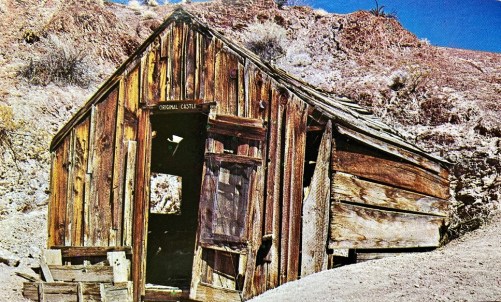
Death Valley Scotty’s prospector cabin

Jackrabbit Homesteader: A Lyndy Martinez Story, Part-7

Link to Part-1: Jackrabbit Homesteader Part-1

Lyndy Life Tip #183: Despite an endless barrage of new year’s advertising that would have you believe getting fit or losing weight will somehow change every aspect of your existence, from your career to your love life, take it from me, it won’t. You’ll be in shape, with all your other problems the same.

She’d been studying the map.

“Change of plan. Turn here,” Lyndy ordered, gesturing right.

With a flick of the wheel, Jack had them veering onto Black Mountain road.

No commuters were heading their way. The new road was arrow straight—one could tie the wheel in place with a rope—but coarse, stretching to an isolated range of volcanic ridges. With little maintenance, the median strip had all but weathered away. Rusty wire fencing, twisted and broken in places, paralleled the eastern side of the pavement. And it was so bone dry here only half-dead coyote brush dotted the pebbly soil. The color palette of this desert was something akin to a Siamese cat.

Overhead, numerous contrails blended with the whitish haze.

With one foot on the clutch and a fist on the shifter, Jack went into third gear, followed in a quick surge of engine power. Alluvial fans radiating from the hills meant the terrain was increasing steadily in elevation. Every quarter mile another fifty feet or so.

“When do I get to drive?”

“Middle Tuesday of never.”

“Figures. Typical male,” she complained, turning over the map.

“Uh, Lyndy, I really should have mentioned something else to you back at the hotel. These bandits who robbed us were heavily armed. I hope your … will and stuff is up to date.” His attempt at a joke landed flat, as they both knew it was tinged in truth.

“Meaning what?”

“Automatic weapons.”

People didn’t move to this county for the social life.


Minutes later …

“Hey, slow it down hotshot,” Lyndy chided, as they were approaching a dirt crossroad.

A steel cattle guard and white metal sign stamped with numbers marked the junction. Though peppered many times in shotgun pellets, the digits were discernable and matched the address they were seeking. No mailbox. Two miles ahead at the far end of the access, a mysterious cluster of steel buildings gave the appearance of a fortress.

Lyndy and Jack eyed one another, exchanging concerned glances. Still he turned in, Jack proceeding across the grate at a lowly ten miles an hour. After a mere thirty yards he stopped, setting the e-brake and cutting the ignition.

Reaching out his palm, he demanded, “Alright. Let me see it.”

She shrugged. “Uh. See what?” Suddenly they could converse at normal volume. Her brain was taking time adjusting. “What the hell are you talking about?”

“Your protection.” He chuckled to himself.

Truthfully, she knew what he meant before he said it. She hesitated because indecision filled her heart; this being intrusion at a level beyond matters of love life. The gun was fully loaded. As a rule, she never allowed curious strangers to see the Beretta. She could say no.

Reluctantly, Lyndy gazed into his green eyes. Continuing to glare, she reached a hand for her purse and undid the top flap. Then retrieving the matte black pistol, she passed it in a downward facing position, fingers round the barrel, setting the grip in Jack’s waiting hand. She wouldn’t have let go if she’d thought him incompetent.

With it pointed toward the gauge cluster, he rubbed his greedy palm along the slide, feeling cold metal and each of the grooves. The diamond pattern on the grip was crisp and sharp as a brand new wood file.

Careful. That son-of-a-bitch is cursed.

Slanting it side-to-side by 45 degrees he muttered, “doesn’t appear to have a serial number does it.” He poked a finger at the small black lever, liberating the clip. Under the force of gravity the loaded magazine dropped in his palm. She could tell he was counting up bullets.

“No. It’s a one-off. Made entirely by hand. I’m told it’s very difficult to trace; not that it matters.”

Jack nodded, wordlessly shoving the magazine back in place.

“I’m not using it on this job,” she repeated.

“Reminds me of a nineteen eleven with a short barrel, easier to conceal and a higher capacity magazine. Yeah, this is a nice piece.”

Satisfied, Jack handed the gun off in the same manner back to Lyndy, then pulled his door latch. Exiting the driver’s side he circled around to the trunk.  After stowing the Beretta safely in her leather purse Lyndy stepped out as well, intending to follow him to the rear of the vehicle.

Nevertheless, freed of the noisy cabin and with her feet planted on the road, her instinct to explore took over. She paced to the metal grating, pausing just shy of the gap and daring not cross. Her boots, being something akin to animal hooves, could just as easily become ensnared in the rust colored slats. Trapped amongst the steel she observed a 3-foot long rattlesnake skin.

Seeing the diamond pattern made her jump back, every muscle clinching and her chest feeling like a heart attack. Obviously it was only a harmless shed skin, and the real snake was long gone, yet her natural reaction was the same.

She turned back, concerned Jack may have witnessed this embarrassing incident. He was preoccupied, bent down, accessing something in the trunk; the polished latch of a briefcase glinted in the light. The front of Jack’s shirt had been unbuttoned, flapping in the wind. From the case he lifted a semi-automatic pistol of a type she’d not seen.

One glimpse and it appeared as though it were transported from the future, over fourteen inches and polished steel—something like a prop out of a spy movie—but one surely the bad guys would have had. This was hitman behavior.

“Hey! What is that?” she challenged.

Raising his head and shoving the case out of view, he spun around. “It’s a German P-330.” His unbuttoned shirt revealed a tan-colored side holster, and his fit torso. He held the gun sideways, exhibiting chagrin, then holstered it. “Costs about $1900 new.”

“You know they can see us now.” She nodded to the distant steel castle. “If they have binoculars.”

“I know.” Rebuttoning his shirt, he made sure his holster was covered. “I want them to.”

“Have you ever considered the idea that Kareem Abdul-Jabbar isn’t good at basketball because of his shoes?”

“Pretty sure it’s cause he’s about ten feet tall,” said Jack dismissively. Setting a foot upon the bumper, he leaned down to tie his shoelace. Switching to a firmer tone he added, “Lyndy, I’m not trying to show off. I just wanna be ready. Not like on the train the other night; stupidly I didn’t have my gun or anything with me. I was hungover too, which obviously doesn’t help.”

Climbing back in the car, the two motored on, less in a hurry than before.


Lyndy Life Observation: Driving my car near sundown and the flashing marquee sign out front of a casino had a government mandated PSA reading, “Gambling problem? Call this number for help.” And I thought. “Yeah, the problem is you guys!”

Off pavement, the black Trans Am kicked out a spray of fine soil—like jets of exhaust from a nozzle all the way to the intersection—but crosswinds and swirling eddies were also carrying it ahead, clouding their windshield and dusting up the hood. So much for the paint. Too long like this and Lyndy worried the paper air filter would clog. And if the folks in the metal fortress didn’t know they were coming before, that had surely changed.

All this was making her uneasy. They were giving too much warning. Something else seemed off and it took the better part of a mile to identify it; by this time they were much nearer to the cluster of buildings.

Abruptly she stirred, leaned forth at the hips, squinting at the unpaved dirt passing beneath the car. “Hey Jack, you notice how nice and smooth this road is?”

“Now that you mention it, yeah,” he replied.

Ordinarily a western drive such as this quickly accumulated washboard bumps, dozens at a time; some of these tracks were so bad they’d practically rattle out your teeth fillings.

“See along here,” she remarked, wagging a finger at linear mounds of disturbed soil on both sides. “They didn’t use road grader equipment or a dozer, they’ve leveled it with something else—like a car dragging a metal plate.”

Jack glanced at her as though she were half-crazy.

She signaled to him to slow down again, as they were coming to a chain link fence and padlocked gate, barring entry.

Though there were no additional numbers to confirm, it had to be the place.

The eight-foot-tall fencing stretched one side to the other, presumably encompassing the whole of the property. Prominent no-trespassing signs were displayed every twenty feet. They were unneeded, as nothing about the place invited newcomers. You had to go out of your way just to get here.

Plainly in view near the center, stood a massive hanger style complex, two or more stories in height, way over what a normal garage would be. One man-sized door at the end looked tiny in comparison. Along the roofline, a row of heat-exchanger fans were twirling rapidly—the kind they have at industrial farms. Some of those places were about as creepy.

Open spaces between the building and fence line were paved in concrete, quite nicely too, containing no cracks or weeds, not like a home job. In fact there wasn’t a plant or bit of vegetation to speak of. It was airport-like, but lacking a runway.

Squeezing on her door latch, The Spitfire stepped out. Placing an elbow above her eyes, she protected them. A breeze twisting the no-trespassing signs created a repeated creaking, as they were sheet metal and attached by loops of wire.

She was keeping near to the car, still behind the door for the small margin of safety it provided. Unexpectedly those crummy Lovelace Corporation repossession jobs piling up on Chan’s desk were looking better and better.

Jack stepped out as well, taking his time. They exchanged looks, both thinking the same: “What the hell is this place?”

Taking a page from The Spitfire playbook, he left the keys in the ignition and door open. Striding to the gate, Jack picked his way through a jumble of tumbleweeds which were piled against it. He cupped a hand on the beefy padlock. She sensed he was determining how to get in. This type of fencing was easily scaled, but often resulting in torn clothing and scrapes.

Coming up behind him, “I should never have let this happen,” she whispered.

“Way too late now. You can’t turn back,” he lectured.

“I know. I’m a fool. I wanted to change my hair style and now I hate this sixty-five dollar perm,” she voiced.

Jack shook his head. He looked back at her, flashing a smile.

With a better view, she soon noticed details she hadn’t gotten from the car—her initial thoughts consumed by the enormous building—but scrap metal piles were heaped up everywhere around its walls and base. Most items appeared to be surplus girders for those heavy duty shelves they have in warehouses. Others indeed looked like military hardware, jeep axles and wheels, tank turrets, unrecognizable vehicle parts painted tan or olive drab. If anybody would buy a commando army truck it was this person.

Hector Martinez always used to say the surest way to avoid a snake encounter was by pounding the ground extra hard with your boots as you walked, so at least they knew you were coming. Same could be said regarding people.

Fact is, most strangers are harmless. It was the element of surprise which could lead to disastrous outcomes. So as long as one made their intention clear, people would live and let live. Even at the scariest of shotgun shacks—dudes cooking up moonshine, half-coming-apart silver mines, homesteads with pirate flags and animal furs hanging off tree branches—yes even those places.

Nervously she shouted, “Hello in there! Anyone home?” Then she shrugged.

Arms twitching and constantly shifting his feet, Jack stared at the hockey-puck sized lock. She knew he was contemplating ramming the gate.

A long couple minutes passed. She thought about adding her traditional, “we come in peace” greeting.

And then the one door flung open. A Caucasian man sporting of all things a backwards Brewer’s cap, bowl haircut flaring from underneath and a beer belly, came charging out. Before meeting them he gently laid a shotgun next to the door, propped up by the stock.

As if suffering from a leg injury, he waddled forth with a stiff gate. Still the rest of him moved rather easily for a man of size, traversing the section of hard concrete swiftly, and constantly waving at them in a sociable way. Even his face was welcoming.

“Howdy. My name’s Bo,” he announced with a booming voice. “Bo Rawlins!”

The syllables rebounded in her skull. A mister Bo Rawlins. Some names could be challenging to recall, but this one she wouldn’t easily forget.

If this man were a dog, he’d be one of those excited and goofy rottweilers.

“Whew!” Bo faked an arm wipe across his brow. “Thought I was gonna have to scare off another herd of them Harry Krishnas. Them weirdos been drivin me nuts lately.” Lifting his ball cap, he stuffed more of his unruly blonde hair inside.

She couldn’t help but deliver an amused smile, genuine, and he smiled back. Mr. Rawlins had gotten the name of the quirky religious group wrong, maybe on purpose.

“What can I do you two for?” He started rolling up the sleeves of his flannel work shirt.

She politely waited for Jack to answer.

Jack cleared his throat. “Sir, I promise we’re not here to take up your valuable time. My name’s Jack Decklin. I’m an investigator with the Santa Fe railroad.” He gestured to Lyndy, adding, “and this is my colleague Miss Martinez. Maybe you can help us … with something … if you’re not too busy…” as Jack tilted his head he trailed off, gazing downward, as if disturbed by interrupting thoughts.

“The two-a-you undercover cops or somethin?” questioned Bo. His blue eyes were darting furtively back and forth between their faces. But overall, his attentions lingered most on The Spitfire; he was studying her.

“Definitely not cops,” replied Jack. “Hold on. So you actually get the Hare Krishnas out here?”

Bo chuckled. “Tons of em. Them people wanna buy some a my acres for cheap and build one of their temples out here, near Black Mountain road. Told me this land has spiritual significance. I keep tellin them to get lost.”

Lyndy noted Bo’s wrists were covered in grease marks; he’d been in the middle of something. Time to put on the charm. Arms at chest height, Lyndy stuck her fingers through the fence separating them from Bo, gripping it tightly—like she wanted in. She was working on her puppy dog eyes. Please sir, let us in.

“I have records indicating you recently purchased a vehicle we’re interested in seeing.” Jack pointed to the building. “Is it possible we could discuss this more inside?” As if on cue the breeze picked up, again assaulting them with an irritating spray of sand.

Bo turned back to glance at his building, then grinned at them. “Sure enough. Anything for such a pretty lady,” he said, looking right at The Spitfire. The way he said it, and the positivity in his voice made it come out sweet, rather than creepy. Reaching to the pocket of his jeans, he retrieved a circular key ring, loaded with several dozen jangling keys. “But what is this about?”

Jackrabbit Homesteader Part-6

IMG_2873Sml

Desert Highlands Hot Springs: Five different temperatures!

Jackrabbit Homesteader: A Lyndy Martinez Story, Part-6

Link to Part-1: Jackrabbit Homesteader Part-1

Next morning …

Lyndy Life Observation: School lunches are universally derided and for good reason. But you know those soft chocolate chip cookie bars, which they made square and baked like brownies so they filled the entire cookie sheet? Sometimes I crave those.

Raising a four-inch heel, she brushed the sand from her boots. These designer shoes were the kind with metal buckles as opposed to laces, less comfy but prettier, not like her grungy ones meant for hiking. You couldn’t pronate at all or you’d fall right on your ass—walking straight was a must.

But she needed the shoes, otherwise she felt like a Christmas elf next to Jack Decklin.

The Spitfire was standing in morning sunlight outside the Shasta c-store, resting a hip against the fender flares. Needle-like leaves of desert willows coated the ground. Both her hands were now shoved in her rear jean pockets; she was waiting on Jack, supposedly inside buying water jugs and snacks. This part of Barstow seemed bustling—in a Barstow sorta way. Townspeople were zipping by, some who recognized her. They wouldn’t ever speak, or if they did, it was to whisper in the ears of youngsters: “avoid the scary Hispanic woman.”

She was chewing the tip of her sunglasses.

Tilting her head skyward she could see it was hazy, reducing the day’s brightness. The atmosphere over the distant mountains was a milky shade of white, the type of weather sometimes preceding wind storms. Not a good omen.

She had the blue AAA map—most accurate Mojave resource known to man—sprawling over the hood of the black and gold Trans Am. She was excited to be navigator, except her concentration kept faltering. Problem was the fonts were in mice type and you had to be really close to read it.

Chan so would have hated this car.

It was such a groovy ride. Gliding fingertips over the hood and fenders, she marveled at the smoothness. It had a special clear coat paint, soft to the touch. The motor was a torquey 455 HO, unmuzzled by emissions equipment. Imagining herself shifting through gears, she wanted to test drive it, but feared making such a request would reveal further weaknesses for nice things.

She wondered why in the world she should want to impress a spoiled rich man whom she barely knew. Mostly she scoffed at girls who wasted time on these activities. And yet she was trying so hard not to impress him that she’d worn her best fitting pants, purchased from the gap. Sapphire earrings. A black tank top. Favorite underwear too.

In part she was curious, wanting to know how he conducted his obscure line of work; but it didn’t explain everything.

She heard a squeak, saw him pushing open the screen door with his foot. Lyndy hastened her attention back to the addresses Jack had saved in his notebook. With a pencil she marked the locations, tracing out an access route on pavement; albeit this exercise was theoretical. About the best one could do was estimate the condition of county roads. There was no surefire way to know whether these were passable. Thunderstorms producing flash floods, wrecks and unscheduled roadwork—anything could happen out here.

“Bad news Miss Martinez, they’re out of Tab,” he declared, strolling to the hatchback lid.

“Ay caramba,” replied Lyndy.

“But they have plenty of Newports.” He set a bag of groceries in the trunk.

Using her pinky finger she traced a circle round the approximate location of the third address. “The first two places on your list I’m less worried about, we can use the Trans Am to get there, but this one, the dashed line …” she faced him. “This is a mining trail in open range. A long one. It could be fifty or a hundred years old. We’ll need to use a Jeep.”

“That purple thing you were driving?”

She nodded, making a funny expression by twisting her mouth and biting her lower lip. “It’s bad. Held together with bailing wire. Literally.”

“Very well. Whatever. Where to first?” He seemed fairly accepting.

“This one is closest to us.” She pointed to a spot near Hinkley, then began gathering up the map at the edges. “Jack, something else I’ve been puzzling over. How exactly did these bandits know the train would be coming through at that time, and that you’d be on it?”

He paused longer than seemed necessary.

“I mean, was there a wedding announcement maybe?” she questioned.

“There was, in a local  paper, but … it’s gotta be the sideband radios, Lyndy. These men know there are different codewords for important cargo. If a train is traveling west and my sleeping car is attached with the mail car, then it’s called a Fireball. That means it has primary right of way. The same is true traveling eastbound, except then it’s called a Snowball. The dispatchers use those names when speaking of us.”

She set a finger on her temple. “So then, doesn’t it appear like an inside job to you?”

He twirled the key ring and sighed. “Those codenames haven’t changed in years. It could be anybody at this point. I’m starting to think it’s time for new ones.”

She reached for the door.

“You don’t get carsick do you?” he asked.

She shook her head no. Soon they were peeling out, sending a spray of rocks in the direction of the c-store. Their destination required roaming northwest out of town, taking highway 58 through Hinkley.


Minutes later …

Lyndy Life Observation: Should people who live in Venice Beach legitimately be allowed to call themselves Venetians?

She watched the shaker scoop, rocking back and forth with the motions of the engine. Someone, a prior owner perhaps, had poked a crude hole through the block off plate making it functional again. Hillbilly performance mods.

With Italian leather purse in lap, The Spitfire set her new shades on her face, feeling very much like Sally Field minus a wedding gown. It took all of her patience not to be driving.

And on the open highway Mr. Decklin possessed a lead foot; she’d expected as much. Discretely she glimpsed the speedometer, using only her eyeballs. The needle was hovering between 95 and 105 mph. Even when borrowing a vehicle capable of such speeds—Darrel’s cars for example—she didn’t dare travel such a rate on public roads. Above one hundred the crime was considered reckless driving, worse than exhibition of speed. The highway patrol didn’t write a ticket, they took you to jail; the car would be impounded or confiscated. To get it back again took a miracle.

All at once there was a noticeable lack of talking. With the car interior loud as hell, polite quiet conversation was basically out of the question. If only she’d brought a book. The Spitfire was still holding onto the map, now folded into quarters. Intertwining fingers she stretched her wrists, thrusting them outward against the dash.

“You got a boyfriend?” Jack shouted, his voice elevated to outdo the hum of the motor.

She rolled her eyes, scowling, then staring down at her feet. “Good one.”

Silence again. Undoing the flap on her purse, she began searching for breath mints.

“Have you ever been married,” Jack sneaking a peek at Lyndy’s hands, “Or do ya have a psycho ex-husband I ought to be aware of? Or uh, …. well, are you into ladies?”

She shook her head, edges of her mouth curving reflexively to smile, but still pretending to frown.

“Umm. So is that a yes or a no?”

She adjusted her seating position, slouching lower. “Give it up, Jack. Next topic please.”

“Sorry.” He glanced to her, shrugging and feigning innocence. “Making conversation. I’m not trying to be nosey at all. For example, I was married about a year and a half, but in the end things didn’t work out. We’re still friends though.”

His hands were absent any rings so that much was obvious. “I wonder what the problem was,” she thought, sarcastically.

In response, Lyndy mimed an imaginary wall by running her hand up and down along the console between seats. “Dude, I don’t care. I don’t wanna know anything about you. This is a professional relationship. Think of it as a business trip.”

“This car hasn’t got a stereo,” he argued, poking at a hollow delete panel where the AM radio would have been.

“I know.” Her eyes following the curves of the thin blue lines on the map. “You want conversation? Here. I tried making healthy cookies last night. It was a recipe I clipped out of a women’s fitness magazine. The pictures were incredible. They have banana in them. But of course after baking in the oven they tasted really bad, like … racoon crap; basically inedible.”

Jack cleared his throat, eyes on the road, single hand gripping the top of the wheel.

“I ended up crushing them into tiny pieces and putting them in my bird feeder. The birds seemed to tolerate them. Then I ate a Klondike bar.”

Jack nodded in silence. “So is this what you do to entertain that Chan fellow?”

Pretty much.” The car was feeling warm.

She pinched at the skin around the ring finger on her left hand. She remembered trying on dazzling engagement rings—you know those crazy one-carat diamonds they put under lamps bright enough for surgery—getting sized, one sunny afternoon with Deputy Keynes; obviously they couldn’t afford a stone that big. Another time, checking out the matching gold wedding bands, hooked over the tail of a bronze cat figurine, lonely on Colonel Rickman’s nightstand. He was sound asleep beside her and she was in a nightgown, listening to soft music. She was curious about those pretty rings, but never asked him, fearing he’d react in anger. He never spoke about his ex.

Snapping out of the daydream she placed a palm flat against her forehead. “It happens that I was engaged, once. In a galaxy far, far away.” She could feel herself becoming red-faced. “Lucky, I was spared further humiliations.” She sniffed, clearing her throat. “What else can you tell me about this military truck?”

“I’m glad you asked. They’re called the Deuce-and-a-Half, somewhat famous actually. Two US companies built them, REO—the fire engine people—and Kaiser. Even unladen, they can weigh up to 12,500 pounds and have a 10,000 pound payload capacity.”

“Are those the ones you see with the big green canopy on the back? They carry refugees in those sometimes.”

“Yes, exactly. They come with a six cylinder turbo diesel engine and I recalled hearing the sound of those a hundred times in the war. When it passed in front of the headlight, it only confirmed what I already knew. They have a low civilian ownership, partly because so few come up for auction. But I think the main reason is the top speed with the wind at its back is only 50, so they aren’t very practical on the highway.”

“I know what that’s like,” remarked Lyndy, gazing out the window; fifty yards beyond a barbed wire fence someone’s appaloosa horse galloped through tumbleweeds and dried grass. Moving at top speed the hooves were nearly floating, as though racing their car.

“You know, in a strange way I’m looking forward to this,” boasted Jack. “I always wanted to spend more time exploring the desert. This is my opportunity.”

Right. That’s because you don’t know anything about it.

Soon Lyndy was hoping for some golden silence, thoroughly fed up of his self-centered talking. She exhaled, placing hands on her thighs, shutting her eyes to rest.

Not a minute later the screech of a blaring siren startled her, jostling them both to full alertness. Straightening her spine, she glanced to the passenger mirror, observing the uniformed patrolman on a motorbike. He was gaining on them, a brightly painted California Highway Patrol helmet protecting his head. Sometimes these fellows were called CHiPs.

“Oh fantastic,” said Lyndy, unable to resist a gleeful chuckle. “Now you’ve doomed us! Kiss this gorgeous ride goodbye Jack.” She patted the leather console, tempted to kneel on the seat like a kid and look behind.

Jack was checking his mirror too, but acting cool about it. With his fingers he raked the hair from his forehead and into place.

“Don’t be sad,” teased Lyndy with a smirk. “I bet you’ll love riding shotgun in my open top CJ-5. Had several lovely first dates in that car, with boys who also didn’t know how to drive it. Might want to buy you a straw hat though.”

“I know how to drive a god damn Jeep. Now if you would shush, this will only cost us a few extra minutes.” Confidently he applied the brakes, slowing the Pontiac below fifty and veering onto the side of the road. The nose sunk abruptly as front tires touched soft gravel in the shoulder. “Stay calm.”

“You think you’re getting out of this?” she challenged.

“Pipe down and quit acting like you’re having fun,” he replied curtly, not looking at her, keeping his head locked in place and chin pointed up.

She turned her attention to the passenger side mirror. She saw the highway patrolman rolling to a stop. The bike was a clean Harley Sportster. With a fluid motion of his black boot, he kicked down the stand for the cycle. He undid both gloves, resting them atop the gas tank. Up until that point, everything seemed normal and rehearsed. Then with a snap of his wrist he unbuckled his helmet, gripping it by the loose strap and flinging it in the dirt embankment. Her eyes widened.

“Oh dang,” she whispered. “I think the only time I’ve seen one do that was in a movie.” Her muscles were tensing and she wasn’t the one facing a ticket.

Swinging his leg around, the cop stomped his way toward the driver’s side window. Approaching the car, she could see he closely matched the description Tammy had provided, including an irate, ready to chew anyone out expression. “Too bad Jack can’t cry his way outta this,” she thought.

“By the way, I do know a good bail-bondsman if you need it,” mouthed Lyndy to Jack, slumping down in the seat as low as she could go, then beginning to chew on her thumbnail.

“Do you even know how fast I was riding to keep up with you!” the man roared.

Jack inflated his cheeks as if playing an imaginary trumpet, tapping his thumbs.

“One hundred ten, son. One-ten and my speedometer is calibrated!” He pounded his palm onto the roof. “Ain’t never seen a one of these clown cars that wasn’t up to no good. No seatbelts. If you were to hit somethin that girl a yours be flying fifty yards out the window.”

Wonder what he did to get assigned out here, the California equivalent of Siberia?

Holding out his palm he barked, “wallet please.”

Holding his neck stiff, Jack used rapid motions and minimum of body movement. He flicked open his bifold wallet, passing it in this open position to the highway patrolman. His breathing was steady.

“This is a military ID. I need a driver’s license son,” the patrolman demanded.

“Sorry, force of habit,” Jack explained. He motioned with his arm, gesturing to the glove box. “I have it in here, just gonna open this up okay.” The patrolman glanced to Lyndy with a skeptical eye.

Jack clicked the button. “It’s gotta be in here.” He pretended to dig around, pushing up loose papers and the owner’s manual unnecessarily, then withdrawing a brilliant purple heart which had been loose inside. Lyndy knew the article must be genuine, as Rickman had an identical one in a shoebox.

“Hmmm. Didn’t know this was in here,” Jack muttered, rubbing a thumb over the top as he laid it gently on the dash.

The Patrolman took a breath as his bluster faded and his demeanor abruptly softened. He waved his hand side to side. “Hey uh, you know, we can forget about this whole mess.” Dejectedly he turned and strode away. His tone sounding defeated, he added, “You need to keep that speed down next time you pass through here, you all hear me? It’s unsafe.”

“Ummm, okay,” said Jack.

“Get yer lady friend to put on a seatbelt. I got somewhere I need to be.”

“Yes sir I understand,” said Jack obediently.

Lyndy watched in awe as the cop sauntered back to retrieve his helmet. She could see him carefully brushing it off, lost somewhere deep in the jungles of his memories. Seconds later she heard him kickstart the bike, and soon ride away.

“Christ sake. Buckle your seatbelt Miss Martinez,” Jack scolded with a wink.

After a suitable pause, allowing the motorcycle cop time to get a mile or two away, Jack restarted the Pontiac.

Lyndy folded her arms. “Well I for one am ashamed to have witnessed that.”

“Oh relax. Sounds like he and I were in the same shithole together,” declared Jack, as they continued on their way.

Some sanctions you look forward to, the rest you dread.

Jackrabbit Homesteader Part-5

IMG_2854Sml

Convict Lake, CA

Jackrabbit Homesteader: A Lyndy Martinez Story, Part-5

Link to Part-1: Jackrabbit Homesteader Part-1

Lyndy Life Observation: Gorgeous mid-century design aesthetic—I mean seriously, look at the floating staircase—but come on, how in the hell did The Brady Bunch only have one bathroom with six kids in the house?

One didn’t end up at this crap-can hotel if life was going splendidly. Hector Martinez once cornered a fugitive at the El Cielo. The man attempted to elude capture through the bathroom window, but he was too big and fat; got stuck halfway, couldn’t go in or out. Dale Keynes eventually yanked the fellow by his shoulders, his pants fell off, and sprawled his bare ass out on the dirt. That’s how the story went anyway.

In the spot adjacent hers was a derelict shopping cart, liberated from the Sav-A-Lot over a mile away. A stray cat, shedding and presumably baking in the heat, rubbed itself against one of the wooden posts supporting the second floor walkway. But it was quiet.

Reaching under the seat to retrieve her purse, Lyndy left the keys dangling; no one with any sense ever tried to take the burgundy Jeep. It was a universal advertisement for the bounty hunter’s office. Was a wonder sometimes nobody tried to put a grenade under it.

Hopping to the ground, she observed the door to unit 8 was cracked by at least ten inches. She breathed in, tucking in her blouse, tightening her belt by a notch as well.

Walking the row of rooms on the ground floor, her heels clicking on the concrete, tiny lizards scurried out of her path. She laid fingers upon each four-by-four joist as she went by. Arriving at the open door, still no one had appeared. But a person was there inside. She could see a set of clothes on the bed.

“Knock, knock,” she said, in a loud but friendly voice, gripping the mid-plane of the door.

A smell of moisture in the air—heavily chlorinated—and the dollar store shampoo they used permeated the scene.

“Okay, I come in peace. Don’t shoot me.” She pulled the door wider, stepping around it. He was combing his hair in the mirror.

“Sorry to barge in on you sir, but you …. uh …. said you had a job for me,” she explained, her tone empty of all emotion.

Jack Decklin turned to face her, a charming smile on his face, black hair wet from a shower. “No, no, it’s totally alright.” Compared to the previous night, he’d transformed quite a bit. A fresh shirt and nice pants were helping. In the light of day, she could see he was in his early thirties, still very fit looking with green eyes. “Come right in,” he invited. “I just finished shaving.”

“Are you surprised to see me,” Lyndy asserted, striding into the crummy room.

He nodded once, setting down his comb. “To tell the truth, I wasn’t sure you’d show.”

“And why’s that?” she asked, re-positing her purse so it hung across her chest. She maintained her aloofness.

“People say you’re a hard person to get a hold of.” Stepping away from the mirror, he came around the bed, extending his hand to greet her. She responded by reaching for his.

He had a strong, firm grip—not the usual way a man shook a female’s hand—but this was no usual meeting. “I’m Jack Decklin, with railroad loss prevention. Employee number 84592—you can look that up if you don’t believe me. I have a badge too.”

Her shoulders sank and she exhaled. “Lyndy Martinez. I’m a private investigator for Chan’s Bail Bonds.” Talk about a world-renowned company. She gazed at the floor, and the terrible shag carpet. “It’s on Route-66. You can’t miss it.”

“What?” he questioned, approaching her.

“Nothing,” she replied quietly.

“No, I said something that upset you. What did I say?” He was genuinely baffled. Jack patted the made bed. “You can sit you know.” She could smell his cologne now.

“You’re rail police.”

“Oh right,” he said, acknowledging this fact. “My father is on the board. They couldn’t find a job that fit my, let’s say, active personality. I mean, look at me. I’m not really a desk and cubicle kinda guy.”

She took a seat on the firm double bed, hands in lap, not wanting to meet eyes with him.

He sniffed. “Right. So I guess you’re imagining the nine-teen thirties, uniformed men with clubs beating up poor people. You know hobos, workers riding the rails, hungry, stealing food. Guys like me had a reputation for that back then.”

“That’s putting it mildly. And I’m thinking of migrant workers experiencing those same struggles now.”

“Hey, if I saw anyone doing that today, I would absolutely hold them accountable.” He breathed heavily. “Trust me Miss Martinez. That’s not who I am.”

In spite of everything, he did seem genuine. However she also knew, part of her analysis was muddied in his distractingly good looks. He was an inch or two over six feet, not overly tall but larger than Ted. She wondered if he’d ever had a pimple in his life.

“Sorry, this situation is unorthodox to say the least. I feel like we ought to start over.” Glancing around the cheap motel room Jack added, “I thought I could try and fit a workout in before you came, you know and …. and this place is a dump.”

Lyndy chuckled.

“Glad I could lighten the mood,” he said.

Jack proceeded to the back wall, where a sopping wet towel had been draped over the bathroom door and dirty clothes were taking up the only chair. He quickly started folding them, lofting them one-by-one onto the bed. “Man, sorry for the mess too. This place isn’t exactly the Ritz, but it’s all I’ve got to work with at the moment.”

Fate was dealing a cruel blow. She wanted not to like him, just as she wanted not to like that clapped out white mustang at Darrel’s place.

“Mr. Decklin, doesn’t your company have a place for you to stay at the depot?” she wondered aloud. “I thought there were overnight rooms, like dorms. I’ve seen the inside of those. Not too shabby as I recall.”

He immediately turned dismissive of the suggestion. “Yeah, if I wanted to sleep in a twin bed.” Uncapping a water bottle, he gulped a long drink. “And the food is all rotten.” Then he switched his attention briefly to the slatted window on the wall—cranking it wider. Between this and the open front door, it enabled a modicum of air exchange, keeping the temps manageable.

She sensed he was hiding something—like he was afraid of being here—and wanted to change the subject. All the brakemen she knew raved about the food at the depot.

“Phew, it’s like pottery kiln out there today.” Inching the chair closer to the bed, Jack propped up his feet on the rail while pulling on dress socks. “So how did you get the nickname The Spitfire?”

She’d been expecting many questions, just not that.

“Somebody told me you’ve shot people in self-defense. Sorry for being direct. Shit happens you know,” Jack assured, sensing he was making her uncomfortable.

She put her hands by her sides, gripping the rolled edge of the mattress through the sheets. “I’ll give you the short version. There was this gang run by a racist fellow named Matt Wallach. And every time his pals would get out of jail, they would disappear. They were violent and it was a chronic issue. Wallach had an arrangement with the police and they wouldn’t touch him. So Granville Jackson, county sheriff, asked my boss to step in when no one else would. Probably because I’m an orphan and he hates me, Mr. Chan sends me to track each one of them down, alone. And I did this about twenty five times in succession, finding them in trailer parks, obscure wilderness cabins, people’s barns or motels like this one, leading Chan to the spot, and together with the sheriff we’d arrest them. They’d get to county jail, somebody would ask, ‘what happened to you? Was it who I think it is?’ and the man would nod and answer, La Fierabrosa got me.”

Jack grinned at the Spanish translation.

She stood up, pacing to the three-quarter window by the door, peeking out at the parking lot. “They tried very hard to kill me. Thing is, by the time myself and Wallach actually met face-to-face, he thought I was two-hundred pounds, looking like one of those Mexican lucha libre wrestlers. But I tend to surprise people.”

“That you do,” Jack agreed, following her with his eyes, staring. “So uh, this Wallach character. He still around?”

She turned to Jack. “No. He’s dead. But some of his friends are.” She pressed her palms together. By the way, I live in a trailer and my personal life is a raging dumpster fire—probably best not to say that aloud. “So what do you need me for?”

Jack twisted the cap back on his bottle, setting it beside the chair. He cleared his throat. Then rising, he made his way to the nightstand, retrieving a folded map and green notepad, names, addresses and phone numbers already covering one page. “Well look, I don’t wanna waste any more time. Let me get to the point. I’m not as familiar with this desert territory as I’d like to be—and this county is enormous.”

“Twenty thousand square miles,” she interjected.

“Which is why I need to enlist the help of somebody who knows this area intimately. In case you haven’t picked up on it, I’m pretty good at my job. To use a cliché, this isn’t my first rodeo. The difference this time, it was literally my own damn train that was robbed. Which makes this embarrassing and the matter personal. I can’t let it go unpunished.”

Lyndy exhaled and tilted her head. “Wait, did you say it was your train? You have your own train?”

Jack shrugged.

“Where did you come from? Are you a time traveler?”

He laughed. “I understand that sounds a little stupid. Let me give you some background. See some families have yachts. Some have RVs or private jets. My family has … train cars.” He squinted his eyes and folded his arms. “See, decades ago, when we were in the passenger business, we had all these fancy railroad cars. They’re really nice inside, beautifully made, and we used to store them and rent them for movie props, but there were dozens of em rotting in the elements. So they started selling them to scrapyards. We wanted to save more, but there were just too many. A ridiculous number. The best ones though, they decided to keep for company business, like a rolling command post … okay, this is taking too long to explain.”

Lyndy frowned.  “I get it. Better than a caboose.”

“Yes, absolutely. Anyway The Fireball was traveling to a wedding. Not mine. It’s for my sister. She’s the one getting married in Santa Barbara. She and her whole party were on that train. It’s been tradition. My father stayed behind. He had to tie up some loose ends and he is going to meet us in California.” While he was speaking, Jack was rapidly leafing through his notes. “Thank god he wasn’t on that train. He woulda been angrier than me.” He looked Lyndy in the eyes. “And now you’re staring at me like I’m crazy again.”

She inhaled deeply. She wanted to sound calm but serious. “I’m sorry. For some strange reason I can believe your story, but I’m preoccupied. There’s something you and I need to be clear on. In my experience, when people offer me stacks of cash, they expect a lot in return. I know the Mojave. It’s my home turf. Serving as an experienced guide is something I can do for you …”

“But?” he interrupted, anticipating her next words.

“But, you must understand that I’m not going to fight anyone. I’m not a hit man. I’m not a bodyguard or a bounty hunter either. Bounty hunting is exclusively Chan’s gig and he’s damn good. You need somebody to bust heads, hire him. I’m an ordinary private investigator. And we need a contract.”

Jack waived the notepad in the air. “I meant what I said. I’ll sign.”

Five thousand seemed like too much, given the scope of work. In her mind, she knew Chan would never authorize this. She needed a sanction.

He reiterated, “All I’m asking is for you to drive around with me, serving as a guide. You know the lay of the land, and likely some of the people. I’ve already done half the work.” He ran his finger down the top page. “I have a list of addresses here, but unfortunately none of ‘em are on a map. I got these from a friend who works at Fort Irwin. We’re looking for one thing, a vehicle. There was a government surplus auction recently and they sold three M35-A2 military trucks. That’s the truck they were driving. Three different persons at the auction purchased a truck—and this is what they wrote for their physical addresses.”

Lyndy folded her arms and exhaled through her nose. Nothing was ever that simple. “So in your mind, that equates to one of these bandits robbed your train.”

“You don’t think so?’

She wiped her elbow across her forehead, removing beads of moisture. “I don’t even care. Just pay me the bread. I’ll take you.”

Reaching a hand down, Lyndy instinctively squeezed the sides of her purse, feeling for the hard outline of the Beretta. Knowing this county, she had a feeling none of the buyers on the list would be happy to see them.


Later …

Lyndy Life Observation: Ever wonder how many euphemisms there are for jail? Easily a hundred or more.

Slipping the long silver key into the industrial lockset, Lyndy glanced back at Jack. He was smoking, waiting in the Trans Am, fingers tapping on the wheel. He seemed amused at the idea of her sneaking around without her boss’s knowledge. But she knew he’d say no.

Every once in a while you could hear coyotes yipping or howling from the back lot. Today there were only crickets chirping, so many that their calls blended together into one indistinguishable cacophony.

Chan often boasted he built this building, using bulk pallets of cinderblock, working alongside a handful of day laborers. Given his lifestyle and mechanical maintenance abilities, that story seemed dubious to her.

Nowadays the linoleum was cracked, stained rust colored in places.

But if you were in lockup, only one call allowed, this was surely the place. One never knew when the phone would ring. Some nights Chan didn’t leave the office until midnight. Luckily, this wasn’t one of those nights. The white Cadillac was absent, but sometimes he was running errands. More so if the TV was off, it really meant he was gone home to sleep.

She motioned to Jack. He pushed open his driver’s door, stepping out and checking the surroundings. A streak of white and red taillights marked the linear path of Route-66, extending both directions north-south, to the points it disappeared. The low sounds of engine breaking from the interstate filled the background, long-haul eighteen wheelers.

He dropped and crushed his cigarette.

Inside, the ceiling fan had been left on intentionally. A flick of the switch filled the room with yellow light from buzzing fluorescents. There were tall, nearly floor to ceiling windows at the front. The Spitfire ducked down, for what she couldn’t say. Head down, she crept to the mahogany desk. With a loud creak, she rolled the green swivel office chair out of her way, preferring to kneel.

The top drawer was locked tight. Squinting an eye, she reached up and plucked out a hair pin. She’d done this before.

Steps away, Jack was studying the polaroids pinned to the wall of shame, captivated.

It was a high quality solid wood desk, but the top showed deep grooves black with dirt. Someone had come after Mr. Chan and Hector Martinez with an axe—it had embedded in the top of this very desk, stopping the crazed man long enough to subdue him. That story was undoubtedly true.

Jack stood with his arms folded while she jimmied the lock.

In a few seconds work, she winked at him, grinning as she jerked it free. It held a divider filled with blank sanctions.

In addition to a fresh paper form, she removed and set the special red stamp to one side.

In blue ink she filled in the dollar amounts. $1000 up front by wire transfer. $4000 at completion. The client and guarantor, Mr. Jack Decklin, chief inspector for Santa Fe railroad. Services rendered: investigative and consulting. Job category: “manhunt”. CBB employee assigned: “M. E. Martinez”. The box for “H. Martinez” was grayed out. She signed by her name. One space remained, a title.

Lyndy inserted the tip of the pen between her lips, biting the plastic cap with her teeth. She stood tall, staring out the front at the lights. Then she gazed at Jack.

“What?” he mouthed.

“The job needs a name,” Lyndy whispered. “Mr. Chan is better at these than I am.”

“What do you mean?” Jack came over, rounding the desk, inspecting the form over her shoulder.

“Here,” she pointed to the blank where Chan wrote clever names.

“Can it be anything?”

“Sure,” she nodded.

He motioned for the pen and she handed it over.

She smiled as he scribbled the words, Jackrabbit Homesteader; it was a reference to the pioneers who took advantage of the Homestead Acts to settle the region. It meant he knew his history. She wanted not to like him.

Jackrabbit Homesteader Part-4

IMG_2835sml

Crestline, CA

Jackrabbit Homesteader: A Lyndy Martinez Story, Part-4

Link to Part-1: Jackrabbit Homesteader Part-1

That night …

This cramped, high stakes poker room was lined in faux wood paneling, reeking of cigar smoke—so much it was foggy—and dime store perfume. It was directly attached to a glittery night club called Cadillac’s, where ladies dressed in skimpy outfits carried full trays of mixed drinks. Truckers packed the main room of the night club—the one with the long stage—waiting on shows which came every quarter hour.

But to get inside here you had to push through a door plainly marked “No Entry, Employees Only.” Basically you had to be the pushy type. Gambling was illegal in this county.

Yellow lamps projected cones of light on the middle of the tables, but left people’s faces in shadow. An artsy oil painting of a mermaid adorned one wall; very lifelike. Not like mermaids would wear clothes.

Though enticing, playing illegal cards was never on his mind. Jack had come here on a tip, seeking an employee of a business called Chan’s Bail Bonds. He’d been inquiring as to whom was the toughest, meanest bounty hunter or private eye in the region—a real hell-raising Rooster Cogburn—except not a US Marshall. The answers were unanimous and surprising.

In the card room, no empty chairs could be found.

As he sipped from a half-glass of dry gin, folks were staring. Apparently they didn’t get a lot of strangers in here, and maybe dry gin wasn’t the manliest beverage either. Mixed among the rough looking Barstow regulars, some of them outlaws or wanna-be’s, his eyes fell upon an attractive young lady. She was Latina, raven haired, smallish in build, exotic, wearing an all-black outfit, including a lacey dress and of all things, widely spaced veil. Dressed in this way, she appeared as though she worked at a funeral parlor.

Violet had gone through a stage or two like that. By some measures, she still was.

Beside the brown-eyed girl, two stacks of poker chips as tall as a coke bottle. Judging by the size she was making a killing, briefly grinning and laughing, pretending to cover her teeth at a joke that was uttered. And seconds later she slapped down a hand of cards—straight flush—raking in yet more chips.

Approaching a table of rough looking truckers, Jack planted his fist on the green felt top, forcing them to pause their game.

“You lookin’ for somebody son,” grumbled one of the gamblers, his tone condescending and itching for confrontation.

Jack cleared his throat. The dry air was making him congested and hoarse.

“Yes, as a matter of fact. Gentlemen, I happen to be a high ranking official with the Santa Fe railroad. My father is a member of the governing board.” Sensing these men were confused by what he was telling them, he clarified. “I’m an inspector in the rail police.”

“Well how ‘bout that,” said outspoken trucker.

“Often for convenience I travel by rail and strangely enough, just last night for the first time in my adult life, my god damn train got hijacked and robbed. Happened east of Amboy, carried out by hooligans whose identities were disguised in ski masks. One of them didn’t speak. Perhaps others were involved, supported them, or knew of their scheme.”

“They get anything good?”

Jack nodded, finishing the remainder of his drink, then setting the empty glass on the rim of the table, twisting it forward and back by 45 degrees. “Plenty. Twenty thousand dollars in cash, stock certificates valued at several hundred thousand to as much as one million, a diamond ring, a watch, two gold wedding bands and assorted jewelry worth thirty grand.” He could see the men salivating, wishing they knew where they could get their hands on the treasure. “I have a hunch it’s still here, in this desert.”

“What does it have to do with us?” questioned one of the other gamblers.

Jack  lowered his voice, enough to not be overheard at other tables, but still driving home his point. “I’m not going to rest until I find these men I’m looking for, and when I do I won’t be leaving this matter to the police, bringing them to justice, or any of that traditional nonsense.” Jack paused, scanning the room again. The irritating sound of poker chips clinking occupied the momentary gap. “I’m going to straight out slit their throats … ear to ear.”

The men chuckled uneasily at the macho talk, a few murmurs between, but their boldness was waning.

Jack flicked his fingers, standing up straighter. “Feel free to spread word around town a little. Maybe, just maybe, if the criminals turn themselves in I could have a change of heart and show some mercy. I’d also like your help with something else. I’m hoping to locate a person named Lyndy E. Martinez; that’s why I’m here. She has a nickname: “The Spitfire”. Have you seen her?”

Uncomfortably, the first trucker to speak lifted a shakey finger, gripping his cards with his thumb, pointing in the direction of the back tables. He was aiming for the stunning woman with the veil.

“Wait. The goth chick? That’s The Spitfire?” Jack turned his back, gazing at the girl again. She was now engaged in the delicate act of picking her teeth with the nail on her pinky, periodically examining her fingertip, checking for bits of food. His shoulders slumped.

“What were you expectin railroad man?”

Jack scratched at the stubble forming on his chin.

The truckers began to deal again, their attention back on the game.

“I guess I expected her to be taller.” Somewhere in the recesses of his mind, Jack heard the distinctive tuba effect from bad TV, “Bum-bum-ba-dum.” Still, for the first time since he could remember—probably a decade—he was fascinated by another person.


Next day …

Lyndy Life Observation: Here’s one of those shower thoughts. Do you suppose anybody on death row, about to executed, ordered a “vegan” last meal?

A car honked, someone behaving like an idiot at the gas station, attempting to draw the attention of the nose-picking attendants. A warm, stagnant air enveloped the scene, smelling like road tar. Glare was high, but as the mirror tilted she could see her face, revealing the consequences of rash decision making.

“Ugh. I think I’ve made a giant mistake. I look like a space alien,” she complained.

The Spitfire sat perched atop a laminate quick serve counter, legs dangling, purse in lap, staring at her reflection in a makeup case provided by Mrs. Ward. She grabbed onto a small handful of glossy curls, watching them spring back in place with magical shape memory.

“I can’t believe I paid somebody to do this.”

“Relax. Relax. Perms take some gettin used to is all.” Snatching back her mirror, Tammy exchanged it for cold Tab Cola in a foam cup. “Drink this and try not to think about it.” She whipped a white drying rag over one shoulder.

“Thank you much,” said Lyndy, yawning as she began to sip the fizzy liquid. “I was up late over in the cardroom at Cadillac’s—Andy’s special table. Those boys don’t finish til like three-thirty in the morning. And do you know dudes have been shot in there? Like, recently.”

“Dudes have been shot here in my parking lot.” Tammy leaned alongside Lyndy, resting pale, chubby forearms over a fresh copy of The National Enquirer. “Win anything?”

“Surprisingly, fifty bucks. Not enough to retire young though.” Lyndy jerked her head, causing her sunglasses to slip in place on her nose. A few spaces away, she admired the green Buick GSX. It was parallel parked, windows down to keep it cool. Ran the fastest quarter mile in town. The car was also a creation of Darrel’s, and Tammy kept the only key pinned to her hip.

Three days had passed since Ted Crawford boarded a greyhound bus, bound for a seasonal job on a Montana ranch—he had a tendency to do that. In response, Lyndy was doing her best to keep busy, but the mission wasn’t going well and she found herself losing focus; everything was reminding her, particularly in a small, boring town.

Tammy’s head shot up. “Oh hey by the way, there was a tall hunk with black hair and big shoulders stopped by yesterday. He was from the railroad, an inspector or somethin. Said he was lookin for help tracking down suspects in a train robbery. Sounded right up your alley actually.”

Lyndy frowned. “Must be the guy who handed me a business card at the poker tables. He wants to meet face-to-face.”

“Reminds me of the type of man who reads GQ magazine.”

“That’s a good description.” Lyndy poked at the pea-size ice cubes using her straw.

“He was acting all mysterious with details; didn’t want to tell me nothin about the actual event. Plus I sensed he thought you were a man.”

“Did you correct him?”

“Someone must have,” said Tammy, with a devilish grin. She gestured northward, in the direction of the train depot. “Are you gonna take the gig?”

Lyndy turned to face her longtime friend.

“There’s something off-putting about him,” she replied, palm out in a gesture indicating caution. “On the other hand, work is slow and we need the dough. Not sure if Chan will agree with me, but no matter how bad it is, I doubt we can afford a pass.”

Tammy nodded. She checked her timex, bringing it near to her eyes as she lacked bifocals. “You notice the guy was wearin a submariner on his  wrist?”

Lyndy shook her head. She was certain something more would be coming, as Tammy had a characteristic speech pattern involving flurries of information, followed by minute long lulls of introspective silence. A great many desert folk were that way; came with the lifestyle.

A moment later Tammy tugged on Lyndy’s sleeve. Shading eyes with one hand she warned, “Okay now—10-o’clock—here comes your favorite person.”

In response, Lyndy searched the road for peculiar Barstow citizenry. Along the stretch of sidewalk and thirsty potted plants fronting main, she spotted the unmistakable figure of a skinny blonde, swinging a purse and pink paper sack.

Excited to notice them too, the woman changed course, stepping gingerly their way and skipping the final dozen yards to the stand. Per the norm, Miss Cookson was outfitted in her snug uniform, sky blue, excessively tight, white name patch and colorful logo for Vanishing Point Roadhouse embroidered on the front.

“Oooh. Ooh. Hey there Lyn, I’m itching like crazy today. Will you just scratch my upper back, please, please? I’ll never ask for another favor again.” Rushing to the counter, she did a double take. “Nice hair by the way. First time I’ve seen you in tight curls.”

“Geez. What do they make these uniforms out of? Vinyl seat covers,” remarked Lyndy, as Cathy did an about face. “Don’t you sweat like a pig in this?”

“Oh god yes. Like a hooker in church,” she replied, leaning over and fanning her neck. “I should challenge Mr. Potz to wear this for a day.”

Lyndy curled her fingers, using the nails to approximate a bamboo back scratcher and swiping up and down in cat motions “You should be askin Mr. Potz for a damn raise.”

“Yes, yes, right there. You’re on the spot,” Cathy encouraged.

Lyndy continued a few moments more. Then breaking away and extending her arms, Miss Cookson flopped her loaded purse onto a nearby Sancho’s picnic table, swatting away a pile of crumbs left behind by the previous customer.

Uninvited, she commandeered the tabletop, facing the stand, classy high-heel cowgirl boots resting on the intended seats. “Sorry. Rude of me to break up a meeting of the 4-H club,” Cathy snorted. From the pink sack she drew a chocolate glazed doughnut. One could tell it was mouth-wateringly fresh, as frosting or cooking grease had turned the bottom of the bag translucent.

“Wow, you’re hilarious,” muttered Lyndy.

“Give it up, Cathy. Yer jokes make no sense,” declared Tammy, staring disapprovingly.

“Thanks for the warm welcome,” Cathy mouthed, chocolate frosting now showing on the corners of her lips. “Oh, I hear there was a super-hot guy looking for you, Lyn. Drives a black Trans Am. Is that what you two were talking about?”

“We seen him first,” asserted Tammy.

“For god sake! Should we post it up on one of those scrolling marquees? Has anyone not heard?” The Spitfire plunked down her soda cup and removed her glasses. Positioning fingers on both eyebrows, she massaged her forehead in gentle circles. Of course Catherine would find out that Ted wasn’t around; she was picking at the scab.

Thankfully, seconds later Tammy sprang up like a toy robot with a fresh key winding. She disappeared in the back, abruptly kicking open her side door and wielding a push broom. She then began clearing the mess of crumbs and crinkled food wrappers around the area where Cathy was seated.

Speaking through her hands, Lyndy added, “And do you mind carting yer awful diet somewhere else, other than right in front a me.”

“I got an extra right here,” she offered, holding out the sugary treat.

“Catherine you’re driving me nuts!”

“Okay, okay, pipe down both of you,” Tammy interjected. “I remembered what I wanted tell you all morning. There’s a new highway patrolman been assigned to work the stretch of old 66 between Danby and Goffs. I think Deputy Keynes knows him, cause I seen them fellars parked by one another in the median strip. Poor guy must have bombed police academy, or else offended one of his superiors fierce cause they set him up at Needles substation where it’s like two-hundred degrees with no AC.” Tammy chuckled at the idea. “Give’n him free gas for his bike and a cot to lay down on. So anyways, he got himself one of those fancy looking radar machines—and he clocks me doin 85 in the Buick see—but them things are always defective. Anyway, pulls me over near the crossing at Goffs, actin real serious and mean. And yet, I managed to get off with just a warning.”

“How did ya’ll manage that?” Cathy marveled.

“Yes, enquiring minds want to know,” Lyndy chimed in, pounding her finger on the newspaper. “Cause I’ve tried every trick imaginable, including massive flirting, and I just end up looking like a fool, getting the same ticket and going to court.”

“Well, he was definitely about to write me up. Darrel would have flipped his lid, and we was about to have our date night, so I put my face down on the steering wheel and I started balling. It was torture. Like I was choppin some onions and heard my favorite dog died. I can cry on demand.” Tammy demonstrated by lowering her head against the broom handle.

“Did it work?”

“You bet your ass it did,” she replied proudly, facing Cathy. “Man rips up the ticket and rides off.”

Lyndy held up an index finger. “Wait, so why did you say those radar guns are defective? It’s not how fast you were driving?”

“Naw, I was goin like 120.”


Minutes later …

Lyndy Life Tip#182: Think of one of the worst marketing phrases of all time: “One Size Fits All” It’s a bs term, more often than not meaning the item won’t fit you worth a darn. It’s like “Two in One Shampoo”. There’s no such.

You needed two hands to shift this car.

Rolling at thirty, one hand on the wheel, in the other she held the business card. It was printed on a type of card stock with the appearance of woven fabric—so stiff one could make the sputtering effect against bike spokes on a twirling wheel. The only other folks who used these kind were lawyers.

The Spitfire turned the card over in her hand. The front listed his title: “Chief Freight Inspector” and a key specialty as “Loss Prevention”. On the back he had written a note in cursive: “I have a job for you worth $5000. This is not a joke. If you’re interested, meet me at the El Cielo, 0800 tomorrow.”

Of course she was interested. For god sake, she needed something to occupy her.

You could tell a lot about a man from their handwriting. Instead of eight-o-clock he had written 0800—indicating a person of military background. And the writing was precise, faultlessly parallel, bordering on elegant. He’d been educated in the east. Berkeley men didn’t write like that.

Mr. Decklin was offering a princely sum. In the recesses of her mind she could already hear Chan disapproving: “Melinda, in our business big money equate to shit job.” That was the thing about Mr. Chan, if something rubbed him the wrong way about a person or task, he wouldn’t take their work—even if it meant living on rice and beans for a month.

But as bounty hunters go, he was a long-lived one.

She’d been driving southbound, so she performed an illegal U-turn, barking the tires as she bounced the burgundy Jeep over the uneven concrete lip, and into their parking lot. She checked her watch. The time was 0815.

The black and gold muscle car—by far the nicest in the lot—was stowed by unit 9. A fat man was walking a Jack Russell, and it was pissing on the cast iron railings.

Roughly a generation ago, the El Cielo motel was on par with some of the finest accommodations between here and Chicago. Now the property was showing her age, and time hadn’t been kind. Where once had been a glistening swimming pool with a diving board, now had turned to a dank pit half-full with blow sand. A rusty signboard advertised free long distance calling. Yippee.

Gripping the shift knob hand over hand, she steered with her knees into an empty slot, bumping a telephone pole used to support an outdoor light.

Jackrabbit Homesteader Part-3

IMG_2849

Long abandoned Roadrunner Retreat near Amboy, CA

Jackrabbit Homesteader: A Lyndy Martinez Story, Part-3

Link to Part-1: Jackrabbit Homesteader Part-1

Next morning …

To survive he’d need a miracle. Tortoise was in trouble; upside down in the relentless sun, all four feet struggling useless in air, and panic setting in.

It started as simple jockeying for territory with another male. Somehow he’d been flipped, left teetering on his domed shell. The other tortoise soon split the scene—thanks for nothing. Now a group of turkey vultures were circling lower and lower, with two of eight brave enough to land.

Turtle soup was on the menu.

Some people assumed these dinosaur-like birds waited for death to take its course. Not always true, frequently they helped move things along.

All at once the vultures began forming an undivided circle, called a wake. Silently they closed in, only sounds of folding wings and sharpening of beaks against claws. The hideous birds rocked their featherless and bald red heads—each having the skin complexion of burn victims—preparing to peck him to death.

But something gave them pause, an unexpected sound of boots crunching in the desert, footsteps of a small human approaching the scene.

Of course the birds knew mankind as weak willed, possessing technology incomprehensible, putting them at an apex, but when threatened humans were known to back down from confrontation. Even an aggressive goose running amok at a waterpark could scare them. They were afraid of large birds. Weak.

Into view stepped the dark haired female, with the purple colored lips, black fingernails and shaded eyes.

“Little help over here,” thought the tortoise.

The birds had no plans of moving unless charged. And even then, they’d return within minutes. By tradition they moved away from roadkill at the absolute last second.

One by one they craned their necks, eyeing her as if to say: “Move it along woman, this is no business of yours.”

She came closer, at a distance they could smell her breath, menthol. This human had been smoking the cancer sticks.

With a snapping noise she unveiled a black firearm, the rest of her purse falling to the ground. She raised her arm hip level, a swift motion followed by a clap of thunder and whiff of smoke. The nearest bird to her exploded in a cloud of black feathers, falling to ground in a tidy pile, like fresh raked leaves from an autumn-turned maple. It was as if the animal had ingested a lit fire-cracker.

The startled birds looked at the remains of their feathered friend, then each other. All at once wings were out and the massive creatures were taking to flight. “You know what, on second thought we’ll just move it along.”

It was the other kind of human.

The Spitfire smiled as the birds soared out of sight. Then she looked down at tortoise. “Now if you try and snap at my fingers I’m going to be angry,” she warned.


1 hour later ….

An intense Mojave sun shone all its glory on a Chevy Nova with faded paint, pitted chrome trim and sagging doors. It retained the factory five-spoke wheels, but tall weeds were growing around flat tires signaling the length of time it had been stored in Darrel Ward’s backyard. Next to it sat a Dodge Dart on blocks, with bullet holes in the windshield, raccoon poop peppering the seats and a torn, sunken headliner. And next to that junker was a yellow Plymouth satellite in equally clapped out, ready for the salvage yard condition. To somewhat protect them Darrel had laid old scraps of carpet across sensitive areas where water may be prone to enter, such as drip rails. In aisles between the cars Darrel was hording other male stashes like old visible gas pumps, railroad lanterns and the hulks of neon signs, all rusted and decaying too.

Gazing at the pitiful selection—not to mention a revolting 71 Chevy Vega behind them—The Spitfire redid the waist knot of her tie-in-front blouse. The ample airflow on these was a lifesaver for the torso on mid-summer afternoons.

Wisps of cirrus decorated the skies over Barstow, but otherwise it was a fair day with clear views to the distant mountains. Whilst shielding her eyes from glare Lyndy hastily dabbed on lipstick, then smacked her lips together, depositing the plastic cylinder in a rear pocket of her denim shorts.

“Any of these beauties strike yer fancy Miss Martinez?” asked Darrel cheerfully, bending down to pet a slobbery rottweiler with bad gas and horrific breath. The beast panted as Darrel scratched behind one ear.

Lyndy Life Tip #181: You might be a redneck if your new car search begins in people’s junky backyards.

Darrel was the mechanically gifted husband of Tammy Ward, a gossipy character who ran the A-frame taco stand on Main Street. As fate would have it, Darrel was somehow hooked in with The Lovelace Corporation, restoring antique cars or building new race vehicles for them.

Darrel had come of age in the fifties, and still dressed the exact same way he did in high school; white t-shirts and classic blue jeans were his uniform. The only things that had changed were his waistline, bigger in circumference, his hairline, now receding and vision, presbyopic; he sported bifocal glasses with thick brown frames.

Obviously, Darrel was attempting to subtly nudge her toward cars at the lower end of the price spectrum.

The Spitfire sighed. “Sorry Mr. Ward, these old hoopties are totally boring, especially since I just drove a brand new Corvette. Where’s all the sexy stuff at? I know you can do better.”

Lyndy adjusted her purse strap, pulling it higher on her exposed shoulder. She cleared her throat and thrust a hand in her back pocket, as she swaggered up the next row.

Darrel jumped up, suddenly energetic and waddling to keep ahead of her. Lyndy pointed fingers at one of the car covers, moth eaten and coated with dust, but mostly intact.

“Alrighty, whatcha got hidin under this hot mess?” The white cotton cover outlined the curvaceous body of a two-seater coupe.

“Nope. No way not any day. That one isn’t for sale, Lyndy.” Darrel slipped in front of her, blocking her hand from lifting the cover. “If your budget is Robin Hood beer, this here is like Dom Perignon.”

Lyndy crinkled her nose. “But what is it?”

Darrel cupped both hands around his mouth, in a move designed to prevent any nosy neighbors from overhearing—as if anyone cared. “A Maserati 3500 for a special client.”

Special client probably meant miss Rita Lovelace.

Lyndy pointed to a stain on the ground. “This little beauty appears to be leaking fluids.”

“Hmm.” Squatting down, Darrel dabbed his index finger in the puddle of greenish goo. Then he stuck the same digit in his mouth and closed his eyes. “No trouble. Just needs an oil pan gasket,” he declared.

Yum.

He stood up, hiking his pants by pulling on the belt loops. “Come to think of it, I do have somethin else I can offer ya,” he suggested, re-directing The Spitfire to the southern end of his property. “Won it at the auction two weeks ago. I need to warn ya, she’s in pretty rough shape.”

Darrel had a fair point regarding budget—she couldn’t hope to drive away in a fancy European sports car. Not even charm could make that deal happen. But she at least needed something demonstrably more reliable than her current hand-me-down Jeep.

“Does it turn over?” she sighed, not yet knowing what “it” was.

“Of course it does,” answered Darrel, clearing a Frosty-the-Snowman sized tumbleweed away from their path. “And keep it down, Mrs. Ward doesn’t know I bought this yet.”

The dog followed Darrel, and Lyndy followed the dog, squeezing their way between a 57 Chevy with no motor or hood, and an Impala which appeared to have wrapped itself around a telephone pole.

She slapped at her exposed knees and ankles, weary of numerous holes in the ground. “Dang, it feels like I’m about ta get snakebit back in here.”

“Don’t you worry Miss Martinez. It’s near the middle of the day. All my snakes are takin a siesta.”

“Well there’s a comfort.”

Seconds later, they arrived at an American wreck hidden under a blue tarp. The Spitfire already had a hunch what it was from the outline, and also because the lower half of the vintage wheels were ones she recognized. As soon as Darrel whipped away the tarp, her suspicions were confirmed.

“A mustang,” she said, noticeable lack of enthusiasm in her voice. The buildup had not been quite equal to the reveal. Still, it was a fastback. Sidling up to the passenger window she inquired, “How much you pay for it?” Through the opening she observed something in the desirable category, a four speed shifter.

“Five hundred bucks,” he replied, through grinning teeth. “Can’t you just see her now though, cruising down the highway to the beach?”

The hood release lever was conveniently undone, or broken. Swinging her purse around to her back, she hooked both hands under the hood lip near the grill, lifting it high as it would go, accompanied by a massive creak of the hinges.

“It’s a V-8,” she remarked. With her fingernail she scraped at white fender paint, turned chalky with age.

“Yes ma’am it is. And lookie here,” announced Darrel, sliding his finger across the VIN stamping. “It’s a K-code, Lyndy. This is the 289 with the four barrel. Don’t see hardly any of these at a junk auction.”

Don’t make it any less junk.

Squatting down, he pointed to two eighth-inch holes. “I think the 289 badge busted off.”

She smiled back at Darrel, wanting to share in his excitement. Yet from Lyndy’s up-close view, all the hoses were rotted, the air cleaner was missing, sand had penetrated the intakes and the block was coated in black oil.

“Oh Lord. Well, it aint as bad as I imagined it would be,” she said, undoing her wallet. “What do you want for it? And I mean fixed up.”

Darrel held up both hands, seeming embarrassed. “Look … uh, there’s somethin else I was gonna tell you. I already had a talk with Mr. Lovelace about this … car problem. He gave me a budget and we agreed.”

“Wait? Seriously!” she was floored.


Across town …

The initial thrill of striking out on one’s own in the heat of the moment, and the reality of being stranded in a strange place, exhausted without your rolling house, no friends and no vehicle, were two very different things. A small part of Jack Decklin considered giving up on his ill-conceived mission, but the defiant side of him knew he could never live with himself if he did. He had to keep going.

He suffered the early morning hours at the Barstow sheriff’s sub-station, insisting to everyone time was of the essence. Filling out paperwork with a low-on-the-totem-pole deputy was a fruitless endeavor, and as each hour clicked by, the trail was going cold. In the meantime, the Fireball continued on to Union Station in Los Angeles, minus a few hundred thousand.

The standard process of the county sheriff was to document each stolen item in nauseating detail. Aside from the cash and stock certificates, Jack couldn’t recall half the things which were stowed in the safe; many having been put there by Violet alone. As chief inspector for the railroad, he was supposed to be better organized. But of course the RPO safe had never been breached in the hundred year history of the railroad, and really it had only one weakness: if somebody gave out the darn combo.

Eventually they got around to asking about the suspects and their getaway: “So describe for me again this military vehicle…” And all the while Jack was day dreaming how he would hunt the thieves down himself, delivering his own justice, free of law enforcement meddling. Being that he was seated in a police station, he said nothing of his vigilante plan.

By the time he left the substation, it was mid-afternoon. The skies were becoming hazy. Jack was hungry, in a bad mood, impatiently hoofing it down 66 as cars were whizzing past.

Surrounded by desert on all sides, he soon remembered why hitchhiking was never his style. Jack wasn’t really sure how to do it. According to movies, you stuck out your thumb and people stopped. But after testing this method a few times, he found that no-one stopped for a six-foot-tall adult male with crew cut hair.

Racking up seven dusty blocks, shoes and dress pants turning ash gray with silt, he came to a used car lot—symbol of working class America. Prominently displayed on a chest-high lift, in their best corner position, was a black and gold Trans Am.

Around this out-of-place peacock Jack began to circle, hands shoved in pockets staring upward. It was the coveted high output model, with newish tires and straight flow muffler exhaust. And while he noted a few faults here and there—it was used after all—he could live with those. Of course, someone would need to get it down off this mechanical lift.

Several minutes later a chain-smoking salesman shuffled out of the single-wide trailer serving as his office. He arrived panting from just the short distance, fanning himself with a straw cowboy hat.

“Appreciate fast cars do ya, young man?” said the salesman, thinking Jack was a hobo with empty pockets. “This bird here’s the quickest we’ve ever had on our lot. She’ll do 165 flat out.”

“Fat chance,” thought Jack.

“Wanna take it for a spin?” the salesman added, speaking rhetorically.

Jack did his best job of smiling in agreement. “No time for that. I want to purchase it. Do you folks take American Express?”

As expected, this set off a belly laugh reaction in the salesman, followed by a fit of coughing.

“Seriously,” added Jack. He offered the salesman a business card, pointing out the phone number for his bank. The fellow went back to his air conditioned office, while Jack had a seat on the curb outside, gazing at the activity on Route-66.

Ten minutes elapsed and the car salesman returned to the scene, now with a completely renewed attitude. He used the word “sir” when addressing jack. And while they did not in fact take credit cards, they greedily accepted wire transfers, which could be delivered via the western union service. Only took a half-hour.

In the meantime, Jack set to work with a hand-crank winch contraption needed to the lower the car to ground level. It took about a hundred turns on each side, and he was the only man in good enough condition to handle the exertion.


Later …

Lyndy Life Observation: Driving on a two-lane byway, there was a sign beside the road that said boldy: “Dirt Now!” and a phone number. Who the hell buys dirt? Now?

As a courtesy to employees, the railroad provided overnight rooms for the crew, located inside the depot. While secure and clean, these accommodations were spartan, on par with a military barracks. He opted for a newer motel instead. They had free long distance, limited to the first five calls.

Once cooled by AC and settled into a room—he really had nothing to unpack—Jack set about the real business of tracking. His first major task: get in touch with the secretary Miss Jameson before she went home for the day. She could FedEx his favorite gun, money, some clothes, and a few other critical supplies to the hotel. Thankfully, she was in.

Next he made contact with an Army buddy employed at Fort Irwin. Through his many connections, they were able to get in touch with a man who worked in records at the armory. One good thing about the US Army, when it came to records they were unmatched, and just as Jack surmised, they had a list of every buyer at the government surplus auctions, including names and addresses. He could come by and pick up a photocopy in the morning. Mission accomplished. Jack was feeling increasingly confident about the outcome of this whole fiasco. Whomever rammed that gun into his midsection was going to suffer the same fate in return, several times over.

At last, Jack’s thoughts turned to his bruised empty stomach. He hadn’t eaten for near 24 hours; an A-frame taco stand on the other side of the street was calling his name.

Jackrabbit Homesteader Part-2

IMG_2249Sml

Near Marysvale, Utah

Jackrabbit Homesteader: A Lyndy Martinez Story, Part-2

Link to Part-1: Jackrabbit Homesteader, Part-1

Later that same day …

Jack Decklin stared at his reflection in a tarnished bathroom mirror, both hands gripping the edges of a tiny art-deco porcelain sink. He had two-and-a-half days of beard growth evident, dark circles under each eye. This black and gray stubble, combined with horizontal creases on his forehead, was making him appear older than his 33 years. He felt it in his bones too.

“Fireball,” he muttered, bitterly.

Constant clanging of steel wheels rolling on iron rail—resonating at each connector gap—and swinging up and down motion; all this was starting to foul his mood.

Jack knew the special code word used on all company radios to identify the passenger train he roamed the west in. They didn’t make these anymore, quite literally. When a mighty diesel locomotive connected up with his sleeping car—this dignified, opulent Pullman Coach from the 1930s—it was labeled a “Fireball”. The exact way this nickname got started, Jack wasn’t sure. But with time it grew on him.

Something else was clear: a Fireball had primary right of way on westbound mainlines, occasionally eastbound too. Jack’s trains were fast and light, hauling incidentals like express mail, corporate documents, cash, odd perishables and precious cargo. Intermodal freight—traveling slower—had to pull into sidings or take the crossover to clear the way. Only in an emergency was Jack ever to see a red signal, otherwise the terms were absolute.

It had been this way for near a decade, and that was precisely what concerned him. How many everyday stiffs—the train obsessed civilians armed with side-band radios, listening to their chatter—also knew that name?

Two full days had elapsed since departing Colorado. Days of eating caviar, drinking $100 bottles of champagne that didn’t taste any different from regular champagne, and carousing with a gaggle of star-struck bridesmaids. His mind was in a haze from over-stimulation. He needed a 24-hour nap and some detox. But first, he wanted to make it to Santa Barbara.

The engineers had been instructed they would be skipping a traditional crew change in Barstow—no time. They would work the double shift to get by.

Which is why it was shocking that as Jack shuffled to the urinal to relieve himself, the train began to stutter and slow, causing him to miss the bowl. He frowned.

“What on earth?” he thought. “Why are we stopping now?”

It was supposed to be the eastern Mojave, a desert wilderness called San Bernardino County, five hours distant from Los Angeles.

Next came a sudden high-pitched whine from the air brake cylinders; ear-splitting, obliterating his concentration. Full pressure was being applied to every car. Bracing against the wall he separated two of the blinds. Peeking outside the windows, Jack confirmed they were still in wide-open range.

Yet his train was coming to a steady, grinding halt.

In the distance Jack could see searchlight beams, piercing the darkness, divided now and then by twisted silhouettes of yuccas. Something strange was going on, maybe sinister.

He zipped up his jeans and exited the tiny restroom, sparing no time for washing hands. Passing through the narrow halls of the sleeper, he rushed back to the lounge car. When he came to the two air-assisted metal doors he shoved his way through with both arms.

The first person he locked eyes with was his sister Violet, the celebrated bride to be. She was standing, gripping anxiously onto the brass overtop rail with one arm. She was also huffing and puffing, her free hand still gloved in black, body shaking. Violet’s maid of honor, a curly-haired brunette named Ellison, was seated and attempting to calm Violet down. On the opposite side of the car, Violet’s utterly worthless fiancée Devon sat reclined and paging through a magazine. As usual, he managed to look bored and clueless. Either he was unaware they were in danger, or just didn’t give a crap. If the entire world were coming to a fiery destructive end, Devon could scarcely be convinced to lift a finger.

“God, I hate my family,” mused Jack privately.

Ready to burst into tears, Violet pleaded to Jack, “The conductors said something metal is blocking the tracks. We can’t see anything from here. Have you gotten a glimpse?”

Jack shook his head, but shared his sister’s concern.

“I’ve told you, it’s probably a random car stalled at a blind crossing. These things happen all the time,” declared Devon, sounding irritated. “No reason to panic.”

“Doubt it. There aren’t any legit crossings for another 15 miles,” said Jack to Devon. He then directed his attention to Violet. “Just sit tight for now. The crew and I will handle this,” he reassured.

“Where are we anyhow?” inquired Violet.

“The Mojave, somewhere in the stretch between Baghdad and Ludlow,” replied Jack. “Still a ways to go til we reach Barstow.”

“Interesting,” Devon remarked, gazing through a gap in the curtains. “As I recall, you despise Barstow.”

Jack exhaled. Briefly he fantasized about opening that window and hurling Devon into the darkness. “It’s a story for another time, and you probably wouldn’t understand.”

At that moment a stranger burst through the doors; he was dressed in all black coveralls, gripping an M1A1 Tommy Gun of World War II vintage. Fearing the intruder was going to open fire, Jack instinctively whipped around Violet to block the path. A ski mask hid the man’s identity, and his body was covered head-to-toe including black gloves. A partner, also armed, thrashed their way into the car.

Violet commenced screaming at the top of her lungs, accompanied by whimpers from Ellison. Meanwhile Jack met the intruders with a confident glare. Their fingers were near the trigger of their weapons, but instead of shooting, they seemed inquisitive.

As the screaming quieted down, Jack confronted the first man, “Blocking a train is a federal offense. Who are you? What do you want from us?”

“The combo to yer blue and gold safe,” replied the man, his voice muffled by the mask.

“What safe?”

“Two cars ahead; it’s in an old RPO office coach.” He glanced back, his partner holding a gun pointed at the girls.

“I don’t know it,” replied Jack forcefully.

“Fer Christ sake, cut the shit Gandy Dancer,” said the man in the ski mask. Then he shoved the tip of his sub-machine gun into Jack’s stomach, hitting him hard. Jack winced, doubling over in pain.

“We ain’t got all day. Give me them numbers kid. We’re not playin’ games.” The way he spoke reminded Jack of someone deliberately trying to disguise their voice, like the fictional Batman. Evidence was mounting that this person had targeted their train, somehow knowing it was coming and carrying goodies.

With no immediate answer the fellow then slapped Jack on the side of his head, right in the ear, using a flat palm. The smack of the leather glove made it sting worse.

Jack grabbed onto a chair back to brace himself from toppling over. He felt as though he was going to throw up; it was that good a hit.

“Oh god. Stop this!” exclaimed Violet, terror in her voice. “I’ll give you the combo.”

The fellow with the tommy gun turned to Violet. She closed her eyes and lowered her head, counting fingers on her hand. “22 – 16 –39”

“Jesus Violet,” groaned Jack through gritted teeth. “Way to stay strong.”

“Thank you Miss. Least one of ya’ll has some common sense.” The masked fellow and his partner pushed their way back out of the lounge car, heading to the front of the train and the office car. The doors slammed shut with a puff of pneumatic pressure.

“Jack you’ve gone insane. What’s wrong with you? That man could have murdered us,” Violet scolded. “What are they getting? A stack of hundreds and some diamond jewelry, a few wedding gifts? If this is about money they can have it.”

Ellison grabbed onto Jack’s waist, helping him up. “Violet, it’s never been about the money and you know it.”

“What’s it about then?” Violet challenged, her tone suddenly filled with rage. “Your manhood?”

Jack limped his way to a seated position. Not wanting to answer, he inhaled and exhaled three times before continuing. “We do not tolerate criminal offenses of any kind against a train. I thought you understood that.”

“Screw you Jack. Save your rhetoric for a stupid board meeting. You act like you’re still living in the old west or something. Your bravado went out with the buffalo herds and the pony express. It’s the 1970s now Jack, not the 1870s.”

“I’m aware of what decade it is,” said Jack dryly. “At least I think I am,” he thought.

He continued breathing hard. He would have had greater endurance were it not for the fact he was hungover—a imprudent champagne hangover no less.

Jack was disappointed in his sibling, but this was no time for a long-winded lecture on family dignity, or to rehash arguments they’d been having since they were teenagers. Still in pain, he rested a moment while catching his breath and thinking.

“Funny he called you a gandy dancer just now,” said Devon, chiming in.

“Helpful,” replied Jack.

“But I don’t understand. Why didn’t you pull your badge and inform that miscreant you’re the chief inspector.”

Jack massaged his forehead with his fingers and thumb, quietly laughing to himself. He was laughing to keep from crying.

Just when one was certain Devon Chalmers couldn’t be any dumber, he would make a statement to prove you wrong. “Devon, with all due respect buddy, I’m pretty sure that would have made things infinitely worse.”

Unlike the sleeper, this comfort-glide lounge car belonged to Violet Decklin, featuring her decorative aesthetic. Hovering over his aching head was a Victorian portrait of a high society lady, massive ruffled yellow dress, strutting the streets of Paris with a matching yellow umbrella. Classy.

Holding out his empty palms, Jack studied the lines under the glow of a yellow reading lamp. He remembered crouching in a Vietnam jungle, flashes of gunfire brightening the night, fired from countless Soviet AKs. The terror and chaos of those forests, the screaming of wounded men, it was palpable. These were the things nobody else would understand. Jack took a final deep breath, then slapped his thighs, snapping himself out of another pointless flashback.

“Alright look, we’ve got to try and get a decent view of these bastards as they leave,” Jack asserted. “That might be our only hope of catching them.” He was staring straight at Devon.

“It’s pretty dark now, I doubt we’ll be able to see anything,” Devon replied.

Jack turned to face Violet. She quietly took a seat on the cushion, averting her eyes.

“Oh hell. Sit on your asses all of you,” Jack admonished. “When we get to town I’m sending a wire to fetch my gun and holster.”

Violet shook her head in disdain.

“You’re setting off on foot then?” asked Devon.

“Whatever’s necessary,” replied Jack, making his way to the forward doors.

“But … but … you’ll miss the wedding,” sniveled Ellison.

Jack thrust his empty hands in the air, twisting around. “Screw the wedding. Somebody robbed our train!” Pointing a finger at Devon, whose eyes were also tilted down. “Mr. Chalmers, I am never forgetting your failure to act. I will explicitly be noting this in my report to the CEO.”

With that, Jack squeezed his way out of the parlor and into the vestibule between cars. He felt the dry night air tickle his throat, scents of wild plants stimulating his sense of smell. It was a relief to be moving, but he knew he was on his own now.

Jack unclipped a small chain gate and jumped down to the nearest railroad tie. Adding to the din of the idling locomotive, Jack could hear more shouting, and an unmistakable rumble of a heavy military vehicle rolling across the rocky landscape. Its primitive engine was low in frequency, almost “growly” like a wild beast. But he also detected a changing tone as it accelerated, a turbo mechanism winding up and down, compacting air for the cylinders; that military truck definitely contained a diesel used in tanks.

An engineer came rushing toward him. “Sir, I think you ought to stay inside.”

Jack ignored the advice, instead picking up his pace, jogging toward the front of the train. Reaching the locomotive, he took note of the powerful cone of light created by the headlamp. It extended on a linear trajectory for miles into the desert, but unfortunately could not be adjusted.

However, there was something lucky about his circumstance. Jack could tell the diesel powered truck needed to make it back across the tracks, and in fact it was moving toward them. He ascended a small step-ladder to a platform located over the nose of the train—the cow-catcher area. With his arms on the railing, leaning forward so he could get the best view, he waited.

Chance sometimes favors the well prepared. Only a hundred feet ahead, the military vehicle was driven diagonally across both sets of mainline track, right through the beam of light extending from the train. It was too bright for Jack to read any lettering or capture identifying marks, but the type and class of vehicle was unmistakable. He recognized the two-and-a-half-ton style truck used in the army, with sets of double wheels in the back, all driven by the engine in a six-by-six configuration. He saw the outline of the driver and passenger in the cab.

Not many average Joe Citizens were taking that type of vehicle to a coffee shop, or on their daily commute to work.

“I’ve got you now,” Jack whispered. He resolved then and there to pay a visit to every person in the county who owned one; couldn’t be a long list. He also considered another factor in this equation. He was going to need some help, a local guide of sorts. It needed to be someone tough, assertive and energetic like he—the complete opposite of his train companions—who knew the area well.