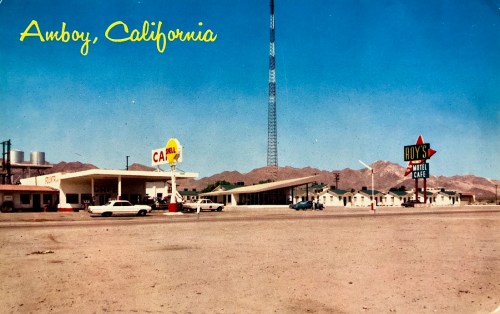
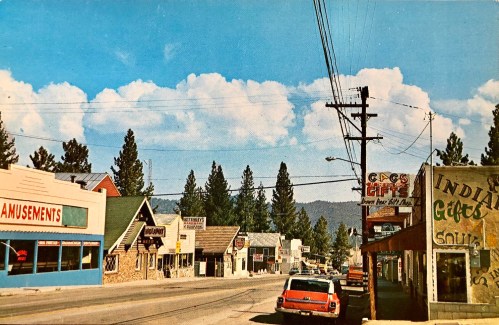
Roy’s of Amboy. (Here’s proof that Roy’s was once a Shell station.)
La Fierabrosa: A Lyndy Martinez Story, Part-18
Link to Part-1: La Fierabrosa Part-1
He would always be her first love, and that had to mean something.
Without leaving her rickity chair, The Spitfire bent down to retrieve the dented, half-folded sign. Chips of white porcelain were flaking off the edges.
Brushing gently with the base of her palm, she cleared a layer of cinder dust endemic to this valley. One could still read the word, “Mexicans”, in faded whiskey-bottle lettering, knowing the whole phrase warned: “No Dogs or Mexicans Allowed”. In days of old, these were a common sight in the agricultural communities.
“Do whatever you want with that relic,” declared Dale. “Target practice would be my suggestion.”
Her heart beat faster, the fingers on her empty fist clenching by rote. Flashes of Pinegate jolted her mind.
Ever since her detention, one incident troubled her above all; it had nothing to do with day-by-day abuses per se. It came after. Warden Dixon used to force juveniles to fight one another, as a form of sport and entertainment for the guards. In particular, she liked to make The Spitfire fight, because Lyndy was known as a safe bet. Over time, Mabel Dixon evolved to such a demonic figure, she began to seem immortal; a creature immune to confrontation. Yet the day Hector knocked her one time with a board, she crumbled, collapsing on the spot like some wrinkly old balloon deflating. He hadn’t even used his full power. So it was with the porcelain symbol of hate. Time and rust had eaten away the core, encroaching along the seams where the coating flaked off, to the point it was no more rigid than a pop can.
She felt anger rising. “Dale, you juvenile son-of-a-bitch. I know for a fact Matt Wallach would never have given this up without a fight.” Shaking the sign at him, she added, “this wasn’t necessary.”
Dale was in the sunlight. He remained straight-faced, thumbs locked through loops above his jean pockets, five-o-clock shadow outlining his beard. The deputy’s uniform hung loosely on his six foot frame, like he hadn’t eaten a solid meal in over a week.
Lyndy glared at him. “I believe our deal was, you were first going to have a talk with Wallach’s parole agent.” She gestured a long leap with two fingers, infusing her words with indignation. “So how did we get from there, to you punching the snot out of him?”
Appearing like a brash teenager, Dale gazed at the hills, smirking and shaking his head. On some level he was proud of his actions. “Just lost my cool or somethin. Look, I don’t understand why yer frettin about stuff? That isn’t the Lyndy I know. Wallach’s taken care of, stuck in an old hospital bed for another two weeks. He eats meals from a straw, watching Days of Our Lives. And if he does try anything, you know I got yer back.” He patted his leather holster.
Oh sure….
Lyndy gained not the slightest sense of relief from his words. A chill radiated out from her spine through her nerves, buoyed by the prospect of bloodshed to come. Dale could protect her from Wallach’s cronies no more than Chan could protect her brother from being shot in the back.
“You’ve started a war,” she admonished, exhaling audibly and fanning her drying toes. “You’re like one of them strong but reckless guys in a kung-fu movie, and when you eventually get your ass whupped, I’m the one standing who has to face the big boss by my lonesome. Happens every time.”
Dale took a hesitant step, bringing himself closer to her table. “Can I please sit down at least? We should talk.”
He was met again with Lyndy’s fierce brown eyes. “No way. You need to leave.”
“Man, you’ve changed.”
“Damn straight I have,” snapped Lyndy.
Backing down, Dale nodded to the North. “Heard you caught up to those thieves at the JBR.”
“I did. There were four border-riding outlaws, all working for our Mr. Wallach. At least two of them grew up in Mexico. So figure that one out.”
“Not much of a surprise,” said Dale with a shrug.
“If you can control yourself, please lay off Ted Crawford a while. Stop your bullying. He hasn’t done anything to you.”
“You got a thing for him?”
“None of your business!”
Dale pressed his hands together, covering his nose and breathing into them. “Sorry.” His eyes narrowed again. “Look Lyn, I need to come clean …” he stammered mid-thought. “It’s been difficult for me too. I care about Miranda a lot. God knows I do. I care about my kids, and I want to be a good dad.”
“I wish I could believe you,” Lyndy lamented, raising her arms.
Dale stretched out his hand. “Hold on, let me finish. It’s hard for me. I know we … correction … I made some unfortunate decisions up to now. I shouldn’t have done what I did. I’m tired of letting Miranda down. I failed her multiple times, and almost created a whole bigger mess.” His voice was cracking.
Lyndy couldn’t think how to respond. She wanted to put a positive spin on the situation, perhaps offer words of encouragement, or apologize for flirting with him, or for failing at knowing where to draw the line. But you can’t very well polish a turd, so she simply replied, “You’re a pretty good cop.” She couldn’t even make an unqualified statement on job performance, because in her world, Granville was a model lawman, and Dale paled in comparison.
“Fine, then we ain’t even friends no more. And since it’s the only thing left that will please your highness, I’m going,” grumbled Dale, visibly upset—probably tearing up—and leaving words unsaid.
“Don’t come back,” thought Lyndy.
Lyndy Life Tip #172: There’s a common phone scam where a caller claims to be working for the FBI or local police department, and they tell you there is warrant out for your arrest. In order to avoid arrest you must pay an immediate fee by credit card over the phone. The absurdity of this circumstance is, why would the police or anyone call you to warn you they are going to arrest you? It would only give you, the criminal, a chance to run.
As soon as Dale’s Bronco peeled out onto 66, kicking up dust while zooming away, Lyndy jumped up. She flicked the old sign into a rusty barrel of decaying car parts. Then, hobbling like an injured duck, she waddled to her clay planter of cacti—a desert garden. She felt as though she needed to act, or risk continual rehashing of painful memories.
On the tallest cactus were three picture-perfect white blooms, each beginning to open with the transition to nighttime. Lyndy rubbed her fingers against one, picking up a bee’s leg worth of pollen. Unlike most perennials, these succulents were flowering to attract nocturnal fliers such as moths and bats.
Feeling more at peace, Lyndy pulled on cleanish socks and boots, preparing herself for a ritual she repeated every week or two. Inside the trailer, Lyndy probed underneath the bed until she located a hand-made Indian basket, near as old as she, woven from entwined raw strands of yucca and bear grass. Plucking several of the best cactus petals, but leaving enough to do the plant’s job, she deposited them in the basket; it contained many more dry petals.
Basket in one hand, Lyndy ascended the rock steps once leading to a silver mine. They were constructed sturdily by workers whose mules often carried satchels of heavy ore. Few people knew this trail existed. The pathway switch-backed methodically along the ridge behind the airstream, to a high point several hundred feet above the town. There, amongst thriving specimens of nolina, stood a four-foot high monument of stones. It was where she spread the ashes.
Lyndy rested her knees on a flat rock, cradling the basket in both hands. As sunset arrived, so did a blast of air, the same as the first night. Cupping a handful of the dry petals, she gently released them to be carried aloft by the breeze. At times they passed from sight quickly, floating for miles on air currents, never seen again.
With the day’s heat subsiding, a line of distant thunder clouds spread over the valleys, turning pinkish. Those clouds reminded her of something, a neon sign, shining atop an iconic Barstow restaurant. In a mock cursive writing, the beacon read: “The Vanishing Point”.
Lyndy combed the hair from her face as she mouthed: “Why the heck was Blondie staring at me during the street race? If you think about it, she’s the one who slept with my boyfriend. How’s that my fault?”
The hankering for loud country-rock music came at odd times. But when it hit you, it hit you.
Minutes later …
Back in the airstream, Lyndy shifted her weight from foot to foot, while plucking her eyebrows in the medicine cabinet mirror. For her next act she needed to look her best. The Vanishing Point felt like crossing into hostile territory, or maybe the twilight zone. And one never knew how many ex’s could be there.
For her outfit she selected shorts, a halter top, gold hoop earrings—gifts from Rita—and strappy heels. Her shirt exposed the classy amount of bare shoulders and back, but no more. Her skin was extra tan, from the day she’d spent in the backcountry. While the frilly shoes compromised stability, they brought her eye level with most men.
Lyndy squinted to spritz on a few puffs of her priciest perfume—the kind that made males pause mid-activity thinking: “what’s that smell?”
One hour later …
One consistent thing about hate, it never really goes away, it evolves. The Vanishing Point didn’t post any signs warning away minorities, but it didn’t need such signs. The fact that they were unwelcome was written on the faces of the patrons, and the way the hostess acted put out anytime a non-white person wanted a booth; even the allowed records on the Happy Days style jukebox were screened.
The copious parking spaces were defined by old railroad ties—one resource this town never seemed to run out of—positioned horizontally and half-buried. Lyndy rested the front bumper against one of these markers. So far, people coming and going were paying her no attention, which was a good thing.
Before stepping down from the driver’s seat, The Spitfire paused to slip the shoes on her bare feet. The air was so dry it irritated her nose; the kind of night when a miniscule spark could ignite a raging forest fire.
The Vanishing Point was a roadhouse in every sense of the word; a shimmering beacon to macho truckers on the interstate. Standing alone in the gravel parking lot, one would never know such a thing as stars existed. Neon lights buzzed with retina searing brightness. Come all ye drinkers, guzzlers of cold beer, play some cards, see the opposite sex in the flesh and perhaps even speak to one. But despite these earthly attractions, it was inconveniently on Blondie’s half of town.
Frequent fist fights led to calls for it to be closed down on more than one occasion. In one instance, the place had been reduced to ashes by a disgruntled patron, only to be rebuilt in much the same fashion. Somehow, like the bedazzling waitress, it endured.
Cathy Cookson presided over this fandango like a queen, worshipped and revered; hell, she got tipped when she wasn’t even somebody’s waitress.
With loud country music wafting from the smoky interior, Lyndy repositioned her form hugging top and touched up her lipstick. By this time of night, traffic on I-40 thinned out. Only a half-dozen trucks, moving like a string of pearls, traveled along the westbound lanes.
“I used to be so nice,” thought Lyndy, reaching for her purse.
The front double doors were meant as a reflection of an old timey saloon; now they were just irritating. As loud as the conversations had been, as soon as The Spitfire pushed her way inside, all went hush. A redneck trucker at the jukebox deposited a quarter, and prepared to make his selection. Mid-search, he turned around to stare, as did two men who were playing darts. The hostess, clad in the blue and white uniform, eyed Lyndy up and down, probably thinking: “there goes my night.”
Romulans have entered the neutral zone.
A quick glance around the room showed no blondie. The two waitresses working the tables wore light blue skirts and matching tops, their lesser attire indicating fewer years of experience.
Lyndy stepped to the counter.
So far everyone was behaving respectfully, save for three rough men seated in the booth nearest the pool tables, underneath a mounted pair of bull horns. They were in their early twenties, playing tough, with preposterous leather jackets—probably trying to act the part of a gang. One of them was snickering.
In less desperate times, and with an easier case, The Spitfire would have ignored them. But somehow, Dale’s incompetence had fueled additional rage.
Brushing past the hostess, Lyndy strode to the far booth.
A song from The Bellamy Brothers began to blare; the trucker had made a bold choice.
The Spitfire rested her palms on the filleted metal edge of the table, leaning over til she got a whiff of the tangy, cheap lager beers.
“Gentlemen, what’s so hilarious?” she whispered, gesturing for truthful answers.
All three were slumping down, exhibiting terrible posture.
“By the way,” she added in the same breathy tone, “you boys look disgusting to me.”
A man with oily, curled hair shrugged. “Nothin. We just heard you and Deputy Keyne’s days are numbered; that’s what somebody said.”
“Is that a fact,” replied Lyndy. “How amusing.” She stood up straight, drawing her feet together to appear taller. “Do any of ya’ll know who Evan Stone is?”
They shook their heads, using minimal effort and checking each other’s faces.
“You sure bout that? Want me to repeat the question?”
Still no answer.
“Alrighty. Then do you think one of you can deliver a special message to mister Wallach for me? It’s brief.”
All the boys nodded, with one sitting up more and mumbling in the affirmative.
Lyndy raised her voice this time, loud enough for anybody on that wall to hear. “You tell him I’ll be waiting.” Then she slammed her palms on the table, making the beers slosh.
Talk about tense. Ordinarily, there was no non-awkward way to exit out of a threat. But right at that moment a young trucker, breathless, green trucker cap and all, tapped Lyndy on the shoulder. She whipped around, nearly elbowing the poor guy in the ribs; but he had quick reflexes.
This fella had superb timing.
“You look nice. Care to dance Miss Martinez!” He said, with the verbal deftness of a cattle auctioneer.
Lyndy smiled kindly. “Sorry, definitely not today; I came to find Cathy,” she asserted. “How bout next time.” Then she dodged sideways, charging straight for the shiny kitchen door, throwing it open with max forcefulness.
The kitchen was a zoo, pans sizzling and plates sliding everywhere, but Cathy wasn’t there either. Lyndy locked eyes with the head cook a moment. He was wearing a red and black bandana on his forehead, dark sunglasses, but he seemed to know exactly what she wanted.
“Yo, Cathy’s in the back man, taking her break.”
In all the years The Vanishing Point had been operating, Lyndy have never ventured to the area behind; a forbidden zone. Lyndy twisted the handle on the creaky screen door—the kind at mountain camps—stepping out guardedly.
Their unkempt brick porch had been piled high with discarded pallets and buckets of cooking oil. An old generator, rusting, sat adjacent to a mounds of rocks. After letting her eyes adjust, she could see outlines of storage units, empty foundations and lived-in trailers, and a line of trees bordering the riverbed. Moths danced at the windows, and by the door.
In the light cone of a caged outdoor bulb, stood a feminine silhouette. They were resting against a support pillar, fully at ease, with the smell of menthol wafting in the air. Unmistakably, that silhouette belonged to Miss Cookson.
“Hey there Lyn,” came Cathy’s breathy call, through her shroud of smoke, almost as if she’d been expecting a visit from The Spitfire all along. That was the sign of a person with something emotional to get off their chest.
Waving away the smoke screen, Cathy strode her direction, and Lyndy could see that the lady’s uniform was undone, with the sleeves resting against her hips. Covering her skin, she had on a simple white slip.
“Howdy,” was all Lyndy could say.
Cathy half smiled, gesturing to her body. “When I was a teenager, this thing used to fit me with room to spare. Now I can hardly breathe in it.” She pressed the half-full pack into Lyndy’s hand, drawing a silver lighter from the middle of her bra.
Looking down, Lyndy recognized the green label. “Huh. I didn’t know you smoked Newport,” said Lyndy.
“You don’t come around my restaurant very often,” replied Cathy.
Her restaurant. Of course.
“True. But that’s because I thought you hated me,” argued Lyndy. She stuck the filtered end between her lips, as Cathy touched flame to the tip.
Once red hot, Cathy flicked the cap back on the lighter, slipping it away and advancing to within inches of Lyndy’s face; with The Spitfire’s advantage of taller shoes, they stood eye to eye.
Holding a Newport, grinning her slyest and most seductive smile, Cathy asked, “Why aren’t we better friends Lyn?”
With an idea like that, Lyndy had to chuckle. “Where oh where to begin Cath. For one thing, you’re always trying to one-up me. And I know that isn’t my imagination. Been doin’ it since we were in tenth grade.” Lyndy puffed a few times to get it going. “And then there’s the whole Kyle Ellis fiasco.”
Cathy frowned, inhaling deeply and making a hissing sound with her front teeth. “I crossed the line didn’t I? I’m sorry about that. I know you were seeing him first.” Blondie’s country accent was distinct as ever, but her silky voice seemed strained and a little raspy on this night. She lowered her cigarette to the side, between her second and third finger, depositing ash and exhaling through her nose.
“Ah well, that’s alright I guess,” Lyndy said. “He must not have liked me as much as I thought he did.”
The Spitfire paced the uneven brick surface, being careful with her heels, pondering to herself when was the last time she ate an actual meal. She chuckled discretely, unable to suppress a memory of her brother.
“What?” demanded Cathy, thinking the laugh must be about her.
Lyndy waved her hands across her face. “Sorry, I was thinking when Hector was alive, he used to like to eat at this stupid hole-in-the-wall chicken stand, every chance we got. It had dirty picnic tables and flies buzzing around. And I hated the food. Plus their kitchen cleanliness was suspect; real dicey. I felt sure we were doomed to get food poisoning one day.” Lyndy stared at Cathy’s faded blue eyes. “Damn. You know I’d give anything to eat a meal there again, with my brother.”
Cathy’s expression had changed to one of weariness. “You didn’t go to elementary school out here, did you Lyn?”
Lyndy shook her head. “Nope. We were still living with Aunt Rose in Los Angeles.”
“Right. So you never met my brother.”
“Far out! I never knew you had a brother!” Of course, the moment the words rolled off her sharp tongue, Lyndy regretted saying them. She could see by the pain on Cathy’s face her brother was also not of this world. “I mean…uh…no I didn’t.”
“My older brother was the best thing about life. We did all kinds of stuff together. He was the only person who could make me happy, the first boy I loved—not in that way obviously—but you know what I mean. Which is why I despise guns.” Cathy gestured to Lyndy’s handbag. “Cause when he was 12 years old, he died in a hunting accident with his friends. They were shooting quail, by Soda Springs, and he tripped over a rock and landed on top of his gun—shot himself in the jaw. My father wouldn’t let me see the body, it was a bad scene. At least, they say it was quick.” Cathy touched a hand to Lyndy’s shoulder. The fingers felt warm, pressing on her bare skin. It was the peculiar kind of touch, lingering, like the prelude to a kiss. Had a man done this, or really anybody not in emotional distress, Lyndy would have smacked their arm away. “When my brother passed, he took most of my soul along with him. In those days, I thought I would never experience happiness again.”
“I understand,” said Lyndy, knowing there were no words which would be respectful to somebody who suffered such a loss. “I swear, I never knew any of that story.”
“Some things are so awful even small towns won’t talk about em.”
Lyndy nodded.
“With my mother and brother out of the picture, I’m the only Cookson left to take care of my dad, which is why I never left town. I got dealt a pretty crummy hand if you ask me.” Cathy deposited the butt of her smoke in a coffee can by the screen door. “Anyways, break time is over.”
“Cathy, before you go back in, I really need to ask you something important. I’ve been searching for somebody all week, and now the week is over, and I’ve got nothing. All my hours are used up.”
“Go ahead,” said Cathy, reaching around for the zipper to put her dress back together.
Lyndy took a deep breath. “Do you know who Evan Stone is? I’m guessing you might recognize the name. Maybe he came in here once in a while? He was a singer.”
Lyndy tried to read Cathy’s body language. If this didn’t work … well … there wasn’t any plan-D.
Cathy struggled with her zipper, head down, sucking in her stomach through gritted teeth. “Yeah, I remember him. We went on a couple dates long time ago.”
“Lemme help,” offered Lyndy, reaching for the zipper. “You two went on a date?”

 Aiden S Clarke, author