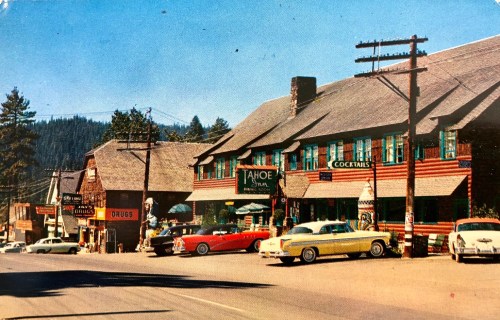
Tahoe City, California (1960’s)
La Fierabrosa: A Lyndy Martinez Story, Part-11
Link to Part-1: La Fierabrosa Part-1
Dale stuck out his palm, softly pressing it to her midsection. With a smooth but forceful motion, he backed Lyndy up, asserting his way further into the Airstream trailer. He hung up his cowboy hat on a peg by the door.
“All the males in my county have lost their damn minds,” thought Lyndy.
As the door closer shut automatically, he latched it behind.
“You shouldn’t be in here,” said Lyndy.
“Miranda thinks I’m working late,” he replied.
Years had elapsed since he’d laid a heavy hand on her body. Deep inside, she missed that blissful feeling. It was the only reason she hadn’t punched him in the nose.
He began unbuttoning his shirt.
“Hey, I apologize,” said The Spitfire. “You must have got me confused with somebody else. I ain’t never been a homewrecker.”
He paused and looked up.
“I leave that job to folks like Catherine,” she added.
Why she chose to throw Cathy Cookson under the bus, Lyndy wasn’t sure.
Dale inhaled suddenly, then slapped a hand against the doorframe. “Dammit. You used to be different.” His breathing was audible.
Lyndy nodded. “Perhaps you’re right.” She exhaled, calmly taking a seat at the table. She needed to be off her wobbly ankles, lest they give out. She took a moment to adjust the top of her robe, so it thoroughly covered any bare skin below the neck.
“So, I had a friendly chat with our buddy Wallach,” declared Dale.
Lyndy frowned. “What do you mean by that?”
“I called him up—asked him if he knew where Evan Stone was holed up.”
“Why would he bother telling the truth?”
“Because I also told him where and when to meet me in plain clothes.”
Lyndy sniffed, eyes downcast, fingers tracing wavy lines in the pattern of the Formica table. “He won’t fight fair you know,” she warned. “He’ll probably bring his brain-dead pals to back him up.”
“Doesn’t matter who he brings,” said Dale, placing a hand flat on the table, inches from her fingers. Each of his knuckles were badly scarred, from prior bare-fisted boxing matches.
Lyndy shook her head. “I’m sad to say, eventually it will matter. You have two kids now. There are many more of those guys than there are of us—even counting the bounty hunter—and he pretty much counts double. That’s exactly why I backed down today.” Under the table she crossed her legs.
Lyndy reached for the pack of Newports. She shook two out, passing the extra cig to Dale. Then she stuck the first one in her lips, raising the lighter to it. Once lit, she flicked the lighter like a skipping stone, landing topside in her purse.
“I ain’t sure why I backed down. It’s not like me,” whispered Lyndy. “I guess I chickened out. I was thinking of my brother—the way he died alone.”
After a few puffs, Dale added, “Wallach told me Evan knew of a remote hunter’s cabin, way out in east county, not shown on any maps. He’s self-sufficient there for weeks, and he won’t come out until the charges are dropped. Wallach claimed he’d never been there.”
Less than half a day, and the story had changed. She still didn’t believe it.
Lyndy felt ready to speak again. “Alright, remember two things: Number one, you cannot keep fighting battles for me. I swear to god you are gonna get us both killed. Second, and most important, you are the one who had a decision to make. You chose Miranda over me and I still don’t know why. But it was your call who to marry, and you have to live with the consequences. I’ve already accepted it. You sure as hell can’t have the both of us. What will it take for you to understand?”
Dale had a really ticked expression.
Lyndy rested her forehead in her hands. “I would have changed for you. I would have been a good wife.” She didn’t know why she threw that stuff in. It was probably a lie. The Spitfire knew she could not have changed for anyone, let alone Dale.
“I can’t stop my feelings for you,” replied Dale.
“Well maybe you ought to try hypnotism. I hear those dudes can cure you of anything,” she said sarcastically.
Next morning …
Birds were chirping. The Spitfire opened her eyes partway. Judging by the light flooding her bedroom, she’d slept in. But at least she felt rested. She pinched at the motheaten curtain pleats, raising them an inch to see out. The foothills were bathed in a golden yellow.
Lyndy turned back to the ceiling, placing a hand under her head for support. Sure, there were advantages to being single. You get to hog the exact middle of the bed, and stretch out. Nobody tells you when to get up. Plenty of time to focus on one’s career aspirations—so many opportunities—and … and … who the hell are we kidding? Being alone is awful. She closed her eyes.
Time to get serious, chica. Get up.
Rolling out of bed sideways, Lyndy stumbled to the drip coffee maker. Along the way she collected items of clothing: a faded pair of denim shorts she had to squeeze her hips into, a comfy bra despite underwire, a lightweight cotton cowgirl shirt with pearly buttons. And at the table, she re-laced her favorite hiking boots, in case she needed to traverse large distances on foot. Her faith in AMC product dependability—what little remained—was shaken to the core.
Lyndy Life Tip #158: Unless you live in a Brady Bunch household, get a four or five cup coffee maker. Who the hell needs 12 cups of coffee in the morning? It’s a waste.
Meanwhile, The Spitfire hatched a new, better plan. Something had been bugging her ever since Ted Crawford stopped in at Roy’s Cafe, and it had nothing to do with Evan Stone. Wouldn’t it be sexist to assume a female wasn’t as capable as a man at cattle rustling? There were numerous red flags surrounding her Good-Samaritan image. Julia Russell had the hardened appearance, and practical skillset, of an individual who knew their way around ranching and cows. Suspicion was warranted.
Working this case somehow seemed more pleasant anyway—too bad she couldn’t bill Lovelace for it. Cattle rustling was a good old fashioned western crime. Nobody was going to threaten to disfigure her face or drag her behind a horse—that only happened in cheesy action movies. She could avoid contact with crazy people like Dale Keynes and Kyle, and it would allow her time to ponder how to peacefully resolve Chan’s case. As a bonus, there might be opportunities to accidently “bump into” the cowboy Ted, particularly if her route of travel took her anywhere near the JBR.
While waiting for coffee to brew, Lyndy unfurled the county map, spreading it over the double bed. Daylight revealed faint blue dashes tracing out the ephemeral courses of the namesake Mojave River, dotted outlines marking dry lakebeds, and the no man’s land of sand dunes. The crisp folded edges crinkled under the weight of her fingers and thumb.
The East Mojave was an ideal stomping ground to play T. E. Lawrence. The I-15 and I-40 freeways formed a tilted V shape, the double end opening to the borderline. This wedge contained vast wilderness sprinkled with abandoned mines, rock forts, ghost towns and other archaeological sites; a last bastion of the wild west oddly positioned in rural California.
Included were a lifetime’s supply of dirt roads waiting to be explored. Some of those trails were on BLM sanctioned grazing land, others part of a network of stock ranches including Kessler Springs, the OX and the JBR. The possibilities were endless.
Good news was, Julia Russell had provided several clues to her whereabouts. The Old Mojave Road connected a series of natural seeps and watering holes, stretching horizontally from the Colorado River wetlands, through the middle of the wedge, to the Mojave River crossing itself at Afton Canyon near Barstow.
Because it traversed several high mountain ranges, The Mojave Road was by no means an efficient passage, but without adequate sources of clean water each night, your pack animals were going to die anyway. Knowing this, modern ranchers had developed additional water sources for their cattle, informally called guzzlers.
Resting on her stomach, Lyndy tucked a number two pencil behind her ear and charted a course that would take her through or near all the major points Russ had mentioned. A few of the names she recalled were Marl Springs, Cedar Canyon, Rock Spring and Fort Piute. The proposed route would also take her to Government Holes, where some of the cows went missing, and Lanfair Valley, where presumably a large truck could have driven them out.
Chan never called and that was a good thing—must have forgotten to pay his phone bill. The other thing that happened, she didn’t even want to contemplate yet.
Minutes later …
Under the protective shelter of a paloverde tree, Lyndy loaded her SLR camera with iso 64 color film. She exercised the advance lever repeatedly until she was certain the take-up spool had engaged. Next, she hosed dust off the neglected igloo cooler, and filled it to the brim with crushed ice.
Lyndy shook and punched at the lid of Hector’s old Dodger ball cap until it resembled a hemisphere, then flipped it on her head using the bill. This was a day to be practical. No time for monkey business.
Using a bowie knife, Lyndy began smearing natural peanut butter and strawberry jam onto slices of plain white bread—the finest available at the gas station c-store. She wrapped her culinary creations in layers of tinfoil, placing them atop the ice in the cooler. What kind of nut-job enjoys a warm PB&J? She also tossed in some extra cans of soda.
Back in town, Lyndy topped off her fuel tank, pocketed the receipt, and headed east on Route-66, to the first junction with Kelbaker Road. Cruising at near fifty miles an hour, the morning air was energizing. She switched on the do-nothing factory radio, and though struggling for reception, could faintly hear a song she recognized. At knee level, it felt like the heater was stuck on. Adjusting the knobs made no noticeable difference—perhaps they weren’t connected—and with all the other air movement it didn’t seem to matter.
Lyndy submitted a radio request via ESP. Humming along to the music, filling in parts of songs that weren’t audible, she didn’t pass a single other motorist until she made the turn onto Kelbaker Road. Shortly thereafter, she passed a man in a non-descript Carry-All heading the other direction.
Approaching the interstate from the south, Lyndy was treated to a panoramic view of the Granite Mountains. They were among the tallest and most rugged peaks in the desert. Spires of solid granite, like the buttresses of a cathedral fronting the range, with no foothills to speak of. The rocks themselves had a pinkish tint, rather than the cool grey of Yosemite’s famous walls. The highest points, Granite and Silver peaks, hosted island forest of juniper and pinyon pine. They often received snowfall in the winter.
The surrounding landscape was changing fast. Unlike Amboy, where land was low and prairie-like, this place had a high desert feel, with greater variety of flora. One could smell the differences in the air. Notable were the Mojave yucca, still in bloom.
Reaching far side of the I-40 undercut, Lyndy crossed paths with two additional vehicles; first was a Jeep, this one a pretty shade of cobalt blue. Lyndy received a traditional Jeeper’s salute from the driver. She responded hastily with a quick wave. Were it not for that person snapping her out of a daydream, she would never have noticed the second car.
It was a Ford Galaxie station wagon, tan in color, and behind the wheel sat a familiar character. Lyndy did a double take. It was the older woman Lyndy had seen in Barstow on numerous occasions, otherwise known as “sweater lady”. Both her hands were squeezing tight to the steering wheel as if she were on a Big Dipper roller coaster, about to crest the largest hill. She was leaning forward so much her old lady scarf or shawl—whatever that thing was called—was practically touching the crooked visor on the windshield. And yep, still a trademark ugly brown sweater to complete her ensemble. The side vents were cracked outward, but the main windows were all rolled up tight. Yikes! Did she have functioning air? Without that, it would have been like riding around in the tropical punishment box from Bridge on the River Kwai.
And what would an encounter with the sweater lady be without a scornful glance and the same evil eye, unprovoked of course? This woman embodied the “drive angry” mantra.
Wait, the sweater lady has a car?
Lyndy took her foot off the gas, decelerating to watch closely where the car went in her rear view. As expected, the woman turned westward, entering the ramp for I-40. That meant she was returning in the direction of Barstow.
Lyndy couldn’t imagine a more fitting ride for her, replete with sloppy Earl Scheib style re-paint, cause originally that land-boat came factory two-tone. Lyndy whispered aloud: “But if she actually owns a vehicle, why the hell is she walking all the time?”
After miles of steady incline, Lyndy crested the summit of Granite Pass, and was rewarded with a scene out of a western movie. Visibility was superb. In the valley below sat a miniature Saharan landscape called Kelso Dunes. Adjacent was the fancifully named Devil’s Playground. Both were a product of the Mojave River, changing courses and generating shifting sand over millennia. Sometimes it was fun to hike out there. Except with the high-pressure system unabated, it was sure to be another blistering and windy day, making the dunes not at all inviting.
Something encouraging was beginning to stir in The Spitfire’s soul. She was starting to gain back the feeling she loved most about the desert: a sense of tranquility and freedom. Hector had once said, “It may be an acquired taste, but the desert works its way down in your soul. One day you decide you don’t dislike the dry open spaces—you actually start to miss them. That’s when you know you’ll never leave this place.”
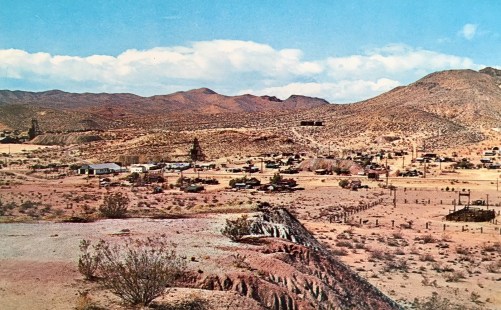
Lyndy chugged on to the intersection with Kelso-Cima Road, in the tiny whistle-stop town of Kelso. Kelso was roughly the same size as Amboy, but in a competition for which town could disappear off the map sooner, Kelso was leading the charge.
By far its most prominent feature was a majestic 1920’s train depot, done in a lavish mission style of early California. In the bygone era of steam this had been a crucial resting point, where crew and passengers alike could take a hot meal, play some card games, or even sleep in a normal bed.
Though it must have been romantic in its heyday, modern Kelso was a real dump—comparable to a thirties dust-bowl adventure park. No TV signal even reached the town. So, by one measure of civilization, in Amboy you could watch Johnny Carson, but in Kelso forget about it. That all assumed you even owned a television.
Near the depot, a rusting away sign, flapping and squeaking on a metal post, advertised a six-pack of Schlitz beer at 29 cents.
“Sheesh! What a killer deal,” thought Lyndy. “It’s like 5 cents per can.”
No motorists were coming either direction.
The Spitfire couldn’t help herself. Emboldened by curiosity, Lyndy parked the jeep adjacent to the decaying wooden saloon. A single pane window, having become near opaque from decades of sandblasting, was still her best option for seeing inside.
Lyndy opened her car door. Stepping out onto the sand, she post-holed her way to the window. Knotholes in the pine-board roof allowed shafts of light to illuminate the room, but to see anything with clarity, she had to wipe a circle using her elbow and bunched up sleeve. It was good enough she could cup her hands and peer inside. The room was mostly cleared out, with half a dozen spider webs dangling from the rafters. Anything which could be strapped to a model T Ford, or even the back of a tired mule, had been hauled off to the next boom town; all except for a decrepit pool table. It was a common sight, as very few settlers had the wherewithal to move a pool table when pulling up stakes in a hurry.
“Man, I bet that old thing could tell some stories,” pondered Lyndy. “Wyatt Earp himself might have knocked a few balls around it.” She levered off one of her boots, needing to exercise the arch of her foot, and at the same time discard some sand.
Meanwhile in San Bernardino …
Matt Wallach was busy polishing his fifty-year-old bar top, when he heard the door hinges creak, and the click of boots.
Being too early for any customers, he had a sinking feeling. His war buddies were still at home, sleeping off hangovers from the previous night.
Without having to look he knew it was the deputy, the one asking about Evan, and who protected The Spitfire.
He continued mindlessly with circular motions on quarter-sawn oak, using the soft rag, but his attention was fully on how to survive this encounter.
“Can I get you something, pal?” he offered, a touch of humor in his voice.
There was no answer from the huge cop. Matt gave him a sideways glance. He could see brown leather gloves covering both his fists. The cold, unfeeling stare on his face was the same the guards had prior to a beat down. This young man wasn’t here to “check on him”.
Wallach chuckled nervously.
“I uh, heard you were some kinda bare-knuckle fighter in Saigon. I myself am a veteran. Never got a chance to see you there, but I knowed some folks used to bet against you.”
No answer, but he knew the cop was observing him in silence.
“I suppose they wanted to see an American officer get his ass whupped by a local boy.” Wallach was thinking about his pistol, and whether he could get to it faster than that cop could get to him. “This one time, was a champion martial arts expert come to town. He was about twenty-five years old, and obviously pretty cocky. He was Chinese I think. His wife or girlfriend was there in attendance, and part of his family. That fool was supposed to put you in your place—like one of them Kung Fu TV episodes.” Wallach suddenly felt his throat getting dry. “Carson—he’s my regular bartender, usually stands right here—told me that was the first time he’d witnessed a shunning after a match.”
“Look Wallach, your friends are idiots, but you knew that,” said Dale Keynes. “I just hope you enjoy fruit smoothies, cause that’s the only thing you’ll be eating for the next six weeks.”
A deep feeling of regret was steadily chipping away at Wallach’s state of mind. His pride may have cost him teeth, and he would not be able to help Evan after this.



 Aiden S Clarke, author