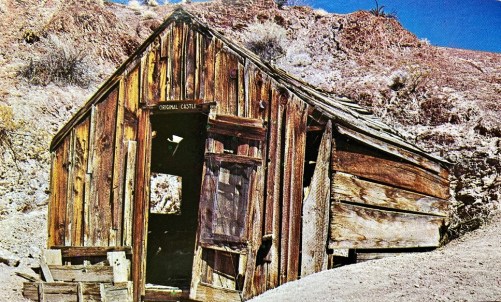
Death Valley Scotty’s prospector cabin
Jackrabbit Homesteader: A Lyndy Martinez Story, Part-7
Link to Part-1: Jackrabbit Homesteader Part-1
Lyndy Life Tip #183: Despite an endless barrage of new year’s advertising that would have you believe getting fit or losing weight will somehow change every aspect of your existence, from your career to your love life, take it from me, it won’t. You’ll be in shape, with all your other problems the same.
She’d been studying the map.
“Change of plan. Turn here,” Lyndy ordered, gesturing right.
With a flick of the wheel, Jack had them veering onto Black Mountain road.
No commuters were heading their way. The new road was arrow straight—one could tie the wheel in place with a rope—but coarse, stretching to an isolated range of volcanic ridges. With little maintenance, the median strip had all but weathered away. Rusty wire fencing, twisted and broken in places, paralleled the eastern side of the pavement. And it was so bone dry here only half-dead coyote brush dotted the pebbly soil. The color palette of this desert was something akin to a Siamese cat.
Overhead, numerous contrails blended with the whitish haze.
With one foot on the clutch and a fist on the shifter, Jack went into third gear, followed in a quick surge of engine power. Alluvial fans radiating from the hills meant the terrain was increasing steadily in elevation. Every quarter mile another fifty feet or so.
“When do I get to drive?”
“Middle Tuesday of never.”
“Figures. Typical male,” she complained, turning over the map.
“Uh, Lyndy, I really should have mentioned something else to you back at the hotel. These bandits who robbed us were heavily armed. I hope your … will and stuff is up to date.” His attempt at a joke landed flat, as they both knew it was tinged in truth.
“Meaning what?”
“Automatic weapons.”
People didn’t move to this county for the social life.
Minutes later …
“Hey, slow it down hotshot,” Lyndy chided, as they were approaching a dirt crossroad.
A steel cattle guard and white metal sign stamped with numbers marked the junction. Though peppered many times in shotgun pellets, the digits were discernable and matched the address they were seeking. No mailbox. Two miles ahead at the far end of the access, a mysterious cluster of steel buildings gave the appearance of a fortress.
Lyndy and Jack eyed one another, exchanging concerned glances. Still he turned in, Jack proceeding across the grate at a lowly ten miles an hour. After a mere thirty yards he stopped, setting the e-brake and cutting the ignition.
Reaching out his palm, he demanded, “Alright. Let me see it.”
She shrugged. “Uh. See what?” Suddenly they could converse at normal volume. Her brain was taking time adjusting. “What the hell are you talking about?”
“Your protection.” He chuckled to himself.
Truthfully, she knew what he meant before he said it. She hesitated because indecision filled her heart; this being intrusion at a level beyond matters of love life. The gun was fully loaded. As a rule, she never allowed curious strangers to see the Beretta. She could say no.
Reluctantly, Lyndy gazed into his green eyes. Continuing to glare, she reached a hand for her purse and undid the top flap. Then retrieving the matte black pistol, she passed it in a downward facing position, fingers round the barrel, setting the grip in Jack’s waiting hand. She wouldn’t have let go if she’d thought him incompetent.
With it pointed toward the gauge cluster, he rubbed his greedy palm along the slide, feeling cold metal and each of the grooves. The diamond pattern on the grip was crisp and sharp as a brand new wood file.
Careful. That son-of-a-bitch is cursed.
Slanting it side-to-side by 45 degrees he muttered, “doesn’t appear to have a serial number does it.” He poked a finger at the small black lever, liberating the clip. Under the force of gravity the loaded magazine dropped in his palm. She could tell he was counting up bullets.
“No. It’s a one-off. Made entirely by hand. I’m told it’s very difficult to trace; not that it matters.”
Jack nodded, wordlessly shoving the magazine back in place.
“I’m not using it on this job,” she repeated.
“Reminds me of a nineteen eleven with a short barrel, easier to conceal and a higher capacity magazine. Yeah, this is a nice piece.”
Satisfied, Jack handed the gun off in the same manner back to Lyndy, then pulled his door latch. Exiting the driver’s side he circled around to the trunk. After stowing the Beretta safely in her leather purse Lyndy stepped out as well, intending to follow him to the rear of the vehicle.
Nevertheless, freed of the noisy cabin and with her feet planted on the road, her instinct to explore took over. She paced to the metal grating, pausing just shy of the gap and daring not cross. Her boots, being something akin to animal hooves, could just as easily become ensnared in the rust colored slats. Trapped amongst the steel she observed a 3-foot long rattlesnake skin.
Seeing the diamond pattern made her jump back, every muscle clinching and her chest feeling like a heart attack. Obviously it was only a harmless shed skin, and the real snake was long gone, yet her natural reaction was the same.
She turned back, concerned Jack may have witnessed this embarrassing incident. He was preoccupied, bent down, accessing something in the trunk; the polished latch of a briefcase glinted in the light. The front of Jack’s shirt had been unbuttoned, flapping in the wind. From the case he lifted a semi-automatic pistol of a type she’d not seen.
One glimpse and it appeared as though it were transported from the future, over fourteen inches and polished steel—something like a prop out of a spy movie—but one surely the bad guys would have had. This was hitman behavior.
“Hey! What is that?” she challenged.
Raising his head and shoving the case out of view, he spun around. “It’s a German P-330.” His unbuttoned shirt revealed a tan-colored side holster, and his fit torso. He held the gun sideways, exhibiting chagrin, then holstered it. “Costs about $1900 new.”
“You know they can see us now.” She nodded to the distant steel castle. “If they have binoculars.”
“I know.” Rebuttoning his shirt, he made sure his holster was covered. “I want them to.”
“Have you ever considered the idea that Kareem Abdul-Jabbar isn’t good at basketball because of his shoes?”
“Pretty sure it’s cause he’s about ten feet tall,” said Jack dismissively. Setting a foot upon the bumper, he leaned down to tie his shoelace. Switching to a firmer tone he added, “Lyndy, I’m not trying to show off. I just wanna be ready. Not like on the train the other night; stupidly I didn’t have my gun or anything with me. I was hungover too, which obviously doesn’t help.”
Climbing back in the car, the two motored on, less in a hurry than before.
Lyndy Life Observation: Driving my car near sundown and the flashing marquee sign out front of a casino had a government mandated PSA reading, “Gambling problem? Call this number for help.” And I thought. “Yeah, the problem is you guys!”
Off pavement, the black Trans Am kicked out a spray of fine soil—like jets of exhaust from a nozzle all the way to the intersection—but crosswinds and swirling eddies were also carrying it ahead, clouding their windshield and dusting up the hood. So much for the paint. Too long like this and Lyndy worried the paper air filter would clog. And if the folks in the metal fortress didn’t know they were coming before, that had surely changed.
All this was making her uneasy. They were giving too much warning. Something else seemed off and it took the better part of a mile to identify it; by this time they were much nearer to the cluster of buildings.
Abruptly she stirred, leaned forth at the hips, squinting at the unpaved dirt passing beneath the car. “Hey Jack, you notice how nice and smooth this road is?”
“Now that you mention it, yeah,” he replied.
Ordinarily a western drive such as this quickly accumulated washboard bumps, dozens at a time; some of these tracks were so bad they’d practically rattle out your teeth fillings.
“See along here,” she remarked, wagging a finger at linear mounds of disturbed soil on both sides. “They didn’t use road grader equipment or a dozer, they’ve leveled it with something else—like a car dragging a metal plate.”
Jack glanced at her as though she were half-crazy.
She signaled to him to slow down again, as they were coming to a chain link fence and padlocked gate, barring entry.
Though there were no additional numbers to confirm, it had to be the place.
The eight-foot-tall fencing stretched one side to the other, presumably encompassing the whole of the property. Prominent no-trespassing signs were displayed every twenty feet. They were unneeded, as nothing about the place invited newcomers. You had to go out of your way just to get here.
Plainly in view near the center, stood a massive hanger style complex, two or more stories in height, way over what a normal garage would be. One man-sized door at the end looked tiny in comparison. Along the roofline, a row of heat-exchanger fans were twirling rapidly—the kind they have at industrial farms. Some of those places were about as creepy.
Open spaces between the building and fence line were paved in concrete, quite nicely too, containing no cracks or weeds, not like a home job. In fact there wasn’t a plant or bit of vegetation to speak of. It was airport-like, but lacking a runway.
Squeezing on her door latch, The Spitfire stepped out. Placing an elbow above her eyes, she protected them. A breeze twisting the no-trespassing signs created a repeated creaking, as they were sheet metal and attached by loops of wire.
She was keeping near to the car, still behind the door for the small margin of safety it provided. Unexpectedly those crummy Lovelace Corporation repossession jobs piling up on Chan’s desk were looking better and better.
Jack stepped out as well, taking his time. They exchanged looks, both thinking the same: “What the hell is this place?”
Taking a page from The Spitfire playbook, he left the keys in the ignition and door open. Striding to the gate, Jack picked his way through a jumble of tumbleweeds which were piled against it. He cupped a hand on the beefy padlock. She sensed he was determining how to get in. This type of fencing was easily scaled, but often resulting in torn clothing and scrapes.
Coming up behind him, “I should never have let this happen,” she whispered.
“Way too late now. You can’t turn back,” he lectured.
“I know. I’m a fool. I wanted to change my hair style and now I hate this sixty-five dollar perm,” she voiced.
Jack shook his head. He looked back at her, flashing a smile.
With a better view, she soon noticed details she hadn’t gotten from the car—her initial thoughts consumed by the enormous building—but scrap metal piles were heaped up everywhere around its walls and base. Most items appeared to be surplus girders for those heavy duty shelves they have in warehouses. Others indeed looked like military hardware, jeep axles and wheels, tank turrets, unrecognizable vehicle parts painted tan or olive drab. If anybody would buy a commando army truck it was this person.
Hector Martinez always used to say the surest way to avoid a snake encounter was by pounding the ground extra hard with your boots as you walked, so at least they knew you were coming. Same could be said regarding people.
Fact is, most strangers are harmless. It was the element of surprise which could lead to disastrous outcomes. So as long as one made their intention clear, people would live and let live. Even at the scariest of shotgun shacks—dudes cooking up moonshine, half-coming-apart silver mines, homesteads with pirate flags and animal furs hanging off tree branches—yes even those places.
Nervously she shouted, “Hello in there! Anyone home?” Then she shrugged.
Arms twitching and constantly shifting his feet, Jack stared at the hockey-puck sized lock. She knew he was contemplating ramming the gate.
A long couple minutes passed. She thought about adding her traditional, “we come in peace” greeting.
And then the one door flung open. A Caucasian man sporting of all things a backwards Brewer’s cap, bowl haircut flaring from underneath and a beer belly, came charging out. Before meeting them he gently laid a shotgun next to the door, propped up by the stock.
As if suffering from a leg injury, he waddled forth with a stiff gate. Still the rest of him moved rather easily for a man of size, traversing the section of hard concrete swiftly, and constantly waving at them in a sociable way. Even his face was welcoming.
“Howdy. My name’s Bo,” he announced with a booming voice. “Bo Rawlins!”
The syllables rebounded in her skull. A mister Bo Rawlins. Some names could be challenging to recall, but this one she wouldn’t easily forget.
If this man were a dog, he’d be one of those excited and goofy rottweilers.
“Whew!” Bo faked an arm wipe across his brow. “Thought I was gonna have to scare off another herd of them Harry Krishnas. Them weirdos been drivin me nuts lately.” Lifting his ball cap, he stuffed more of his unruly blonde hair inside.
She couldn’t help but deliver an amused smile, genuine, and he smiled back. Mr. Rawlins had gotten the name of the quirky religious group wrong, maybe on purpose.
“What can I do you two for?” He started rolling up the sleeves of his flannel work shirt.
She politely waited for Jack to answer.
Jack cleared his throat. “Sir, I promise we’re not here to take up your valuable time. My name’s Jack Decklin. I’m an investigator with the Santa Fe railroad.” He gestured to Lyndy, adding, “and this is my colleague Miss Martinez. Maybe you can help us … with something … if you’re not too busy…” as Jack tilted his head he trailed off, gazing downward, as if disturbed by interrupting thoughts.
“The two-a-you undercover cops or somethin?” questioned Bo. His blue eyes were darting furtively back and forth between their faces. But overall, his attentions lingered most on The Spitfire; he was studying her.
“Definitely not cops,” replied Jack. “Hold on. So you actually get the Hare Krishnas out here?”
Bo chuckled. “Tons of em. Them people wanna buy some a my acres for cheap and build one of their temples out here, near Black Mountain road. Told me this land has spiritual significance. I keep tellin them to get lost.”
Lyndy noted Bo’s wrists were covered in grease marks; he’d been in the middle of something. Time to put on the charm. Arms at chest height, Lyndy stuck her fingers through the fence separating them from Bo, gripping it tightly—like she wanted in. She was working on her puppy dog eyes. Please sir, let us in.
“I have records indicating you recently purchased a vehicle we’re interested in seeing.” Jack pointed to the building. “Is it possible we could discuss this more inside?” As if on cue the breeze picked up, again assaulting them with an irritating spray of sand.
Bo turned back to glance at his building, then grinned at them. “Sure enough. Anything for such a pretty lady,” he said, looking right at The Spitfire. The way he said it, and the positivity in his voice made it come out sweet, rather than creepy. Reaching to the pocket of his jeans, he retrieved a circular key ring, loaded with several dozen jangling keys. “But what is this about?”

 Aiden S Clarke, author