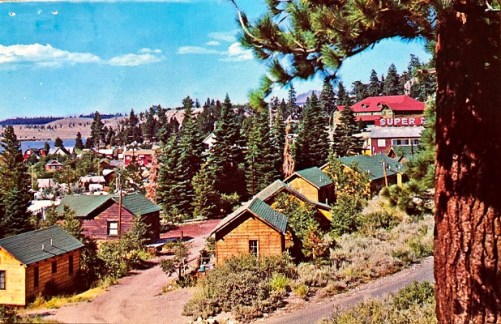
Cherokee Lodge, June Lake, CA
La Fierabrosa: A Lyndy Martinez Story, Part-14
Link to Part-1: La Fierabrosa Part-1
Lyndy Life Tip # 167: Just because an item is touted as being “new and improved” doesn’t mean it’s any better than the old version.
Something was inherently cowboy-ish in the way Julia Russell looked at other people. When she did, one felt as though she truly saw you. In contrast, persons in the city were able to look right through you as if you were Casper the friendly ghost.
Russ bent forward at the hips. Positioning her nose one centimeter from the sheet of paper and squinting, her face took on a look of bewilderment as she scanned the text. “Actually, someone deposited that thing-a-ma-bob under my wiper blades while I used the ladies can at the truck stop,” she explained.
If this were all theatre, Russ was doing a commendable job of pretending to read it for the very first time. Straightening her back, she added, “I have never heard of nor been to that particular event.” With her swiss army knife Russ popped the cap from a beer and took a swig. “Sounds like a hoot of a time though.”
“I see,” said Lyndy, lowering the flier.
Waiter, check please.
“Miss Martinez, might you be accusing me of something in a roundabout way?” This time, Russ’s voice had lost all cheeriness. And it was practically universal that older adults only addressed you by the terms “miss” and “mister” when they were agitated.
Russ waved her beer bottle toward the open range, which hugged the roadbed on both sides. “Do you really think I’m stealing cows out here, even though you’ve seen my ride?”
Lyndy backed away, feeling anxious and ashamed. She pretended to be interested in the many bumper stickers on the CJ-7. It was time to make for the exits.
“Russ, if I ever needed to find you again, where would I have to look?” she demanded.
Russ directed her thumb west. “Gotta get back to my home in Norco. Husband probably thinks I’m dead, organized a search party, and hasn’t taken out the garbage since I’ve been missing.” Russ shrugged her shoulders. “Sure ya don’t want a beer?”
Who wouldn’t want a cold brew on day like this?
There were two brightly colored bumper stickers standing out amongst the others. The first read: Let Freedom Ring, 1776 – 1976; the other: Study the Past.
“Thanks for offering, but really I’m good,” said The Spitfire, patting her stomach around the beltline. What a lie.
Lyndy had seen her share of decals celebrating the bicentennial, but never one for history buffs—though the concepts went hand in hand.
As she drove away at needlessly slow speed, Lyndy observed Russ in her rearview, using her eyes and not turning her head. Russ was shading the precious camera with a canvas tarp, as she worked on changing out film. You only got a max of 12 exposures for a whole roll of 120 film; only artistic types or otherwise obsessive people bothered with those.
“Damn,” Lyndy whispered under her breath. Russ was pretty helpful on information. “What idiot steals a cow anyway? Why not rob any corner liquor store and call it day? Takes less effort.”
You know what the real problem with human aging is? There are no new privileges gained between 25, when you’re finally allowed to rent a car, and 55, when you start getting those senior discounts. It leaves a gap of 30 years with essentially nothing positive to look forward to. So how about these novel ideas: When you reach your thirtieth birthday, you get to cut in line at grocery stores and amusement parks. When make it to 35, you’re legally allowed to ignore and set aside one speeding ticket per year. When you reach 40, you get to use those emergency exit slides once a plane taxis to the gate, so you don’t have to wait for all the bozos who take forever to move out of the way.
Lyndy exited I-40 at Essex road, twisting her wheel to the right for the Providence Mountains and Mitchell’s Cave. Except she was aiming for the more obscure JBR ranch headquarters.
Beneath a line of classic western mesas, the collection of one story ranch buildings blended well with surroundings. The only reliable way to identify them was by searching the horizon for wispy clouds of dust drifting skyward from the corrals, places where horses were trained and cows branded the old-fashioned way; perhaps the only way.
Lyndy navigated the unpaved access roads, her tailbone hammered by a combination of shoddy suspension and washboard bumps. She was thirsty, tired and in a lousy mood. Mind you, this whole expedition was doing nothing to help Chan’s case.
Why again was she putting herself through it? Another hour of driving would bring her to The Vanishing Point roadhouse, where she could slouch in an air-conditioned booth and suck on Herradura—all while Catherine waited on her in a cornflower blue uniform.
Perhaps it was time to state the obvious fact; what she really wanted from this young man was neither cash payment, nor a diverting mystery; it was elemental. But he was acting blind to her affection. The Spitfire had to conclude she was not his type, or he simply wasn’t into girls at all.
Most outsiders, but especially the tourists, were unwelcome here. The JBR existed as a place of serious business, not a museum. Male energy ruled. The Spitfire’s normal approach was to seem focused as a laser beam, or downright aloof: “Give me what I want and I’ll leave.”
Except this time, she had to let her eyes wander, allowing them fall on each and every mode of transport. It wasn’t about Internationals, almost any make could be the one she was searching for. Beat up as they were, everything she studied had the same problem. They each had matching hubcaps or wheel covers, equipped with standard width axles.
She stopped the burgundy Jeep alongside a corral fence, where the commotion seemed to be centered. Lyndy waved excitedly at two cowboys. These ranch hands knew her only in passing, but nodded in recognition, certainly having heard stories.
Lyndy ditched the blue hat, applying lipstick and brushing out her hair. Her clothes were filthy. Nothing would compensate for her outfit, but she would try. At least the rugged cowboys were unlikely to notice her shabby appearance.
With a measure of resolve, Lyndy marched herself to the fence and hopped up to perch on the middle of three parallel boards, gripping the top-most with her fingers.
A rider on horseback was concentrating, paying no attention to new arrivals. His palomino horse was being trained to work with a calf. Its nostrils were flaring, as it breathed heavy from exertion. Each time the animal cut right or left, the young horse was supposed to block its path, as the rider was commanding. From the boisterous laughter, Lyndy could tell it wasn’t going well. Also pacing the corral, a border collie kept barking, seemingly mocking the horse for mistake after mistake.
Lyndy shouted across to one of the men, asking for the location of Ted Crawford. Wordlessly, the man tapped his arm, pointed further up the valley, flashing two fingers from his gloved hand. The latter indicated mileage. As expected, funny looks were exchanged. Ted was likely in for a round of ribbing later at mealtime. But at least he was still here, not having left for another opportunity.
Water for the ranch was sourced mostly from underground aquafers. Lyndy found Ted at one of the main pumping stations, marked by two galvanized metal cisterns on wooden platforms, and a rustic windmill. Nearby was a twenty-foot long cattle trough, green with algae, but depleted.
Ted was straining with a giant pipe wrench, leveraging with both arms. All the muscles in his forearms were flexing, the veins enlarged. Perspiration soaked the front of his shirt, stretching down to his belt buckle. Ted’s favorite horse, a mare named Gilda, was tied loosely to a nearby post. Where shoots of green grass were watered by the leaky pipe, Gilda had her head down, searching for something edible to graze on.
The Spitfire parked several yards away. Before interrupting, she leaned against the front fender shielding her eyes; she wanted to think, and down a Tab at the same time. Long before she knew his name, Lyndy had seen Ted Crawford digging a ditch beside the roadway, with only a pickaxe, in 110-degree weather, hotter than this day. At the same time, one of his lazy colleagues was taking a nap in the shade.
He had no hat on his head, Ted’s brown hair smoothed down by sweat. Lyndy quickly scanned the scene, locating the Stetson dangling from a valve handle. That was one test of a real cowboy; any danger of a hat getting dirty or trampled by stock, and they simply stashed it in some safe location. Kinda defeated the purpose. But it was worrisome too, given the way a desert rat like Russ looked now.
Pausing to catch his breath, Ted finally turned his attention to The Spitfire. Perhaps he’d been thinking too.
“I just don’t know how you can drink them things,” he remarked. “Taste like 30-weight motor oil with fizz.”
Lyndy glanced down and crushed her empty can of pop. “So, I have one question,” she replied with a coy smile.
“Go right ahead miss.”
“Does anybody really like sloppy joes? Or is it possible we’re experiencing some mass societal delusion, brought on by TV commercials hocking worthless tomato paste?”
Ted couldn’t help but chuckle, even though his expression indicated frustration. He shook his head at the ground.
“What? Am I right?” asked Lyndy.
“Thought you were gonna say something profound. You realize we got a real nasty clog in here somewhere?” Ted pointed to the metal pipe.
Boy, you can say that again.
Lyndy pushed back her bangs. “Hey, I thought you got fired?”
“I’m on suspension without pay. Maybe I stretched the truth.”
Lyndy raised her arms in disbelief. “Wait, you’re doing work and ain’t bein’ paid?”
Ted shrugged. “I get bored easy.”
“Oh god.” Now, Lyndy was doing the head shaking. “Look dude, I worked on your case all today, as promised.”
Ted’s face perked up, hopeful.
“But I didn’t get anywhere,” Lyndy added gently. “As a matter of fact, I got very stuck. One of your cows tried to kill me. Then I accused somebody of being the black hat cattle rustler, but I know I was wrong. I felt stupid as the day is long, and they probably hate me. But I found one thing out, the hubcap you drew came from an International Scout. In fact, technically it’s a wheel cover.”
Ted sighed, his legs wobbly. He staggered up to Gilda’s side and grabbed the reins for support. “Startin to think I might have to break down and pack my shit. You know, hit the road and maybe look for another job in a different town—hopefully somewhere nobody will recognize me.”
Gilda started nuzzling up against Lyndy’s shirt, checking the pockets.
In response, Lyndy set her hands-on Gilda’s muzzle, lightly stroking it. “Man, this place would go to hell in a handcart if you left.”
“I bet that’s an exaggeration,” replied Ted. “But I appreciate your sentiments.”
“Sure, you don’t need any money?” Lyndy pointed to the Jeep, and her purse.
“No, I’ll be okay.” Ted lifted his shirt, dabbing his forehead to soak up the sweat. “Did you know my dad is a heart surgeon? Can you believe that?”
“No,” said Lyndy, genuinely surprised.
“He disowned me. I’ve let him down more times than I can count.” Ted stared to the east.
“Please don’t give up. Not yet,” argued Lyndy. “Trust me. I’ll figure it out.” Lyndy pushed up her sleeves, stomping gingerly to the wrench. It was still jammed in the same position on the steel water pipe. She tested her weight against it, and of course it didn’t budge. She tried pushing on it with her butt, but that didn’t work either. So, she twisted back forward. “I mean, I get fired practically every week from my job at Chan’s. And I must have done something to let my parents down, because they dropped me like a hot potato when I was a baby.” Lyndy pushed until her feet slid away like a cartoon, and she was leaning forward on a 20-degree angle from the ground. Her whole body was shaking from holding the awkward position.
Ted watched with his fingers laced behind his head. He knew it wasn’t going to move.
Looking backward over one shoulder Lyndy cried, “Let’s try this together. I need real muscle. Put yer hands over here.”
“You’re trying to nail Jello to a tree, Lyn.”
“No. This will work.”
“I have a better idea.” Ted smiled and pointed to Gilda. “I think she likes you.”
Lyndy turned to face Ted, raising both hands in protest. “Me on Gilda? Not a chance!”
Ted grabbed hold of Gilda’s reins, while leaning against one of the cisterns. He coaxed her closer to Lyndy.
“Lyndy doesn’t ride horses,” she added.
“Why not?”
“I’m too old to learn to ride,” Lyndy argued.
Gilda snorted, almost as though she knew what topic the humans were discussing.
“You mean you’ve never ridden a horse? How is that possible? And Lyn, we’re pretty much the same age.”
Lyndy frowned, embarrassed of the truth, fearing she’d fallen a notch or two in Ted’s eyes.
“Not even at a county fair, on one of them kiddie rodeo circles?”
“Nope.”
“Well you’re never too old to learn to ride a horse,” he asserted.
“That sounds like something out of a fortune cookie.”
“Well, the greatest thing bout riding a horse is how tall it makes ya feel. Your mind clears as you see everything from a new perspective.” Even in this weather, working his ass off, Ted’s blue eyes shone with youthful verve.
“Not interested.”
Ted grinned at the reluctance, holding his hand level and 3 feet off the ground. “Man, I remember one time I seen a five-year-old Navajo girl—she couldn’t even use a saddle cause she was too small—but she grabbed a horse’s mane and somehow pulled herself up. I mean this was a full-sized paint gelding, much larger than Gilda. Didn’t have no bridle or nothin. And that little girl could control an animal 25 times her weight, as well or better than any cowboy I ever knew.”
“Thanks, but I’d rather drive places,” said Lyndy. She stuck the sunglasses on her nose, preparing to leave.
“Look. How can I trust you, if you can’t even trust me,” said Ted.
It was a fair point. Lyndy’s sharp tongue failed her.
Suddenly, as if timed to the silence, a most precious resource came shooting forth from the end of the rusty pipe. A fountain of pure clean water sparkled in the sunlight.
“There you go,” said Lyndy. “Finally.”
“What the hell did you do?” asked Ted in disbelief. He went rushing over to check on things, putting his head near level with the trough. He stuck a cupped hand in the flow and sipped from it, as though checking whether it was truly water, and not some mystery substance.
Feeling smug, Lyndy shrugged and smiled. “Nothin,” she said, after slapping her hands together. And she knew she hadn’t done anything; it was coincidence.
A moment later Gilda trotted over, testing the water herself.
Lyndy walked off to retrieve Ted’s hat.
“Hat’s work better on yer head,” she scolded. “And I ain’t done with this case yet. Gotta get back to town, but I’ll definitely update you tomorrow.”
“Fair enough,” muttered Ted.
Minutes later …
Cracks of thunder were piercing the thick, humid air. As Lyndy drove at top speed to Barstow, crosswinds continued to strengthen; it was those same storms which earlier darkened the western skyline.
Most any day, such a cleansing rain would feel welcome. But in addition to mega-size droplets, the tempest brought with it an abrasive blow-sand.
In the open top Lyndy was suffering; even through sunglasses she squinted, keeping her eyelids as slit-like as possible. As soon as there was an opportunity, Lyndy pulled off and into a lonely rest stop at Newberry Springs. Not another soul was there.
She took shelter beneath the brick awning, pulling her shirt up to cover her nose and mouth. Anytime she tried to leave, her shirt and hair was battered all around, putting strain on her scalp. She might have entered the ladies room, but the smell of those pit toilets was overwhelming, so she huddled in a corner.
In a few minutes she crouched down on the steps and started talking to herself, her words drowned out by the storm. “Come on, now would it have killed you to say yes to Ted? Could have told him you’d ride the horse if he agreed to bring you to the damn party.” But the opportunity was lost.
Sounds of small children laughing roused Lyndy from her funk. A Hispanic family had stopped their camper van so they could all use the facilities at the rest stop. The kids thought the howling wind was fun. It had calmed somewhat, but they were laughing at the blowing sand too, holding up beach towels like pirate flags.
“God, I used to be like that,” thought Lyndy.
One person’s life-threatening event was nothing but a trifling inconvenience to another, or a novelty. Perhaps she was taking life too seriously.
The Spitfire decided she should hit the road again.
By the time she pulled into Barstow proper, it was late in the day and some of the street lamps were turning on. As she angled onto main, Lyndy noticed a fervor had overtaken the business district. Stores were emptying out, closed signs going up. Folks were diverting all cars off the street. Lyndy was forced to park the Jeep half in the road and half on the sidewalk. The atmosphere was riot like.
Lyndy had never seen ordinary citizens drop everything and start running en-masse, certainly not in Barstow. Something extraordinary was about to go down, and having been in the backcountry all day, she was caught unaware. Still several blocks distant from Chan’s, there was no way to get to the office except by foot.
For a moment, Lyndy pondered if there was some town celebration she had not heard about or else ignored. Quickly she dismissed the possibility, since it seemed so haphazard. This was closer to a UFO landing.
Curiosity killing her, Lyndy spotted a trucker who appeared to be rushing to the scene. She grabbed his shoulders and pleaded, “Hey, I just got here man. Please, what’s happening?”
He took off his hat and slapped his thigh. “Damn fool in a Datsun 280 challenged Tammy to a street race. She kept shrugging it off, but then he said American cars are trash—some junk like that—and it was on! Somebody said he’s a for-ner person. Gonna happen in like five minutes.” The man twisted and rushed away.
“Holy smokes!” thought Lyndy.
In a confusing herd of people chattering impatiently, men passing around wads of money—placing bets—women holding purses, dabbing cheeks with handkerchiefs, Lyndy stopped to think.
There were no law enforcement types to be seen. Normally, you’d spot a cop here or there, leaning on a sign post or black and white car perhaps; or at least a few Deputy Keynes wasting time eating sunflower seeds. Right now, nada.
Lyndy folded her arms, putting one finger on her lip. It felt like something more than your average small-town street race, moving into a category of diversionary tactic. And that was concerning. But she took a breath, then sprinted to see if she could catch a glimpse of the race.
Somehow, the puzzle pieces that never fit were moving closer, converging. Of course, Catherine would be in the middle—had to be.






 Aiden S Clarke, author