La Fierabrosa Part-23

IMG_2184Sml

White Mountains, AZ

La Fierabrosa: A Lyndy Martinez Story, Part-23

Link to Part-1La Fierabrosa Part-1

[Author’s Note: The next chapter (Part-24) will be the concluding chapter of La Fierabrosa. This chapter below (Part-23), should not be your introduction to Lyndy Martinez. Please, if you haven’t read any of this book, go back and start at one of the earlier chapters to get up to speed. Part-1 is as good a place as any. There is higher than average fighting/violence in this chapter, and if you start here there won’t be any context for it–although obviously Lyndy has been taken captive. Also, I’m personally not a fan of guns or fighting or violence. However, this is a western novel series depicting times nearly 5 decades ago, so again, it has to be taken in context. — ASC]

 Lyndy Life Tip #178: Like a lot of things in life (books are the cliché) you can never judge how nice a guitar is going to sound by outward looks alone. So if you find like a sad, beat up guitar in a pawn shop or corner thrift store—maybe it has a few cracks in the top—take a chance, pick it up and strum a few chords. Don’t be afraid to give it a quick tune. It might sound like garbage or it might possess the rich tones of an aged, but finely crafted instrument. You can never tell until you play it. Some of the ugliest guitars sound the sweetest.

“Fact is, Dale can be a big ol’ baby sometimes, but in the heat of battle he sure does whup some ass; I’ll give him credit. He’s pretty decent in the bedroom too,” commented Lyndy.

Wallach scowled at his pal, presumably for the inappropriate touching. “Wash out man, the woman bites like a rabid dog,” he warned.

A glint of stray light danced in her periphery. The captor with the long hair possessed a bone-handle trapping knife clipped to the inside of his boot. Hopefully Wallach’s numerous injuries had slowed him down some.

The metal restraints were already making her wrists sore, the constant feeling of mass palpable. “Dude, should you really be out of the hospital?” she inquired.

Apparently, I picked the wrong damn day to be wearing a tank top and skirt.

“Bitch, after we bury you, then we’re goin back for Deputy Keynes,” replied the fellow with the bad hair.

Wallach nodded to confirm. “Thank you for your concern about my health,” he added.

Overall, Matt seemed much less perturbed than she would have liked, as though he had a master plan laid out and was biding his time.

For once, The Spitfire could think of nothing clever to say in response. Yet she didn’t want to make it known she was about to take action. Turning to the long haired fellow, who continued holding onto and fondling her legs, she fake-smiled and said: “Now are you the type of guy who takes a girl out to dinner first?”

He smiled unnervingly.

Melinda means sweet.

The next hard bump they hit bounced them both. Lyndy used the opportunity to her advantage, kicking with both legs at the pointed gun. Though nowhere within reach, Wallach reflexively raised his arm upward and away from the path of her feet. Then leaning over, she bit the long haired fellow on his hand. Simultaneously, she grabbed for the knife handle in the boot, pinching the tip with her forefinger and thumb. Cupping her fingers around as best she could, she slashed the man across his inner thigh. It tore through his jeans like paper. It also must have pierced an artery, as blood spurted from the wound, spraying both her and Wallach in the face. It was hot and thick, and some of it got in her left eye making it even harder to see.

Due to the irritant, Wallach squinted his one good eye and rubbed his forearm rapidly up and down to clear his brow. His pistol landed in his lap. Meanwhile, the long haired dude kept bending forward, frantically grasping at Lyndy’s arms to restrain her. She continued thrusting however, managing to stick him again in the stomach; immediately he started screeching like an impaled animal. This time the blade was stiff to remove.

Disappointed by his partner, Wallach began reaching for Lyndy’s legs and backside to stop her himself. She continued to yank on the knife handle until finally her arms sprung back as it let go. Even with Wallach’s paws gripping her thighs she was able to stretch out sideways, snaking her arms through the cab window. Fully extended and reaching as far as one could, she plunged the tip of the knife into the base of the driver’s neck. The act pierced the man’s spine and his head slumped forward onto the wheel. She had to give up on retrieving the knife though; it was too far.

Lyndy twisted her torso to face Matt. For a handful of seconds, both were waiting to see what would occur next. During their scuffle the gun had been dropped in his lap, but Wallach used this time to pick it back up, again pointing it at her face.

Fun’s over Spitfire,” said Matt.

She felt a tiny bit concerned. Perhaps the truck would coast to a gentle stop. Then what? Thankfully a moment later the tires struck a rut, disrupting the steering components. The vehicle swayed violently, switching directions into a 45-degree turn and rising onto two wheels. Midway into the curve, all the windows burst as it began to roll multiple times.

The Spitfire had never experienced being stuffed into one of those large commercial clothes dryers, but this is what she imagined it was like: repeated slamming from the top to bottom like a pair of tennis shoes at full spin. Her legs and arms were at least secured close to her body, but the uncontrolled weight of the stabbed man kept smashing into her. The cacophony of crunching steel, breaking glass and probably bones too, was frightening.

As the truck settled on its side she began assessing her level of consciousness. Through a jagged opening where the back window used to be, she observed daylight and floating dust particles. The tailgate was open halfway, bowing in the middle like a tortilla chip. The dead man lay beside her, coated in blood and dirt. Grossed out, she attempted to push him away. Wallach was missing. Lyndy figured he’d been ejected.

Next, she surveyed the damage to herself. Red scrapes and cuts oozing coagulating blood had appeared all over Lyndy’s exposed skin. It was revolting to imagine what else was on her body, but there was nothing she could do. Her shoulder felt tender, possibly out of joint. She tried rotating each foot side-to-side. Her right ankle was sprained, or maybe worse, and her skull was aching badly. The upshot: she still had two legs and two working arms attached. Also she was alert. The way her arms and legs had been cuffed together likely helped lessen the injuries.

The Spitfire’s concern turned to locating Wallach. With the wreckage slanting on its side, teetering each time the weight shifted, everything was made even more awkward. The only way to escape was by squirming like an earthworm. Once her feet touched upon the tailgate, she sat up and lunged forward. Since there was no way to control her movements, she managed to somersault out through the opening, landing flat on her back in the dirt. The thud again took her breath away.

The Mojave sun was wicked bright. Reaching up, her left shoulder throbbing, Lyndy set her fingers upon the flared metal edge of the camper shell. Slowly and painfully, she steadied her weight and pulled herself to a standing position.

Her spine was beginning to hurt now. She recognized that feeling: deep tissue swelling from hard impact, pinching against the nerves.

Squinting and looking around, she realized she was standing on a dry lakebed in the midst of a desolate valley. Judging by the outline of the Sheep Hole Mountains at the horizon, it was Cadiz Valley.

In old California, the Spaniards would chain prisoner’s legs together with iron, knowing walking like this would be cumbersome, and running next to impossible.

Then she heard the buzzing of motors. Her eyes fixated upon several rising dust plumes; at first she thought they were whirlwinds, but no. It was vehicles converging on her location—not friends either. Her heart stopped.

“Shit,” she mouthed.

Turning back to the wreckage, she dropped to the ground and started patting along the edges. She was seeking Wallach’s pistol. Instead she noticed something out of place, a loop of fine leather. It was the skinny white strap protruding in dirt near the bumper. She grabbed onto the strap and the purse emerged from the sands, rescued.

Cue triumphant ranchera music.

Obviously her beloved purse was ruined, but adrenaline now coursed through her body like an electrical surge. This ragged thing was sent from heaven. Inverting it, the Beretta slipped into her fingers. She stuffed the contents of the purse into her shredded shirt, tossing away the remainder. Holding the gun between her knees she snapped the top back and forth, arming it.

The Spitfire popped up, taking four baby steps as all three cars were converging. Dust rose in massive clouds behind them. With both hands on the grip, she released the safety and squinted through the sight. In spite of all that was happening around, how close she had come to death already, how Wallach was somewhere nearby, how it was so hot she could hardly breathe, she centered herself. Inhaling and exhaling to the timing of a metronome, thinking only of this moment, she narrowed her vision to what she could see in the sightline. Anything else she would deal with later.

This would be a lot easier without eighteen pounds of metal dangling from my body.

At one hundred yards distance, finger resting on the trigger, she aimed for the farthest right car. All one could discern from afar was the nickel-plated grill, a white hood and the glinting windshield. She knew it was the International. She could see a boiling blur of heat, haze and glints, and this she aligned with the notch horizontally. Experience had taught her one important lesson: at this range she needed to point just a tad high, as the bullet would surely travel in a weak parabola, not a straight trajectory.

At the convergence of exhalation and inhalation with every function of her circulatory system coming to a halt, she squeezed the trigger five times. She barely registered the pops, but the casings were vivid in her periphery, soaring in an arc over her head.

What followed was a perceptible delay. Then with a poof, a large metal panel—what she recognized to be the hood—flipped up and was lost. There followed a yellow flash of flame, and smoke started rising from the engine bay. She knew she’d caught a fuel line. As that vehicle closed in on 50 yards, she was forced to turn her attention to the next.

The center car was approaching just as fast. It had a wide rectangular body with four round headlights that seemed too small for it. The roofline was so low it reminded her of a Lemans racer. But it had to be the Dodge, the one parked outside of Lester’s.

There was no time to overthink. Rotating her stance by 20 degrees, she focused on the Challenger. Aiming a bit over the roof, she squeezed the trigger twice. At that exact moment, she detected a large projectile at roughly her 3-oclock position, barreling in with the ferocity of a flaming meteorite. She catapulted using both feet, knowing she wouldn’t get far. Landing in a crouch position, she ducked her head as low as it would go.

Fully engulfed in flames, the Scout rammed at high velocity into the wreckage of the pickup truck, transferring enough momentum to send the entire heap spinning. An explosion followed, fueled by more gasoline and Lyndy shielded her face from the ball of flame and expanding heat. She could feel it singeing the hairs on her arms, as they protected her face.

No time to assess or take stock of what happened; the worst of the flame subsided and she stood up again. Smoke was beginning to swirl around, but the Challenger was visible through the haze, closing in at 30 yards. She only had a half-second to react, the same time a batter gets with a fastball. Raising and pointing the gun, she fired three more times, twice through the windshield and once at the wheel well. An arc-shaped ribbon of black rubber went flying—it was a tire blowing.

The wheels suddenly turned hard right and the Challenger went into a roll. It had been traveling at such high speed that it took to the air and flipped onto the roof, but continued twirling like a helicopter blade. The forward progress slowed.

Stepping forward and rotating her stance again, she prepared to shoot at the third car, a boring black sedan. With all the time that had elapsed she expected it would be an instant from running her over. Curiously, it was slowing. She squeezed the trigger, but no bang followed—only a dull lifeless click. She squeezed again and nothing. It was out of bullets, but she kept the Beretta pointed at the sedan.

The sedan continued to slow, its dust plume getting weaker, eventually coming to a full and complete stop. With the haze and smoke and glare, she could see only the outline of two figures inside, not much else. Her brain was on such heightened alert, The Spitfire couldn’t understand what was happening. What new form of attack was this? Why were they stopping? Then it struck her: those people were frightened.

A sense of power, at once gratifying and addictive, took hold of her spirit. She cherished that feeling.

After the sedan stopped, it reversed into a 3-point turn, then accelerated away. Lyndy lowered the gun.

“Learn to treat women better,” she whispered.

After waving it in the air a few times to let it cool, she shoved it behind her back, held in by the waistband of her skirt.

In the aftermath the playa became unexpectedly quiet, yet there was a dragging sound, something heavy sliding upon the soil. She turned 180 to follow the sound. It was Wallach, 20 yards distant, dragging himself along the lakebed mainly by one arm. He was moving in a southerly direction and gravely injured from the wreck, his hands clawing for grip.

Since the cuffs on her legs only allowed for an 8-inch stride, Lyndy waddled her way toward Wallach. It was a comical slow-motion foot chase lasting more than a minute. In the meantime, he kept glancing back at her, fearful, but uttering no sounds.

Matt must have known he was certain to lose. Silly, but he wouldn’t give up. He kept struggling along dragging his now useless legs—probably suffering from the same swelling condition she was.

Along her path Lyndy noticed a heavy stone, coarse on three of the four sides, like a broken chunk of concrete left mired in the lakebed. She paused, seeing if she could lift it. It hurt to bend her back. The stone wasn’t light, but it was doable as a bicep curl. The biggest problem was her arms being so close together in the cuffs. She continued on, slower now, weighted down by the rock.

As she caught up to Wallach he paused, looking up at her from the ground. There was anger in his eyes. She lifted the rock high over her head and he shielded his face from the sun.

“Mr. Wallach, to quote a boyfriend of  mine, I have grown tired of this game we’re having,” Lyndy announced, still supporting the heavy rock. “But first, I do want to tell you something. I’ve been noodling it all week. Ya know what still bugs me about Ms. Dixon, the Warden at Pinegate Youth Detention Camp?”

There was an extended stretch of silence, Wallach staring back dumbly and breathing audibly. Her skirt was flapping lightly in the air.

“If she’d only treated everyone the same, ya know equally rotten, I would have forgotten about her by now—not let it ruffle my feathers—forgiven and moved on. But that’s not how it was. She treated everyone bad and Mexicans worse. Can you believe that? She had a hierarchy to her hate. Why did she hate me more than the other wayward girls? You will never know how much that affected me.”

Wordlessly, Wallach shook his head, unable or unwilling to answer.


Dusting off her hands, Lyndy chose South, a direction as good as any on this playa, and continued waddling. A slow and brutal hike awaited. In front of her, a floating visage of Mr Chan popped into view like a genie from a bottle, and she could hear him saying, “Melinda, it will be okay, at least it’s a dry heat. Huh. Huh. Huh.”

“Damn you Chan,” she whispered, raising her fists. “Be quiet.”

She soon felt nauseous, having to stop, hang her head and dry hurl. When nothing came out, she jerked her head back. The horizon once again blurred. She wiped her brow with her forearms. The clothes were literally hanging off her body like rags, victims of the struggle and car accident. The dull pain in her backbone was increasing.

On her ankles and forearms, where the cuffs made contact with her skin, the surface was turning tender and raw. Huge purple bruises were forming. It was misery and there was no way to reduce the tension, without ceasing progress. But she had to move; it was move or die.

In her mind she longed for that strange oasis at The Narrows. That was the place she wanted to go exploring with Ted. She would wear a nice summer dress perhaps. Ted could bring Gilda out. They could ride along together—share the saddle a stretch. Lyndy would wear sandals, slipping them off to dip her bare toes in the refreshing waters. Ted would open up his sketchbook; do another portrait of her.

The fantasy helped her keep moving, but the pain in her back was getting much worse. It was a pinching sensation, making her vertebra feel like they were fusing.

After an hour’s time, Lyndy found she could go no further without a rest. There was simply no choice. She collapsed into a praying pose. Lowering her forehead, she let it contact the silty ground, her hair falling around. Once down, she rolled onto her side. She resolved to shut her eyes, only for a bit—a few minutes relief. After a brief nap she would rise again, then keep moving. Just keep moving.
 

La Fierabrosa Part-22

IMG_2177Sml

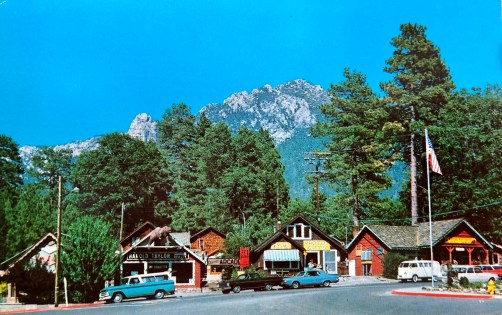
Idyllwild, CA 1970s

La Fierabrosa: A Lyndy Martinez Story, Part-22

Link to Part-1La Fierabrosa Part-1

Lyndy Life Tip #177: If you find yourself living in a single-wide trailer, or really any house under 1000 square feet, never install a cuckoo clock.

Ted grunted as he worked to fasten the last few bolts securing the oil pan to the engine base. When the task was complete he passed the wrench back to Lyndy, then scooted his way out into the open. He could see she was anxiously awaiting an answer.

“Look, I promise I’m a cheap date. Except I do tend to eat your fries a lot,” joked Lyndy.

Ted’s hazel eyes appeared sympathetic, and his voice took on a gentle but serious tone. “It ain’t somebody else Lyn. For one thing, Kyle Ellis told me you were his girlfriend—that you two were goin steady this whole time—and kept threatening me to back off. He was rude about it.”

“Kyle can jump in a lake!” interrupted The Spitfire.

Ted smiled, reaching for a shop rag to wipe greenish oil from his fingertips. “I gathered that.”

“He slept with Catherine.”

Ted’s eyebrows perked up, but he went on, “Another thing, Deputy Keynes is super-protective whenever your name comes up. I hear you two were engaged one time. And anyway, I guess I was afraid cause you have … a reputation.”

Lyndy gave an appearance of confusion.

Ted gripped onto the bumper, then rose to a standing position. “… ya know, for leaving destruction in your wake.”

Lyndy nodded, backing up against the workbench, folding her arms. A genuine feeling of regret overcame her. “I get that sometimes I come on a little too strong. But I promise I won’t be my normal self—like when I’m out doin my job for Chan. Contrary to popular belief, I know how to behave like a lady.”

Ted shook his head. “It’s not that I want you to change. Please Lyn, you don’t need to act differn’t around me. My answer is yes.”

Lyndy’s eyes lit up. “What do you mean by yes?”

“Yes, of course I’ll take you to the party. Just wear yer favorite outfit. What you have on is nice.” Ted smiled and pointed to his truck. “Plus, I’m optimistic I can pick you up.”

“Groovy.”

Going down to one knee, Ted began gathering up any stray tools and remaining hardware. Lyndy swiftly followed suit, kneeling beside to help. She didn’t care if her clothes were getting dirty or her knees were getting smudged by grease. “So Ted, let’s say something sorta bad were to happen to me. You know, like someone tried to hurt me and I had to defend myself. What would you think of me then?”

“I thought everyone was afraid of you?” mused Ted.

“Normal folks are.”

“Well, I know you’re a fighter. I’d say you have a right to defend yourself.”

“I’m more of a wrestler.”

“I could see that.” Ted looked over and their eyes met.

“Okay, cause I’m pretty sure somebody evil will try something. This isn’t like the other times, when Mr. Chan sent some villain back to jail and they made a bunch of false threats to save face. It’s not gonna be a TV show private eye caper either, where I bonk someone on the head and they flop over. It could get very bloody.”

They stood up together, Ted in front and Lyndy resting her back against the workbench.

“Lyn, did you know my dad is a heart surgeon?”

“I didn’t.”

“It’s a fact. He warned me I was throwing my life away coming out here; he knows I like the outdoor jobs better, but he said one morning I was gonna wake up and realize I had squandered my youth, worked my body too hard, and it was too late to go to medical school. Then where would I be? But I don’t ever want to be a doctor Lyn. I just wanna work around horses.”

Lyndy nodded to Ted in understanding.

“Probably the same for you,” he added.

They were so close their foreheads were almost touching. She could feel his hot breath lightly on her cheeks, and his skin ruffling her hair.

“I uh, … , don’t think anyone in my family wanted me to become what I am, especially my brother,” whispered Lyndy.

“Become what?”

“You know … The Spitfire.”

“Well I’m proud of you,” asserted Ted. “I promise to keep sticking up for you. Don’t ever worry about that.”

Ted curved his hands over Lyndy’s hips and under the tails of her shirt, his strong fingers gripping bare skin in places. Effortlessly, he lifted her to a seated position on the workbench. Lyndy tilted her chin down to keep her eyes focused squarely on him. Then Ted unsnapped the lowest button of her shirt, allowing him to slide his warm dirty hands behind the lowest part of her back, clutching her, as she leaned forward to give him a kiss. In between their lips meeting, Lyndy whispered, “God, I feel pretty around you.”


The next morning …

The pink box of hot glazed doughnuts had been calling to her from the passenger seat, but she hadn’t touched a single one. With her right hand she kept it from tipping on its side in sharp corners, having selected the varieties Chan most preferred. Now, it held her best hope of making amends with her boss.

She came in through the front, as the chain of little bells clinked. With a puffed chest and feeling smug, she set the box into position atop the filing cabinet.

Chan was smoking a cigar and scribbling with a pen. An inch tall stack of papers occupied the half-circle of clear desk space in front of him. A partial bandage covered the rear portion of his balding head. On the black and white TV, a rerun of Andy Griffith blared.

He hadn’t bothered to look up. Just to see if he was paying attention, The Spitfire did an impromptu pirouette while she crossed the room, then slumped into the wood client’s chair, nearest the desk. She was grinning broadly. Chan still did not look up.

The Spitfire rotated 90 degrees, using one arm of the chair as a backrest, the other for her legs. He always disliked that move.

“Ever hear of color television?” she mocked, digging in her purse for the hairbrush.

Suddenly he reached for the TV control, switching it off. The next instant he swiped all the papers to one side, apparently having completed the job. “Yes, I hear of it,” he grumbled, dabbing the end of the cigar into a green glass ashtray.

Looking over her shoulder she said, “Wanna hear a fun fact?”

“No,” replied Chan.

“Too bad. The name Melinda means sweet, like honey.”

Chan exhaled and blinked, but otherwise showed no expression.

“Wanna hear another fun fact?”

“No, definitely not,” said Chan. His eyes darted, as he examined her up and down with a frown.

“Later today, I’m going to a place that will wax your body,” she said, folding her arms. “It’s quicker with fewer side effects than a razor, but I’m told it hurts like the dickens.”

Chan held up a hand, laying his fat cigar in one of the notches on the ash tray. “Okay Melinda, please do not share any more fun facts. I am all good for today.” Pushing himself up by the arms of the squeaky chair, he sauntered over to the file cabinet. Using a white cocktail napkin, he stuck his hand inside the pink box to retrieve a chocolate glazed.

“Come on Chan, are you ever gonna find it in your heart to forgive me? It isn’t healthy to hold a grudge ya know.” Lyndy sighed. “Am I fired yet?”

“Sadly not. Somehow we are still in business … unfortunately.” Chan took a bite out of his doughnut. “The Albrights paid us for running off the cattle thieves.”

“Far out!” said Lyndy, jumping up.

After a hard swallow Chan added, “And then there was a reward for information leading to the arrest or capture of Evan P. Stone. Sheriff Jackson says we are eligible to receive the funds; they cut a check. Should at least break even on that ordeal, considering we lost the bond monies. In addition, Mr. Lovelace paid for the 40 hours of your time.”

Lyndy clapped her hands excitedly, skipping her way back to the doughnut box and swinging her purse. She selected a custard filled one for herself. “I think I’ve earned this,” commented Lyndy.

Chan cleared his throat. “So I mention your constant whining about car troubles to Lovelace.”

“You did?” said Lyndy, the words garbled by a mouth full of sugar and fried dough.

“He gave me this business card. You ever hear of a car builder by name of Darrel Ward?”

Lyndy nodded excitedly.

“Says Ward’s Auto Racing.”

Lyndy laughed.

“Mr. Lovelace give you a firm budget of 8k.”

“Holy crap!” Lyndy exclaimed.

“Huh. Huh. Huh,” laughed Chan.


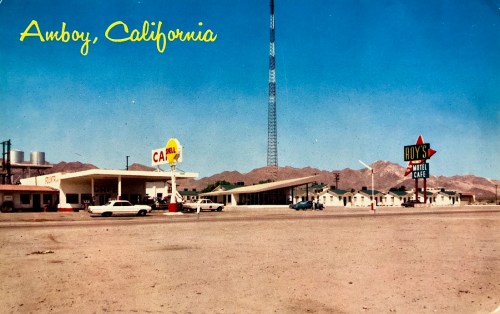
Exiting the Amboy post office, Lyndy was in such a fantastic mood she forgot all about her troubles for the moment. When he attacked, she’d expected Wallach to bring along a handful of cronies. Instead he brought a small army.

She had a fist full of junk mail rolled up in her hand. From the right side someone swung a two-by-four, nailing her in the stomach. She doubled over, the mail went flying. From her left, another man ripped the purse from her shoulder, snapping the strap off at the loop and straining her neck muscles. She caught a glimpse of four parked vehicles, in addition to the Jeep, before a third person dropped a cotton sack over her head—making a FWOOP sound—then cinched it tight.

In that brief instant she recognized the outline of the International Scout, and a white pickup truck with camper shell beside. Amboy was a sleepy place. When she arrived, the parking lot had been deserted.

She always knew this day may come, and her time on earth would end abruptly. Hell, she’d had a lot of lucky breaks til now. The shocking thing was how long it took to finally get someone mad enough to kill.

Inside her purse, tucked underneath the flap, the damn Beretta was fully loaded. If she’d anticipated any trouble, she would have had it out and drawn. But now, in the hands of Wallach’s gang, it might as well be in Timbuktu.

That’s the way it goes some days.

Lifting her by the armpits, two men slammed Lyndy to the ground. The force knocked all the air from her lungs. She had forfeited her chance to scream.

The same two men pinned her down, using their knees and elbows to hold her still, while a third attached cuffs to Lyndy’s wrists and ankles. The ankle cuffs only allowed 8-inches of slack, the ones on her wrists even less. She felt like a penguin out of water.

Where do you even buy ankle cuffs? Prison-mart?

After this she could hear engines firing, that of a modern pickup, then an unrefined tractor-like thumping of the International.

A moment later they carried her by the legs and armpits, swung her in the air and tossed her body like a laundry sack, into the back of the modern camper shell pickup. She grunted from impact. She knew it was that car since the metal floor undulated, as a truck bed would.

Someone shouted, “Hurry up!”, and she heard the sound of the engines revving.

The Spitfire was intensely curious; where could they be taking her and what variety of unpleasantness awaited? And if Wallach were here among them, what would he look like now? The healthy Dale Keynes was one hell of a bare-knuckle fighter.

She felt the truck lurch, commencing a steady acceleration onto the highway. Soon they were zooming along the lumpy pavement of 66. She tried to keep track of time passing, but it was difficult to focus with a bag over one’s head. It seemed like fifteen minutes they were on the mother road.

Then with a whoosh, they swerved off highway, this time onto a badly wash-boarded dirt trail. They were traveling at an unsafe speed and the truck had worn shocks, so the ride and handling was atrocious. It felt as though her butt was resting on a paint shaker, her brain hurting from being jostled so hard. Plus with such a terrible suspension, they could easily overturn. This violent bouncing continued for another five minutes, before mercifully easing some. They continued to speed, but the dirt trail became smoother, the surface turning from loose rock to sand.

All in all, she estimated they traveled 20 or more miles from town. One need not venture even that far to get to some pretty remote places, spots where no one would find your body for years, if ever.

At last, the drawstring was uncinched and the bag yanked from her head. Her bangs covered over half her field of vision, and she had no way to shift the hair other than exhaling. But across from her sat a clean shaven man, no hair on his head, with a horrid appearance. At first, she couldn’t connect who the freak show monster was. Which one of the goons from the bar was this dude?

The newly bald man had fissure-like cuts above his eyes and across one cheek. Outlining the cuts were needle marks of still healing sutures. One of his eyes was purple, and mostly swollen shut. His jawline was bumpy with uneven swelling, and strangest thing of all was how steel wires had been looped up and down diagonally, contrasting with a few remaining white teeth. The metal fogged as he breathed. She couldn’t recall seeing a person like this who wasn’t in critical condition.

There was no mistaking; it had to be Matt.

Next to him was a younger guy, an assistant,—looking just out of prison release or jail—with filthy black hair clumping together into never-washed dreads. He was gripping Lyndy’s legs at the ankle bone, touching the smooth skin like he was petting a dog. It was the creepiest thing anyone had done to her in a long time. Desperately, she wanted to scoot backward, shy away, except there was no room.

For once, she wished Mr. Chan were here to bust heads.

The camper shell was made of fiberglass, left unpainted on the inside. Wind whistled in gaps between the body and the shell, bringing dust as well. Her back pressed firmly against the divider separating the truck cab and bed. Wallach’s back was resting on the tailgate. In his hand he was casually gripping his favorite weapon, the stubby six-shooter from the billiard table. He raised it by five degrees to keep it leveled more at her chest.

Between the cab and the bed was a thin pane of plexiglass, with a sliding section. The sliding section was open six inches, presumably allowing the driver and Wallach to converse. Of all the situations she’d rehearsed in her head, this was not one of them.

She’d caught her breath; time to break the ice.

“Hey Wallach, nice Halloween mask,” Lyndy quipped. “But you can take it off now.”

I loss six theeth from that thy,” he hissed, which took her a moment to translate.

La Fierabrosa Part-21


IMG_2142Lrg

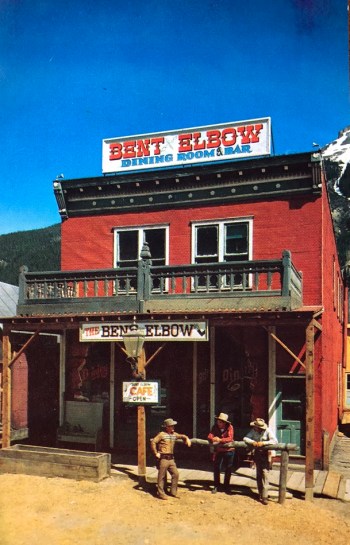
Blair Street, Silverton, CO

La Fierabrosa: A Lyndy Martinez Story, Part-21

Link to Part-1: La Fierabrosa Part-1

Lyndy Life Tip #175: The odds of a microwave actually cooking oatmeal, versus causing the oatmeal to explode into sticky food lava coating the interior, are about 50/50.

Granville Jackson wasn’t one for engaging in small talk; all at once it became clear what the sheriff was trying to tell her.

“Are you saying Matt Wallach checked out of the hospital?” asked The Spitfire.

“Nobody can find him,” Granville confirmed with a nod.

“Crapola,” mouthed Lyndy. She instinctively lowered her right arm, reaching to squeeze the fold of her leather purse. “Then he’s coming to kill me.”

“What makes you sure of that?”

“He believes I sent Dale Keynes to do my dirty work—which I didn’t. Last night I  ran into some wannabe bikers talkin’ trash at The Vanishing Point, and we had you know, an exchange of words. Thing is, Wallach used to have this window sign he was fond of,” Lyndy held up her fingers in the shape a rectangle. “It was like a racist-mantique; Dale stole it from the saloon and gave it to me. I threw it away though.”

You know how sometimes you give someone too much information at once.

Sheriff Jackson squinted, rubbing his eyes with his forefinger and thumb. “Oh,” was all he said.

“Sheriff, I’m telling you right now, there’s no reasoning with that asshole. If we cross paths I’m going to defend myself.”

“Miss Martinez, in my experience you are perfectly capable of defending yourself. Of all the people in this town, you are one of those I worry about the least,” he said, waving his hand dismissively. “And if you’d seen the condition he was in, I don’t think you’d be quite as worried.”

God I need a cigarette.

“What are your plans for apprehending Evan Stone?”

“I talked to somebody I know at the Marshall service. They can send a team. Their first available agent should arrive here later today. In the meantime, we’re putting in checkpoints on the roads…”

“Let me stop you there,” Lyndy interrupted. “I have a much better idea; we can do this faster together. We don’t need them.”

Gradually turning to face her way again, Granville folded his arms and raised one eyebrow. It was difficult to tell whether he was amused, or truly willing to hear out her plan.

“Think of the benefit if you handled this internally,” Lyndy continued. “You can take all the credit when it’s over. Just say you stormed up there and apprehended him. I don’t care what goes in an official report, or for that matter the newspaper.”

Granville took his time in answering. He’d been around the desert a long time, watched the town grow from a simple railroad depot with a few dirt streets, when county sheriffs were as likely to ride a horse as drive. He was already a deputy when Lyndy Martinez was in kindergarten, and had all the lines on his face to prove it. Then at last he pinched along the brim of his hat to adjust it, and replied, “this had better impress me.”


Brother Matt had warned of this very situation: whenever the police were engaged in a manhunt, there came many unorthodox negotiation tactics. Mother was known for her loyalty and stubbornness, but perhaps the law had somehow put the screws to her. It would have taken over-the-top threats, like the gas chamber for one of her sons. He expected at some point, she would want to see him—begging him to turn himself in. And now she was hiking up the dirt mining trail, struggling along with her arthritic hip. He had instructed her never to do this. But it would not be out of character for mother to disobey.

In her time, mother had been some kind of popular ballroom dancer, often blaming dance for ruining her joints; with mother, anything was possible. Now she despised all young women with what she deemed “athletic” bodies.

Matt had also warned of something far worse than a police manhunt. It was the treacherous bounty hunter they called La Fierabrosa; she’d been hired by The Lovelace Corporation to find him. Matt said he would take care of that problem personally, but so far Evan had not heard of her being dispatched. Only her foolish cop partner was down. Stopping this tenacious woman may require the same level of brutality.

It was a cool morning, with a smell of pine tar filling the air. Evan took a swig of cheap vodka from a metal flask, holding it out to his buddy the raven. The raven tilted its head and made a clicking sound, but didn’t take to wing. It was perched comfortably on a pine tree bough, several yards away, observing his activities. They’d spent many afternoons together, admiring this view.

Here’s a fun fact: as soon as they bend their knee joints, bird talons are naturally in a clenched position, meaning it takes physical effort to release their grip on a branch. That explains how they can fall asleep while gripping a tree limb.

If only that coal black bird could speak, the interesting stories it would reveal; certainly he had known every traveler in this section of the desert. Ravens were like a spectator of humankind, always trying to conjure a new way to profit from human wastefulness.

Evan was crouched on his favorite rock, using his knees to steady the rifle, while he ran the pipe cleaner up and down in the barrel. Dust particles coated everything. The gun would perform better, shoot straighter, if the inside rifling were kept clean. It was these spiral grooves created in the machining process, that helped the bullet stay true.

After another ten minutes had elapsed. Evan checked to see how much progress mother had made. She was now within a hundred yards of his rock, but she’d stopped hiking. She was standing still as a statue, maybe catching her breath. Her behavior was baffling. Refusing to speak, she kept her head shielded by the hood, like a veil, never glancing up. Out of reflex Evan pushed himself to an upright position, leaving the gun laying flat.

Then all at once, Evan Stone realized he’d made a fatal mistake. There was a pit in his stomach, as his chest muscles tightened.

The answer was obvious why mother had been acting so strangely, and he cursed his own stupidity. Quickly, he bent down to grab the rifle. He knew it wasn’t worth firing. Still, he was curious. What did this young woman actually look like? The way Matt described made her sound hard-looking, with a damaged masculine face.

Moving deliberately, Evan rested the stock against his shoulder, raising the sight to his eyeball. With the added magnification he could see her head clearly, and watch as she pushed aside the knitted hood. Studying her a moment, he was expecting her to draw the pistol, but her arms remained still. The look on her face was serious, even grim. When she blinked there was something familiar in her appearance—it was a surprise.

A shot rang out. The raven flew off in such a hurry, he lost two of his wing feathers. The black feathers twirled in the air, landing softly near to Evan. He felt a sharp pain in the center of his chest, causing him to drop his gun. Continuing to stand became unbearable, so he went down on his side.

As Evan lay dying, he thought about the face. He had seen a woman who looked like that girl once before, but where? Then he remembered; it was Ensenada. He was recovering from a wicked hangover that day, seated across from an ancient church. Someone had painted a mural on the otherwise white-washed adobe walls. The twenty-foot long scene depicted Jesus on the cross, both Marys to one side and winged angels all above. The angels were weeping. Instead of being generic white blonde figures like you’d see in the states, these angels had ethnic looking faces. One of the angels had the prettiest and kindest face he’d ever seen. Matt was a big liar, cause that angel looked very much like The Spitfire.

Unbeknownst to Evan, Sheriff Jackson had made a circuitous hike to an adjacent summit on the ridge. Through a spotting scope he watched Lyndy’s plan unfold. He saw Evan raise his gun. Knowing the sights were set on her, he was impressed by the bravery Lyndy showed while he took time to compose his own shot. The restraint was admirable.

Peeling off the scratchy, thrift-store wool sweater, Lyndy couldn’t help but feel sorry for Evan; he had a kid after all. By the same measure Dale Keynes had two kids. Evan’s biggest misfortune had been being born into the Wallach family tree.

Her sadness was short lived, because playing out in her mind were ten different grizzly scenarios describing how Matt Wallach might exact revenge.


Later that day …

A Reader’s Digest article she’d sampled in a grocery checkout line claimed lack of sleep was tied to short term memory loss. Right. Then it was a wonder Lyndy Martinez still knew her own damn name. Precious few ZZZ’s were now coming in ten minute spurts, and that was unfortunate. Passing through the land of clinically fatigued, she’d entered into walking zombie territory, with nervous breakdown not too far away.

Restlessly, The Spitfire kicked at the sheets and fluffed both her dime-store pillows, using unnecessary amounts of force. Her trailer was warm, but she refused to crack a window; someone might use that as an entry point. She’d chain-smoked so many menthol lights that it smelled like an old ladies bingo parlor. The stupid out of date calendar hung over her like a reminder of her rocky past.

She had the Beretta resting on the nightstand. When she needed to go pee, she took the gun with her to the toilet. She kept imagining non-existent car engines or armed ex-cons pushing through the weeds, sneaking up on the trailer. The only sounds making their way from the highway were typical, with the occasional stutter of a truck or the airhorn of a Santa Fe locomotive.

Maybe there was some truth in what Kyle Ellis said about this trailer. It was a sitting duck. Who didn’t know where she lived? After what must have been the hundredth repetition, she forced herself to quit staring out the windows.

As she went to open the fridge, she noticed the party invitation was still magneted in place; not that she was in a party kinda mood, but it could be an entertaining diversion. She still had no date and wasn’t keen on going alone—especially now. If luck was on her side, then Ted Crawford might not have a date yet either. She decided to swing by the ranch.

Time to go full Sadie Hawkins on this guy.

Even if he had a date, not like it was possible to embarrass oneself any further in the dating arena.

After taking a hot shower, Lyndy curled her hair, then pulled on tight-fitting cutoffs and a clean cowgirl shirt; as a final touch she added small silver earrings set with solitaire diamonds. Hopping in the C-J, she headed north to I-40, taking the east ramp to the turnoff for the JBR. Hopefully her attempt at a girl next door look would translate to winning him over.


Lyndy rolled to a stop alongside the main corrals. The hour was just prior to dinnertime. Most of the ranch hands were already filing in after a long day of work. The JBR owned one of those cast iron dinner bells roped to a post, but they only clanged it for kids and tourists.

A sweet aroma of beans and some variety of ham dish emanated from the cook tent. White smoke came pumping out the tin stack chimney, as a group of men were busy stuffing themselves, eating off paper plates on the picnic tables. In contrast to her normally voracious appetite, heavy chow was low on her list of desires. Feeling like a hunted animal took a lot of the pep out of you.

Trying to blend in here was impossible—her jeep, her big hair, her outfits and the purple lipstick. Lyndy killed time fidgeting in the driver’s seat, touching up her curls, pondering her next moves.

All these old cow pokes with grey mustaches and beards kept glancing up, pretending not to stare, but probably thinking, “there’s that Spitfire again, lookin for Mr. Crawford, the densest cowboy in the world who can’t tell when a girl is chasing him.”

Wonder how long before I get banned from this place too?

Lyndy scratched her cheek using the back of her nails. She didn’t yet see Ted or his green jalopy truck around. He was not among those at the tables, or in a line that extended out the entry of the mess tent. Maybe he decided not to go to the party. Or maybe Ted didn’t even like her, and that’s why their meetings were so awkward. In a moment or two, she would have asked one of the mustached cowboys standing in line for his whereabouts, but something else caught her eye. From her vantage, she could see the door to the single men’s bunkhouse had been left partially open by about 10 inches. The bunkhouse appeared empty.

Someone should really close that, in case a Mojave green tries to slither in.

Lyndy left the keys dangling in the column and jumped to ground level. Retrieving a pair of heels from behind the seat, she shoved one on each of her feet. After checking both directions for straggler boys, she proceeded briskly upslope to where the bunkhouse cabins were situated, then slipped in sideways through the door gap. As she guessed, the place was unoccupied. The interior smelled like a whiff of sweaty gym clothes covered over by aftershave; your typical bachelor abode. Yellow lightbulbs illuminated the spare décor. Its windows had only summer screens to keep out bugs, but no glass. To close them you unfurled a canvas flap. Distantly, the banter of young men laughing let her know dinner was in full swing.

She was able to locate Ted’s bunk by a sketch of Gilda pinned to the rail, and a stack of his mail sitting on an adjacent table, unread. Pinching at the corner of the mattress, she lifted it eight inches, supporting it with her left hand. After a quick glance over one shoulder, she started feeling around underneath. She was prepared to discover almost anything—cash and porno most likely—but instead found another sketchpad.

Jackpot.

Lyndy tugged the spiral-bound book free of the mattress’s grip. The paper was thick, having a raised bumpy texture you could feel. Setting it atop the unmade bed, she began to thumb through the pages.

Ted’s technique with a soft pencil was free form and splendid. The first page she paused at was a study of various cactus blooms, four to the sheet. Turning to the next she found sketches of stock horses, raised to work on cattle ranches and be herders. The horses were in action, hooves in air, muscles tense. One was being ridden by an authentic looking old cowboy.

Sheesh. I can hardly do a credible stick figure.

The next page showed a sketch of an old Colt pistol. Any one of these drawings Lyndy would have happily framed and displayed on her wall.

Flipping the page once more, Lyndy covered her mouth and gasped. The scene unmistakably portrayed herself, everything right down to the freckles across her nose, which she detested. She was riding atop a lovely paint horse, bareback through a prairie. But the most interesting part of the sketch was how he chose to depict her outfit: he dressed her as a sort of Latina princess, wearing a frilly outfit distinctive of northern Mexico—copper canyon perhaps. The way he’d drawn the shape of her figure was flattering, her thigh muscles tense, and her nose was pointed slightly aloof; perhaps that was a fair assessment. Around her hip and to the side was a gun hostler, decorated ornately with hammered silver. Overall she had no complaints about the sketch.

Then came a thump of boots on the wood stairs; someone was at the landing. Hastily she folded the book shut, flinging it back in place under the mattress.

A young cowboy pushed open the door, no older than 18, looking fresh out of his parent’s home. “Oh, scuse me. Sorry to startle you,” he said softly. “Can I  help you ma’m?” Rather than being suspicious of her activities, he sounded downright embarrassed to have intruded.

Lyndy cleared her throat. “I uh … was just checking to see if Ted was here.”

The boy tipped his hat down. “Not here. But I believe you’ll find him over at the auto shop, workin on his truck. Least that’s where I seen him about an hour ago.”

“Ah, thanks a bunch,” said Lyndy, heading for the exit.


Five minutes later …

A copper fan was whirring on the high-speed setting, pointed roughly in the direction of Ted’s work area. Two hanging bulbs shown from above. The auto shop was a simple wood barn walled in corrugated metal, with a non-running model-A pickup truck taking up about a third the space. The remaining portion was used to service whatever ranch vehicles were in need of a tune-up—most of them were.

Having strolled her way from the corrals, Lyndy kept her fingers shoved deep in her back pockets. Her heart felt suddenly recharged, as if she could have floated here. An urge to cause mischief was also on high, and needed to be suppressed.

Only Ted’s legs were visible, sticking out from underneath the front bumper of his truck, but one could tell he was sporting blue coveralls over his clothing.

The Spitfire snuck her way into the shop, tip-toeing. The floor was coated in pebbles, but her arrival was disguised by the noisy fan. Once she was near to his feet, she crouched down and said in a loud but seductive voice: “Howdy Ted, whatcha workin on?”

At first there was only crickets.

But in a few seconds he’d collected his thoughts. “Replacing an oil pan gasket,” replied Ted. “I’ve grown tired of pouring a new quart of oil in the engine every time I need to drive anywhere. It’s gettin expensive.” He scooted out from under the truck, holding a box-end wrench. There were grease marks on his cheeks and arms. All-in-all though, he looked pretty darn good in Lyndy’s eyes.

“You made up yer mind yet about that party?” asked Lyndy, still crouched at his level.

“About that,” said Ted with a grin. “Whole event got postponed cause the Parker’s are in trouble for the illegal street race.”

“I see,” said Lyndy, relieved and somewhat delighted by the turn of events.

“I hear deputy Keynes got shot by a fugitive, and you rescued him all by yourself. That true?”

“It is,” said Lyndy proudly, wiping her forearm across her head. “He couldn’t move, so I had to drag him like a mile-and-a-half to his car. Took most of the night.”

“I think he owes you one.”

Lyndy chuckled. “That jerk owes me like ten by now.”

Ted inhaled deeply. “Speaking of which. I believe I owe you for finding the cattle thieves. I’ve been given my old job back. Maybe we can work out a payment deal?”

Lyndy gestured with her hands. “Oh please, I forgot all about it. Worry not Mr. Crawford. Chan will hound Rob Albright for the money, if anything is owed.”

“I dunno how I feel about that,” said Ted, worming his way back under the truck.

Lyndy stood up, running her hand over the rough patinaed fenders as she paced between the truck and a work bench; she was hoping he noticed her shoes and ankles. “Ya know somethin Ted. I was thinking about our long-running friendship all day. There’s a reason I came over here…” Lyndy paused. She hadn’t rehearsed what exactly to say at this point, not expecting to make it this far.

Wait. How do you ask someone out again?

“Oh really,” said Ted, speaking from under the car.

“I guess I was wonderin if we should give this another chance—maybe we go more traditional this time. Take it slow.”

She could hear Ted straining to adjust something, a stuck bolt perhaps.

“Lyn, would you pass me that big flathead screwdriver?” he asked. Without needing to look, he pointed an index finger to a location on the workbench. Lyndy snatched up the tool for him and set it down in his waiting hand.

“Say do you need me to hold a flashlight?” asked Lyndy. “I can help.”

“No, I got this,” said Ted.

“Hey, is there something I did or said?” Lyndy inquired. “Or somebody else that interests you? Like uh, … you know how Catherine is totally gorgeous? She’s definitely prettier than I am.”

La Fierabrosa Part-20

IMG_1695Sml

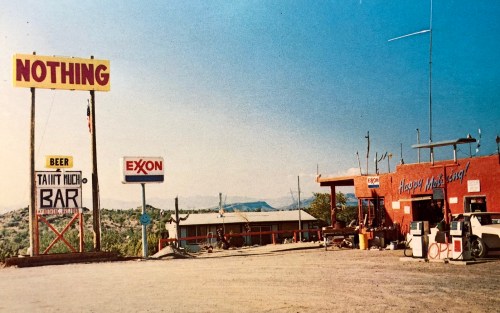
Nothing, AZ

La Fierabrosa: A Lyndy Martinez Story, Part-20

Link to Part-1: La Fierabrosa Part-1

Lyndy Life Tip #174: Better get used to it friend; as an adult you must learn to forgive others on a regular basis. Without complete forgiveness, your daily existence devolves to one punctuated by hatred and self-destructive behaviors. Even more-so if you happen to be female, as the burden is often greater.

This was his best chance to put an end to The Spitfire, exacting revenge for his brother’s beating. So then why had Evan not attempted another shot? Had it become it too difficult to see through the rifle scope?

As sensitive as a human eye is, combined star and zodiacal light are tremendously faint sources, suitable perhaps for slow walking on flat terrain, not much else.

The Spitfire struggled to discern the current time on her decorative watch, because the face and hands were both tinted the same reflective silver. She pictured a page from the Farmer’s Almanac, counting up days from full moon by touching her thumb to each finger. But she knew it must be past midnight, and the waning moon would eventually rise.

Suddenly her body convulsed, and she realized she was fighting off a case of the shivers. Tens of miles away, a semi-truck on the interstate applied engine breaking, making a distinct low sputtering sound.

Long before hydro-electricity and the spectacle of neon lights flooding the white man’s world, human eyes would have been better adapted. She felt sure of this. Crawling on bare hands and knees, Lyndy tapped her way to the water jugs. She was keen to avoid a patch of prickly-pear cactus, spreading beneath the canopy of the Pinyon Pine.

Remarkably, even with her bizarre limping gait, Mrs. Wallach had managed to transport a heaping stockpile for her son; his own little Drum Barracks. Returning to ex’s side, Lyndy placed her right hand in his palm and squeezed, hoping to gain his attention.

“Hey, you know what this place reminds me of?” whispered Lyndy.

“I’m afraid to ask,” groaned Dale.

Her heart rejoiced at finding him alert. The corners of her mouth couldn’t help but curl to an irreverent smile. “Do you remember when we were camping in the sierras, and I drank about 20 Tab colas, then chased it down with 5 shots of reposado … and I was bouncing off the tent walls? Then later I had to pee 15 times in a row as we were getting ready to sleep. And you were all angry cause I kept waking you up, unzipping our sleeping bag.”

Dale cringed, unnaturally flexing his tendons as he clawed at dirt.

“How do you feel now? Are you in a lot of pain? Do you want some water to sip? We’ve got plenty.” Lyndy made a mock rubbing motion on her stomach. “Wow. And for some odd reason I totally have a craving for one of those frozen toaster waffles—know what I’m talking about? The cheap ones at Slater-Bros.”

“Aaargh!” Dale lifted his head, twisting his torso and struggling to cough. “Oh god, Lyndy! Now is definitely not a time to make me laugh. Please cut it out.”

The soles of her feet were feeling unbearably gritty. By undoing miniature gold tinted buckles, she pried off the impractical shoes Rita Lovelace had gifted her. “Dang it. I can’t believe I wasted so much time painting my toenails,” she lamented.

Raising his voice and aiming a shaky finger, Dale scolded, “Did you really just ask me whether I’m in a lot of pain? God I hate you. Don’t you have anything better to do? This is insane.”

Comprende?” replied Lyndy, with a frown.

Dale lowered his head, grimacing and gritting his teeth. “Can you take a hint? Look at this arterial blood. It’s everywhere. The whole situation is hopeless. You cannot transport me and I’m glad. It doesn’t matter how tough you think you are, Lyn, I’m minutes from bleeding out. Let me die here in peace and quiet.” He paused to catch his breath.

From the quivering way he spoke, she could tell he was being sincere.

“I was actually thankful no one was going to come and rescue me. I was certain. And then, inexplicably, proof that the universe hates me, here you appear out of nowhere—it’s like some bad dream.”

Pinned to one of his side belt loops, Lyndy spotted the keys to the Bronco. She would need those, as her two-seater Jeep was impractical for moving an injured person.

“Dale, now is like the worst possible time for an existential crisis,” she asserted, poking his shoulder repeatedly. “At this point I will remind you I took a stupid community college cooking class because of you. I know how to make meatloaf ten different ways. That was after you voiced a sexist, chauvinistic comment how you wanted a wife who could cook dinner—makes me livid just thinking about it.”

“And your cooking is still rotten,” Dale interjected. Squinting his eyes, “… but for the record I do apologize. I know you mean well. Now go away!” He paused for a breath, as he was running out of air. “I just thought it might be nice if Miranda got some insurance money out of this, and I simply faded away.” Dale twisted his body, reaching down as if attempting to unbutton his holster.

Lyndy grabbed firmly ahold of his forearm. Using pursed lips, she exhaled hard to blow up her bangs.

“Hand me my gun, would you?” requested Dale.

“Sheesh! No way in hell,” replied Lyndy, blocking his hand. She could feel the tension release as his arm fell limp upon the sand. All the strength was leaving his body.

With the tails of her fancy shirt, she dabbed more sweat from Dale’s forehead.

“The valley is a radio dead zone. You have to get to the pass if you want to call dispatch,” Dale added. One could scarcely hear him now. He was slipping into unconsciousness.

“I know,” said Lyndy. She undid the clasp on the loop, pocketing the truck keys.

Then, brushing aside his straight brown hair, she leaned in for kiss, whispering: “Shhhh. I promise I will take care of this. I’m stronger than you think.”

For the moment, his chest continued to rise and fall, but she was beginning to detect a gurgling sound in his lungs.

Lyndy rocked back on her heels and rose up. Using the back of her hands, she wiped away dribbles of snot from her nose and moisture from eyes. Then she paused to prepare her mind, staring up at the hundreds of twinkling stars filling the sky, and a sawtooth outline of dark ridgetops. There were many tall boulders, and somewhere amongst them was a man desperate enough to shoot at a cop.

“I’m praying for you Dale,” Lyndy mouthed, “because this is about to get a whole lot worse for us, and we’ve got a long way to go.”

Planting her butt in the soil, with a stance akin to a rower, Lyndy hooked Dale’s ankles underneath her shoulders. Now with her legs bent and parallel in front of her, she was able to push away on the balls of her feet, maximizing the leverage and pulling power. With exertion, Dale slid another six inches. Inhaling deeply, feeling her muscles getting warm, she did it again. And again. It was miserably slow going.

Like rowing a Viking boat across the sea – except without an overseer cracking a whip and the banging drum.

Traversing a total of eight feet, her confidence level increased, and she did it again.

Once or twice Dale began to moan, pleading in disjointed phrases, asking her to stop. But he kept losing consciousness, and Lyndy pretended not to hear him. When he was silent, she experienced the serenity of hard work, and concentrate on her own rhythms of pulling and breathing.

It was a stunningly clear night. A white glow began to form beyond the apex of Granite Peak, like the halo of an angel. Trees started casting moon shadows across the land.

“Darn, I think it’s Saturday,” pondered Lyndy. “Then the party is this afternoon—and I never tricked Ted Crawford into asking me.”


In the dusty Sonoran town of Hermosillo, where Lyndy’s father and uncle were born, the people still feared spirits and ghosts. They would cross their heart and make whispering statements like, “Mira tu lengua, Melinda. Be careful what you say muchacha, our ancestors inhabit the rooms of this adobe house. They might overhear you.”

Or when pointing to a ridgeline on the horizon: “the spirit of Zapata still rides in the mountains. You will know by the hoofprints.”

Yet, who could argue with them?

Particularly when somebody had been wronged in life, it seemed the likelihood of a haunting notched up a few ticks. So if ever there was a personal item which could be said to be possessed, it was the handmade Beretta, same one Hector had been carrying on the day of his death. That unfair fight at the dump was the only situation The Spitfire ever knew of it letting a person down; he was shot in the back.

Her brother had been there for her when everything seemed lost, rescuing her from the hell of Pinegate. The rebellious teenager she was had taken it for granted. Her deepest regret was not being able to repay the favor, nor offer gratitude. She knew somehow Chan felt the same.

She learned of Hector’s passing through a concise telegram, requesting she proceed to the morgue, not the hospital; they needed someone to ID the body.

Against her uncle’s wishes, Hector had been cremated; he had never been a practicing catholic and so she was only following his instructions.

For weeks after, Lyndy remained close to the trailer. She stopped eating, consuming mainly cheap tequila and soda pop. Her depression sank deeper than any encountered at the work camps, or resulting from her broken-off engagement. She wished it had been only about mourning for her lost brother, but that wasn’t the whole truth. She was feeling more sorry for herself. Yet another parental figure was out of the picture, and the universe had dealt a very unfair hand.

On a particularly dreadful afternoon, Dale arrived unannounced. He lifted her up out of bed, then carried her like a sick relative to his car. He drove her to Yermo, forcing her to eat real food at a beloved Mexican taco stand. He made decent progress, as much as anybody, but couldn’t shake her from her continued funk.

Days later, with a Help-Wanted section spread across her kitchen table, The Spitfire considered various career opportunities; none of which she qualified for. Prospects were bleak for a young woman with a high school diploma and mediocre 2.00 GPA. Of course, there was waitressing, a tough trade Cathy seemed to thrive at. But that girl was calm, sweet as apple pie, and able to charm the spots off a leopard. By contrast, Lyndy Martinez had the urge to smack other folks for the slightest grievance; she knew she couldn’t survive one day at The Vanishing Point.

But in this world one needed currency. Even water costs money.

As summer dragged on without rain, she lost sense of time, not able say what day of the week it was. All the while the dull metal case was there, looming, undisturbed on the kitchen counter.


All at once, a covey of startled quail took flight. Darkness still held sway, but the desert shadows were retreating fast as The Spitfire came upon the green and white bronco. Sweat had moistened her neck and back, and stained her shirt. Judging by the morning star, her progress was better than she first imagined.

Dale remained in an unconscious state. She propped him upright against the chrome bumper like a crash dummy. Then she separated her feet in a wide stance; people always said lift with your knees. What remained was the capstone to the entire rescue mission, and Lyndy envisioned herself heaving into place a totem pole, the closest analogy she could think of. Counting to three and pushing with all the residual might of her legs, back and shoulders, she raised Dale’s hips, his center of mass, over the lip of the bumper. Once she had him wobbling there, she folded his legs up and pivoted the rest of him in. Thankfully, these things had a flat cargo area, and she could lay him on his side.

With her back bracing against the tire carrier, she rested, taking stock of her situation. With two fingers on Dale’s wrist she tested for the pulse, again confirming he was still among the living. He was one lucky dude.

The Bronco was equipped with a hearty V-8, a tremendous step up in power compared to the tired Jeep. Easily, she could do a hundred on Kelbaker Road. While ascending, then crossing the pass, she attempted to connect with anyone listening on the police band. Holding the mic in one hand, she knew the words were frantic, but they were understood.

The next few hours were a blur. She met an ambulance somewhere in the flatlands around Newberry Springs, passing Dale to the trained hands of the paramedics. Then she followed the ambulance into town. Over the radio, she was able to explain what had happened to Dale, essentially that he’d been hit by the fugitive Evan Stone, who was camped in the Granites. She was hoping she wouldn’t have to explain the same tale to Miranda.

By the time she arrived at the smaller Barstow regional facility, Dale was being prepped for transport by helicopter to Loma Linda—their surgical center was better equipped.

The Spitfire pushed away several of the nurses, all of whom were wanting to attend to her.  She was covered head to toe in dust, and caked with blood, like someone who crawled free of a collapsed mine tunnel. The rest she waved off.

The mood in the tiny sitting area at the trauma room was grim, and chaotic. Lyndy’s feet were bare, and this was not the kind of floor you wanted to tread on without shoes.

Sherriff Jackson was there, holding the wall-mounted phone at the nurse’s station, listening and quietly taking notes. Miranda had arrived, and a female deputy was seated adjacent, comforting her. Other officers were there too, some she recognized, others not.

Lyndy felt unwelcome. She wanted to melt away, without having to speak, but Granville made eye contact with her while still engaged in his phone conversation. At intervals he began shouting to someone, something about not doing their job. An impatient nurse seemed like she wanted her phone back. She kept making faces, shifting her gaze to a payphone a few yards down the hall. But Granville would have none of it.

The twins were seated on the floor, reading out of a book, too young to fully comprehend what was happening—just knowing their father was hurt.

With his badge and serious lawman hat on inside a building, he looked a great deal more intimidating. Making matters worse, flashes of Pinegate were tormenting her thoughts, brought on by the dismal setting and a lack of sleep. Lyndy knew she wasn’t Granville’s favorite private eye, and the timing was worse than asking Chan for a new car. But no more appropriate time to speak would come, and she wasn’t accepting blame for everything that was to follow.

In view of the whole room, including a head nurse, The Spitfire strode up to the white counter. Granville still had the phone pressed to his ear.

Using two fingers, she firmly pressed down the lever on the cradle, causing the line to go dead. “Excuse me, Sheriff,” she said.

Granville whipped his head around.

“You and I need to talk.”

“I was on hold with the FBI!” he shouted.

“This is more important,” said Lyndy.

This is probably more important.

A sudden shock on his otherwise stern face switched to anger. “May I help you Miss Martinez?” he grumbled, allowing everyone in the room and some folks down the hall to hear his booming voice. “Let me share with you a riddle. When you walk into the bank to make a deposit, do they have loud music, fog machines, mirror balls and go-go dancers in cages?”

Lyndy did not comprehend the point of his question, but presumed it was going to be something negative about her character and reputation. She sighed. “Of course not. That wouldn’t be appropriate,” she offered up, to keep the conversation moving.

Ordinarily it would have been embarrassing to be ripped a new one like this, in view of nurses, deputies and bystanders in the room. But she wasn’t really there. In her mind she could hear midnight screams in the drafty Quonset-hut-like bunkhouse, feel the tight leather straps restraining her to the bed—straight out of a psych ward—and the evil face of Warden Dixon standing over her.

“It’s because it’s a place of serious business Miss Martinez! That’s why you aren’t allowed inside my station. I know you enjoy visiting with your pals, playing poker, gossiping about your personal nonsense, but it’s not a daytime slumber party, or a place to nurture your pet romances with my deputies. Do you understand me?”

Now was not the moment for smart alecky comebacks, so Lyndy respectfully nodded. She could feel emotions overcoming her, and perhaps a few tears soon. With her left hand she gripped her knees, and she held her right in front of her mouth, to hide her lips.

At least Granville truly cared about his deputy, and that was something to admire. In his mind, he was probably readying another string of put downs, but others were fearing she was about to hurl.

Shakily Lyndy replied, “I uh, …. certainly deserved that. I haven’t always behaved like an angel—putting it mildly. It’s kinda my trademark. But people change.”

He halted in his tracks. One could tell the unexpected response had taken all the wind from Granville’s sails.

“Sheriff, this is very important. I know how we can stop Evan Stone, without involving outside agencies. Please hear me out.” Lyndy pointed discretely to the end of the hall, a place out of earshot.

His angry breathing was audible, but starting to resume a normal cadence. After a moment to collect himself, he threw up his hands and followed along.

Long windows at the end of the hall overlooked Route-66. It was morning, with all the bustle of people coming and going. From here, you could see to the Shasta C-store, and the busy truck wash. Granville planted a boot on the low sill, and shoved his hands in his jeans pockets. When at last he spoke again, his tone had changed.

“Miss Martinez, I have to tell you, there was an older parolee being treated at Loma Linda. I saw him. His name is Matthew E. Wallach. He was suffering from massive head trauma, had bandages all over his face, jaw wired shut—complained that an off-duty deputy beat him to an inch of his life. But he couldn’t ID the man. The doctors said his injuries were consistent as though he’d been hit repeatedly with a blunt object, but Wallach claimed his attacker only used his fists. Not many dudes in the county have knuckles that hard.”

Lyndy placed her fingers on the glass, casting her eyes downward. “It was Dale,” she admitted. “Please don’t fire him. I’m the one who told him Wallach insulted my looks.”

Sheriff Granville cleared his throat and looked her in the eye. “Is this somehow related to the Evan Stone case? He was a CBB client.”

Lyndy nodded. “They’re brothers, Evan and Matt.”

“So then is this a form of payback?”

“I’m not sure.”


La Fierabrosa Part-19

IMG_1607

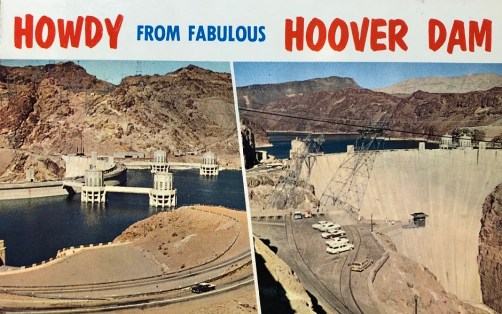
Howdy from fabulous Hoover Dam

La Fierabrosa: A Lyndy Martinez Story, Part-19

Link to Part-1La Fierabrosa Part-1

Lyndy Life Tip #173: If someone at work or in a social gathering says to you, “let’s keep in touch” it typically means you will never hear from that person again. Doubly-so if that person snaps fingers or winks.

Lyndy was secretly entertained by Blondie’s trials with her uniform.

Cathy inhaled again. “Yep. But fugitives aren’t my type. And I don’t know where he is today.”

Lyndy’s heart sank. “Why did you end it?”

“He bought a gun,” answered Cathy, in an un-emotional tone. “That’s a deal breaker for me. But you know, the thing with the dancer at Cadillac’s, she was trying to get back at him. Evan was a heartbreaker in his own way, like you and me I guess. Anyways, doesn’t matter now. He told me he wasn’t going back to jail under any circumstances.”

“Can you think of anything else? I gotta find him. After this, my next option for making money is to give blood.”

Cathy sighed. “That’s all I have to say. I don’t know where Evan is now, Lyn. I would tell you if I did. I haven’t seen or heard from him in weeks. If I do see him, I’m going to tell him to F off, but first I’ll call you.”

Cathy twisted the latch on the back door and was about to step inside. Like a lightning bolt Lyndy grabbed onto Cathy’s upper arm to stop her. “One last question I promise. You grew up here. Who is that older lady who always wears the ugly brown sweaters? Do you know who I’m talking about? Lately, every time I see her, she gives me the dirtiest looks. It’s like she’s judging me, or I’ve got on the scarlett letter.”

Cathy crinkled her nose in amusement. “Sounds a lot like Mrs. Wallach,” she said.

Lyndy snapped to attention, tossing aside the Newport. “Wait a doggone minute here. Did you just say Mrs. Wallach? Or do I need to adjust my hearing?”

Cathy nodded. “I’m pretty sure that’s Evan’s mother. Makes sense why she’s giving you the stink eye. I probably would too.”

“She’s Evan’s mom? So they are brothers?”

“It’s hard to believe, but that lady had like three different husbands.”

Lyndy cupped her fists together, covering her mouth. At last she knew where Evan must be hiding—and she had recently driven right through there. “Thanks-a-million Cath! All is forgiven.”

Cathy appeared bewildered at Lyndy’s excitement.


Meanwhile …

Things like that always captured his attention, details in the eyes of a lawman. He was cresting Granite Pass when Deputy Keynes first noticed fresh tracks, created by a heavy vehicle, departing the road at a 30 degree slant. It wasn’t the sort of place anybody sane would think to stop, nothing particular to see. It wasn’t the way someone with car trouble would pull over either, because this driver had a destination in mind, and had been traveling at moderate speed.

Traffic was non-existent. At this hour one could do complicated yoga moves in the road without fear of being run over. Though on occasion, gangsters from Las Vegas buried bodies out here in the middle of the night. No joke.

This kind of car had a longer wheelbase, and thus would not be very capable off-road; like a crummy family station wagon. The tread pattern was indistinct, with blurry sections, indicating a vehicle possessing open diffs and no four-wheel-drive.

It could be a tourist who made a bad decision or wrong turn, and gotten lost out here. For this reason Dale liked to check on such things personally. But he had his pistol ready too, in case he happened upon someone with a shovel and lots of gold jewelry.

Time to kick up some dirt.

Instinctively, Dale put his Bronco in low range, turning off the pavement and circling back to pursue the tracks. He considered calling in to dispatch to report this potentially hazardous activity, but remembered there was no line-of-sight for the radio here. He would need to backtrack in order to do that, so he didn’t bother.

There were other reasons too. Technically, he wasn’t supposed to be patrolling out here. In fact, he’d kind of gone AWOL on the department.

The tracks followed the trace of a 50-year-old mining or ranch road, curving among the occasional pinyon pine and juniper, dipping in and out of washes. At each turn, he marveled how that boat of a car had managed to navigate this treacherous terrain.

But eventually Dale reached a point where the trail had completely washed out. To continue meant dipping down sharply into a u-shaped ravine. Here, the individual driving the station wagon had been forced to halt. However, their car was curiously absent the scene, and it occurred to Dale they had likely returned to the highway; he hadn’t realized those tracks had been coming the other way.

The department Bronco could have made it to the other side of the gulch, but it wasn’t worth risking becoming the laughing stock of the force if he failed. Dale decided to put it in park for a while and investigate on foot.

The chill air hit as soon as he kicked open his door; an instant reminder he was at high elevation now. He reached under the seat for his balled up hunting jacket, an item he hadn’t touched in weeks. Shrugging on a coat in this isolated mountain range—a fortress of ragged trees and boulders surrounded by miles of desert—he should have felt alone, but he didn’t.

Pointing a flashlight at the ground it became apparent someone had continued on foot, traversing the ravine. They were wearing tennis shoes, a small size. Their vehicle was missing so the person, possibly a hiker, had likely returned safe.

Dale knew the East Mojave as good as any prospector or desert rat alive. He wasn’t aware of any noteworthy mines or other worthwhile destinations in this part of the granites. Though night had come, he decided to find out where the stranger had ventured. He didn’t feel like going home anyway.


Across the valley, Evan Stone was resting atop a boulder, under the sprawling limbs of a healthy pinyon pine. He was lying on his stomach, fingers gripping the vertical edge of the rock, surveilling the dry meadow below. Next to him was his hunting rifle with scope.

It was a secure spot he’d visited a half-dozen times in two weeks. The flat rock had a bird’s eye view of the area, and came with the benefit of camouflage from above. A fat raven lived near the same rock, occasionally croaking at Evan for using his perch. But what made this mountain good for birds, was also good Evan. He’d been living like Davy Crocket for going on 20 days. And now The Lovelace Corporation was so upset they had sicked their two most troublesome bounty hunters, Mr. Chan and his fearless partner, the half-Mexican woman called La Fierabrosa.

Matt promised his gang would take care of her, but so far she had not been stopped. If she ever got too close, Evan knew he might have to shoot her himself.

No rain had fallen the entire time he’d been here. He expected the cache of water and food to have been delivered days earlier, and now he was running low. Something had delayed his mother. But now, with the cover of darkness and a night where the moon phase was creeping up on new, it was a perfect time to venture down to recover the supplies. Evan liked to retrieve them quickly, returning to his high camp like a ghost. It was the definition of leave no trace camping—except the point was to evade Johnny Law altogether.

Because of how deep the valley was, a sliver of moon wouldn’t rise until after midnight. It could be dangerous to move around in the sagebrush with no light; one risked stepping on a snake. The thought of being bitten by a Mojave green or other pit viper out here was terrifying. He would use his flashlight sparingly, only to light the way of his feet.

Evan rose up on one knee, shouldering the rifle by its padded strap. He took it slow trekking downslope, careful to avoid a fall. He tested each unfamiliar stone with the toe of his boot. If he found one to be unsteady, he took another route.

Rounding a bend and pushing aside a screen of cat-claw acacia, he was delighted to see the supply drop, right where he expected, out of view beneath a clump of desert willow. Must have taken multiple trips; it was at least a half-mile walk to the dirt turn-around, and Mother didn’t move well.

Evan was standing ten yards away, still obscured in brush. With his guard down he nearly switched on his light to high and made a run at them. Luckily though, he heard a sound, and noticed a flash from the other direction. The light caught the profile of a man, one who was tall and wearing a cowboy hat.

It seemed like a cop and he felt his stomach lurch. The stranger was soon interested in the supplies, tugging at the string securing them. In another flash of light he saw the glint from a badge on the fellow’s chest, confirming his suspicion. He wanted to curse aloud. The nosey cop would surely report this finding.

Evan continued to watch. Several times the cop looked upward at the surrounding hills, pointing his light at various points of interest. He was searching for whoever was out here, the cop knowing he was not alone. If the beam by chance fell upon him, the jig was up.

Evan put his hand on his chest.

He’d chosen this area for two advantages. One was obvious: these mountains were a maze of boulders, covered over with trees and thick brush. The second was just as important. There happened to be no police radio reception here. The repeaters were too far away. So the cop wouldn’t be able to contact the station without returning over Granite Pass and driving nearer to the Interstate.

The cop was scribbling on a piece of paper, holding the light between his neck and shoulder.

As soundlessly as possible, Evan started to retreat. He needed a higher position. He moved in one step at a time, pausing for five seconds between.

It was only a matter of time until the law came seeking him. Fortunately, this one was alone. Maybe he would leave first, drive away and call for backup. On the other hand, the situation was frustrating. One could bury a body out here easily, but no matter what he did, there was the matter of the police vehicle. How you gonna hide one of those? You’d have to drive it into the river or a lake—even then it might reappear.

His half-brother Matt had trained as a sniper in the Korean War. He had helped Evan  select this gun, for range and firepower. It came with a high quality sight.

From  miles away, a coyote howled, filling the void.

A moment later Evan heard the loud snapping noise, emanating from beneath his feat. Bad luck. He must have put his weight on a dry twig or fallen tree branch. A second passed, marked only by silence, as Evan started to move again. Then the light shone on his back, filtered through bushes and trees.

“Hey you there! Stop right now!” yelled the cop.

Even held his breath as he turned around, resting a finger on the trigger.

“Wait. I won’t shoot or arrest you. I just want to talk,” added the cop.

Evan raised the stock against his shoulder, squinting through the sight at the blinding source of light. In the midst of losing his balance, Evan pulled the trigger one time. The noise of the rifle echoed across the valley. The cop’s flashlight flipped upward and landed on the ground, in the on position. No additional words came, only a thud, the sound of someone falling hard.

Evan relaxed his shoulders and lowered the gun. He rubbed his eyes with his finger and thumb, taking a few breaths. He regretted his actions, already in disbelief at his own recklessness. Unsure what to do first, he knew he needed to get to the man. He wasn’t sure how well he’d hit the cop. Perhaps he wasn’t shot at all, only startled; but that felt like wishful thinking.

Evan took a single step back in the direction of the supplies and then he cursed aloud, because this time he heard the rumble of a motor. It was the distant sound of a Jeep, probably on the dirt mining road. He took a halting breath, laboring to suppress full-on panic. More people were coming. How was this possible? How could it be so soon?

He wasn’t happy to reload in the darkness, or use his own light. Things were going from bad to worse. He might have to return to camp, forgoing the supplies for now. Or he might not get the supplies at all. Rationing was in his future. And maybe he would have to shoot another person.


Ten minutes later …

Lyndy wished she hadn’t said those mean things to him.

The popping sound had made her nervous. Only two things in life made that worrisome noise, and today wasn’t Fourth of July.

She discovered Deputy Keynes lying on his back in the sand, motionless, as though stargazing. His arms were at his sides, palms open. His hat was upside down, indented, and he loved that hat.

It was difficult seeing her one time fiancé this way. Every girl she knew had a crush on Dale in high school; nearest thing to a celebrity in these parts. He was a strong fighter. She depended on him for help with CBB cases. She wished she hadn’t made him leave. It was a stupid argument. They were both equally wrong in their actions.

His body was positioned a few feet from several plastic jugs of water and boxes of groceries, all bound together with brown gardening twine. She knew these were meant for Evan Stone. The fact that they were untouched indicated he’d not been able to retrieve them. It would be a problem for him.

She stopped in her tracks, not allowing herself to rush to Dale’s side. It was probable Evan was hiding somewhere within shouting distance. If he’d shot Dale, he could just as easily shoot her too.

A row of trees and waist high brush skirted the clearing. Scanning her light along the edge revealed nothing but vegetation. She could hear nothing except her own breathing, and a wind cutting through the upper reaches of the granite spires. She was wearing the worst possible attire for this activity, already shivering.

Lyndy switched off her work light, letting her eyes adjust to the stars and Milky Way. The world evolved to grey masses and silvery outlines. It seemed too late in the game to withdraw, or be overly cautious. With Dale dead or dying, and her own days numbered, what was the value of caution? It didn’t matter. It hadn’t helped her thus far. Caring for Dale was more important now.

Overhead, the summer triangle shone prominently: Vega, Altair and Deneb, crisp with virtually no twinkling. At least she would have the darkness. If Evan was going to take a shot, it would be more challenging. As she moved, she kept her head down, feeling her way along the ground to where Dale lay.

Resting on her knees beside his right shoulder, she put her ear against his chest. Listening acutely, she could hear his heart beating and feel a slow up-down rise of respiration. The sense of relief was powerful. He was still breathing. On his face and forehead were small beads of sweat. Feeling his skin, it was moist and warm; her heart rejoiced. On the negative side, the front of his uniform was soaked with blood. Given how cool the air was, the fact that he had sweat beads could be a bad sign.

Little black ants marched across his arms. Lyndy angrily brushed away the insects with her hands. She whispered Dale’s name in his ear; it was loud enough he would hear if he were conscious, but he didn’t make any response.

Vaguely, Lyndy recalled a rule that you should never attempt to move someone who was critically injured. She dismissed that idea as not applicable here. Dale was a minimum 100 car miles to an emergency room, and an ambulance was over two hours drive away. Decisive action was required. Besides, where he was now, she wasn’t sure any ambulance could get to.

Tugging at the slack in his uniform, Lyndy tried to lift him on one side. With both hands and all her fingers pinching, she couldn’t manage enough grip to even turn Dale. The Spitfire was strong for her size, but 200 pounds of limp human body was too much. It wasn’t like she could carry him on one shoulder. Logically she knew that, but she felt obligated to make an effort. To simply move him a few inches, she would have to wedge her arms under his ribs and back, and reposition his legs.

Turning toward the path, she knew it was mainly soft sand and trampled grasses. Only a few brief sections of sharp rocks. She would need to drag Dale along the ground.

The Spitfire pushed herself to a standing position. Turning 90 degrees, she reached down for Dale’s ankle, cowboy boot and all. She wrapped her arms around the leg, gripping it like she was about to snap a football. Digging in her heels, she then yanked as hard as she could. With force requiring both thighs and her butt muscles, she managed to slide Dale a few inches. It was disappointing. Yet she had proven without a doubt, forward progress was possible. That was all that mattered. She tilted her head up, took a deep breath and got ready to pull again. But just as she was about to do so, she heard him speak:

“God damn you Lyndy Martinez! Don’t you ever give up? You’re about to pull my leg out of socket! Just what I need when I’m dying of a gunshot wound—a dislocation too.”

She was relieved to hear his voice at last.

“You’re awake! Oh my goodness,” she said. “I’m going to get you out of this. Trust me. Where are the keys to your truck?”

“Please, please, I’m begging you. Go away Lyndy!” complained Dale. “You’re the one person on Earth I don’t want to see right now.”


La Fierabrosa Part-18


IMG_1615Sml

Roy’s of Amboy. (Here’s proof that Roy’s was once a Shell station.)

La Fierabrosa: A Lyndy Martinez Story, Part-18

Link to Part-1La Fierabrosa Part-1

He would always be her first love, and that had to mean something.

Without leaving her rickity chair, The Spitfire bent down to retrieve the dented, half-folded sign. Chips of white porcelain were flaking off the edges.

Brushing gently with the base of her palm, she cleared a layer of cinder dust endemic to this valley. One could still read the word, “Mexicans”, in faded whiskey-bottle lettering, knowing the whole phrase warned: “No Dogs or Mexicans Allowed”. In days of old, these were a common sight in the agricultural communities.

“Do whatever you want with that relic,” declared Dale. “Target practice would be my suggestion.”

Her heart beat faster, the fingers on her empty fist clenching by rote. Flashes of Pinegate jolted her mind.

Ever since her detention, one incident troubled her above all; it had nothing to do with day-by-day abuses per se. It came after. Warden Dixon used to force juveniles to fight one another, as a form of sport and entertainment for the guards. In particular, she liked to make The Spitfire fight, because Lyndy was known as a safe bet. Over time, Mabel Dixon evolved to such a demonic figure, she began to seem immortal; a creature immune to confrontation. Yet the day Hector knocked her one time with a board, she crumbled, collapsing on the spot like some wrinkly old balloon deflating. He hadn’t even used his full power. So it was with the porcelain symbol of hate. Time and rust had eaten away the core, encroaching along the seams where the coating flaked off, to the point it was no more rigid than a pop can.

She felt anger rising. “Dale, you juvenile son-of-a-bitch. I know for a fact Matt Wallach would never have given this up without a fight.” Shaking the sign at him, she added, “this wasn’t necessary.”

Dale was in the sunlight. He remained straight-faced, thumbs locked through loops above his jean pockets, five-o-clock shadow outlining his beard. The deputy’s uniform hung loosely on his six foot frame, like he hadn’t eaten a solid meal in over a week.

Lyndy glared at him. “I believe our deal was, you were first going to have a talk with Wallach’s parole agent.” She gestured a long leap with two fingers, infusing her words with indignation. “So how did we get from there, to you punching the snot out of him?”

Appearing like a brash teenager, Dale gazed at the hills, smirking and shaking his head. On some level he was proud of his actions. “Just lost my cool or somethin. Look, I don’t understand why yer frettin about stuff? That isn’t the Lyndy I know. Wallach’s taken care of, stuck in an old hospital bed for another two weeks. He eats meals from a straw, watching Days of Our Lives. And if he does try anything, you know I got yer back.” He patted his leather holster.

Oh sure….

Lyndy gained not the slightest sense of relief from his words. A chill radiated out from her spine through her nerves, buoyed by the prospect of bloodshed to come. Dale could protect her from Wallach’s cronies no more than Chan could protect her brother from being shot in the back.

“You’ve started a war,” she admonished, exhaling audibly and fanning her drying toes. “You’re like one of them strong but reckless guys in a kung-fu movie, and when you eventually get your ass whupped, I’m the one standing who has to face the big boss by my lonesome. Happens every time.”

Dale took a hesitant step, bringing himself closer to her table. “Can I please sit down at least? We should talk.”

He was met again with Lyndy’s fierce brown eyes. “No way. You need to leave.”

“Man, you’ve changed.”

“Damn straight I have,” snapped Lyndy.

Backing down, Dale nodded to the North. “Heard you caught up to those thieves at the JBR.”

“I did. There were four border-riding outlaws, all working for our Mr. Wallach. At least two of them grew up in Mexico. So figure that one out.”

“Not much of a surprise,” said Dale with a shrug.

“If you can control yourself, please lay off Ted Crawford a while. Stop your bullying. He hasn’t done anything to you.”

“You got a thing for him?”

“None of your business!”

Dale pressed his hands together, covering his nose and breathing into them. “Sorry.” His eyes narrowed again. “Look Lyn, I need to come clean …” he stammered mid-thought. “It’s been difficult for me too. I care about Miranda a lot. God knows I do. I care about my kids, and I want to be a good dad.”

“I wish I could believe you,” Lyndy lamented, raising her arms.

Dale stretched out his hand. “Hold on, let me finish. It’s hard for me. I know we … correction … I made some unfortunate decisions up to now. I shouldn’t have done what I did. I’m tired of letting Miranda down. I failed her multiple times, and almost created a whole bigger mess.” His voice was cracking.

Lyndy couldn’t think how to respond. She wanted to put a positive spin on the situation, perhaps offer words of encouragement, or apologize for flirting with him, or for failing at knowing where to draw the line. But you can’t very well polish a turd, so she simply replied, “You’re a pretty good cop.” She couldn’t even make an unqualified statement on job performance, because in her world, Granville was a model lawman, and Dale paled in comparison.

“Fine, then we ain’t even friends no more. And since it’s the only thing left that will please your highness, I’m going,” grumbled Dale, visibly upset—probably tearing up—and leaving words unsaid.

“Don’t come back,” thought Lyndy.


Lyndy Life Tip #172: There’s a common phone scam where a caller claims to be working for the FBI or local police department, and they tell you there is warrant out for your arrest. In order to avoid arrest you must pay an immediate fee by credit card over the phone. The absurdity of this circumstance is, why would the police or anyone call you to warn you they are going to arrest you? It would only give you, the criminal, a chance to run.

As soon as Dale’s Bronco peeled out onto 66, kicking up dust while zooming away, Lyndy jumped up. She flicked the old sign into a rusty barrel of decaying car parts. Then, hobbling like an injured duck, she waddled to her clay planter of cacti—a desert garden. She felt as though she needed to act, or risk continual rehashing of painful memories.

On the tallest cactus were three picture-perfect white blooms, each beginning to open with the transition to nighttime. Lyndy rubbed her fingers against one, picking up a bee’s leg worth of pollen. Unlike most perennials, these succulents were flowering to attract nocturnal fliers such as moths and bats.

Feeling more at peace, Lyndy pulled on cleanish socks and boots, preparing herself for a ritual she repeated every week or two. Inside the trailer, Lyndy probed underneath the bed until she located a hand-made Indian basket, near as old as she, woven from entwined raw strands of yucca and bear grass. Plucking several of the best cactus petals, but leaving enough to do the plant’s job, she deposited them in the basket; it contained many more dry petals.

Basket in one hand, Lyndy ascended the rock steps once leading to a silver mine. They were constructed sturdily by workers whose mules often carried satchels of heavy ore. Few people knew this trail existed. The pathway switch-backed methodically along the ridge behind the airstream, to a high point several hundred feet above the town. There, amongst thriving specimens of nolina, stood a four-foot high monument of stones. It was where she spread the ashes.

Lyndy rested her knees on a flat rock, cradling the basket in both hands. As sunset arrived, so did a blast of air, the same as the first night. Cupping a handful of the dry petals, she gently released them to be carried aloft by the breeze. At times they passed from sight quickly, floating for miles on air currents, never seen again.

With the day’s heat subsiding, a line of distant thunder clouds spread over the valleys, turning pinkish. Those clouds reminded her of something, a neon sign, shining atop an iconic Barstow restaurant. In a mock cursive writing, the beacon read: “The Vanishing Point”.

Lyndy combed the hair from her face as she mouthed: “Why the heck was Blondie staring at me during the street race? If you think about it, she’s the one who slept with my boyfriend. How’s that my fault?”

The hankering for loud country-rock music came at odd times. But when it hit you, it hit you.


Minutes later …


Back in the airstream, Lyndy shifted her weight from foot to foot, while plucking her eyebrows in the medicine cabinet mirror. For her next act she needed to look her best. The Vanishing Point felt like crossing into hostile territory, or maybe the twilight zone. And one never knew how many ex’s could be there.

For her outfit she selected shorts, a halter top, gold hoop earrings—gifts from Rita—and strappy heels. Her shirt exposed the classy amount of bare shoulders and back, but no more. Her skin was extra tan, from the day she’d spent in the backcountry. While the frilly shoes compromised stability, they brought her eye level with most men.

Lyndy squinted to spritz on a few puffs of her priciest perfume—the kind that made males pause mid-activity thinking: “what’s that smell?”


One hour later …

One consistent thing about hate, it never really goes away, it evolves. The Vanishing Point didn’t post any signs warning away minorities, but it didn’t need such signs. The fact that they were unwelcome was written on the faces of the patrons, and the way the hostess acted put out anytime a non-white person wanted a booth; even the allowed records on the Happy Days style jukebox were screened.

The copious parking spaces were defined by old railroad ties—one resource this town never seemed to run out of—positioned horizontally and half-buried. Lyndy rested the front bumper against one of these markers. So far, people coming and going were paying her no attention, which was a good thing.

Before stepping down from the driver’s seat, The Spitfire paused to slip the shoes on her bare feet. The air was so dry it irritated her nose; the kind of night when a miniscule spark could ignite a raging forest fire.

The Vanishing Point was a roadhouse in every sense of the word; a shimmering beacon to macho truckers on the interstate. Standing alone in the gravel parking lot, one would never know such a thing as stars existed. Neon lights buzzed with retina searing brightness. Come all ye drinkers, guzzlers of cold beer, play some cards, see the opposite sex in the flesh and perhaps even speak to one. But despite these earthly attractions, it was inconveniently on Blondie’s half of town.

Frequent fist fights led to calls for it to be closed down on more than one occasion. In one instance, the place had been reduced to ashes by a disgruntled patron, only to be rebuilt in much the same fashion. Somehow, like the bedazzling waitress, it endured.

Cathy Cookson presided over this fandango like a queen, worshipped and revered; hell, she got tipped when she wasn’t even somebody’s waitress.

With loud country music wafting from the smoky interior, Lyndy repositioned her form hugging top and touched up her lipstick. By this time of night, traffic on I-40 thinned out. Only a half-dozen trucks, moving like a string of pearls, traveled along the westbound lanes.

I used to be so nice,” thought Lyndy, reaching for her purse.

The front double doors were meant as a reflection of an old timey saloon; now they were just irritating. As loud as the conversations had been, as soon as The Spitfire pushed her way inside, all went hush. A redneck trucker at the jukebox deposited a quarter, and prepared to make his selection. Mid-search, he turned around to stare, as did two men who were playing darts. The hostess, clad in the blue and white uniform, eyed Lyndy up and down, probably thinking: “there goes my night.”

Romulans have entered the neutral zone.

A quick glance around the room showed no blondie. The two waitresses working the tables wore light blue skirts and matching tops, their lesser attire indicating fewer years of experience.

Lyndy stepped to the counter.

So far everyone was behaving respectfully, save for three rough men seated in the booth nearest the pool tables, underneath a mounted pair of bull horns. They were in their early twenties, playing tough, with preposterous leather jackets—probably trying to act the part of a gang. One of them was snickering.

In less desperate times, and with an easier case, The Spitfire would have ignored them. But somehow, Dale’s incompetence had fueled additional rage.

Brushing past the hostess, Lyndy strode to the far booth.

A song from The Bellamy Brothers began to blare; the trucker had made a bold choice.

The Spitfire rested her palms on the filleted metal edge of the table, leaning over til she got a whiff of the tangy, cheap lager beers.

“Gentlemen, what’s so hilarious?” she whispered, gesturing for truthful answers.

All three were slumping down, exhibiting terrible posture.

“By the way,” she added in the same breathy tone, “you boys look disgusting to me.”

A man with oily, curled hair shrugged. “Nothin. We just heard you and Deputy Keyne’s days are numbered; that’s what somebody said.”

“Is that a fact,” replied Lyndy. “How amusing.” She stood up straight, drawing her feet together to appear taller. “Do any of ya’ll know who Evan Stone is?”

They shook their heads, using minimal effort and checking each other’s faces.

“You sure bout that? Want me to repeat the question?”

Still no answer.

“Alrighty. Then do you think one of you can deliver a special message to mister Wallach for me? It’s brief.”

All the boys nodded, with one sitting up more and mumbling in the affirmative.

Lyndy raised her voice this time, loud enough for anybody on that wall to hear. “You tell him I’ll be waiting.” Then she slammed her palms on the table, making the beers slosh.

Talk about tense. Ordinarily, there was no non-awkward way to exit out of a threat. But right at that moment a young trucker, breathless, green trucker cap and all, tapped Lyndy on the shoulder. She whipped around, nearly elbowing the poor guy in the ribs; but he had quick reflexes.

This fella had superb timing.

“You look nice. Care to dance Miss Martinez!” He said, with the verbal deftness of a cattle auctioneer.

Lyndy smiled kindly. “Sorry, definitely not today; I came to find Cathy,” she asserted. “How bout next time.” Then she dodged sideways, charging straight for the shiny kitchen door, throwing it open with max forcefulness.

The kitchen was a zoo, pans sizzling and plates sliding everywhere, but Cathy wasn’t there either. Lyndy locked eyes with the head cook a moment. He was wearing a red and black bandana on his forehead, dark sunglasses, but he seemed to know exactly what she wanted.

“Yo, Cathy’s in the back man, taking her break.”

In all the years The Vanishing Point had been operating, Lyndy have never ventured to the area behind; a forbidden zone. Lyndy twisted the handle on the creaky screen door—the kind at mountain camps—stepping out guardedly.

Their unkempt brick porch had been piled high with discarded pallets and buckets of cooking oil. An old generator, rusting, sat adjacent to a mounds of rocks. After letting her eyes adjust, she could see outlines of storage units, empty foundations and lived-in trailers, and a line of trees bordering the riverbed. Moths danced at the windows, and by the door.

In the light cone of a caged outdoor bulb, stood a feminine silhouette. They were resting against a support pillar, fully at ease, with the smell of menthol wafting in the air. Unmistakably, that silhouette belonged to Miss Cookson.

“Hey there Lyn,” came Cathy’s breathy call, through her shroud of smoke, almost as if she’d been expecting a visit from The Spitfire all along. That was the sign of a person with something emotional to get off their chest.

Waving away the smoke screen, Cathy strode her direction, and Lyndy could see that the lady’s uniform was undone, with the sleeves resting against her hips. Covering her skin, she had on a simple white slip.

“Howdy,” was all Lyndy could say.

Cathy half smiled, gesturing to her body. “When I was a teenager, this thing used to fit me with room to spare. Now I can hardly breathe in it.” She pressed the half-full pack into Lyndy’s hand, drawing a silver lighter from the middle of her bra.

Looking down, Lyndy recognized the green label. “Huh. I didn’t know you smoked Newport,” said Lyndy.

“You don’t come around my restaurant very often,” replied Cathy.

Her restaurant. Of course.

“True. But that’s because I thought you hated me,” argued Lyndy. She stuck the filtered end between her lips, as Cathy touched flame to the tip.

Once red hot, Cathy flicked the cap back on the lighter, slipping it away and advancing to within inches of Lyndy’s face; with The Spitfire’s advantage of taller shoes, they stood eye to eye.

Holding a Newport, grinning her slyest and most seductive smile, Cathy asked, “Why aren’t we better friends Lyn?”

With an idea like that, Lyndy had to chuckle. “Where oh where to begin Cath. For one thing, you’re always trying to one-up me. And I know that isn’t my imagination. Been doin’ it since we were in tenth grade.” Lyndy puffed a few times to get it going. “And then there’s the whole Kyle Ellis fiasco.”

Cathy frowned, inhaling deeply and making a hissing sound with her front teeth. “I crossed the line didn’t I? I’m sorry about that. I know you were seeing him first.” Blondie’s country accent was distinct as ever, but her silky voice seemed strained and a little raspy on this night. She lowered her cigarette to the side, between her second and third finger, depositing ash and exhaling through her nose.

“Ah well, that’s alright I guess,” Lyndy said. “He must not have liked me as much as I thought he did.”

The Spitfire paced the uneven brick surface, being careful with her heels, pondering to herself when was the last time she ate an actual meal. She chuckled discretely, unable to suppress a memory of her brother.

“What?” demanded Cathy, thinking the laugh must be about her.

Lyndy waved her hands across her face. “Sorry, I was thinking when Hector was alive, he used to like to eat at this stupid hole-in-the-wall chicken stand, every chance we got. It had dirty picnic tables and flies buzzing around. And I hated the food. Plus their kitchen cleanliness was suspect; real dicey. I felt sure we were doomed to get food poisoning one day.” Lyndy stared at Cathy’s faded blue eyes. “Damn. You know I’d give anything to eat a meal there again, with my brother.”

Cathy’s expression had changed to one of weariness. “You didn’t go to elementary school out here, did you Lyn?”

Lyndy shook her head. “Nope. We were still living with Aunt Rose in Los Angeles.”

“Right. So you never met my brother.”

“Far out! I never knew you had a brother!” Of course, the moment the words rolled off her sharp tongue, Lyndy regretted saying them. She could see by the pain on Cathy’s face her brother was also not of this world. “I mean…uh…no I didn’t.”

“My older brother was the best thing about life. We did all kinds of stuff together. He was the only person who could make me happy, the first boy I loved—not in that way obviously—but you know what I mean. Which is why I despise guns.” Cathy gestured to Lyndy’s handbag. “Cause when he was 12 years old, he died in a hunting accident with his friends. They were shooting quail, by Soda Springs, and he tripped over a rock and landed on top of his gun—shot himself in the jaw. My father wouldn’t let me see the body, it was a bad scene. At least, they say it was quick.” Cathy touched a hand to Lyndy’s shoulder. The fingers felt warm, pressing on her bare skin. It was the peculiar kind of touch, lingering, like the prelude to a kiss. Had a man done this, or really anybody not in emotional distress, Lyndy would have smacked their arm away. “When my brother passed, he took most of my soul along with him. In those days, I thought I would never experience happiness again.”

“I understand,” said Lyndy, knowing there were no words which would be respectful to somebody who suffered such a loss. “I swear, I never knew any of that story.”

“Some things are so awful even small towns won’t talk about em.”

Lyndy nodded.

“With my mother and brother out of the picture, I’m the only Cookson left to take care of my dad, which is why I never left town. I got dealt a pretty crummy hand if you ask me.” Cathy deposited the butt of her smoke in a coffee can by the screen door. “Anyways, break time is over.”

“Cathy, before you go back in, I really need to ask you something important. I’ve been searching for somebody all week, and now the week is over, and I’ve got nothing. All my hours are used up.”

“Go ahead,” said Cathy, reaching around for the zipper to put her dress back together.

Lyndy took a deep breath. “Do you know who Evan Stone is? I’m guessing you might recognize the name. Maybe he came in here once in a while? He was a singer.”

Lyndy tried to read Cathy’s body language. If this didn’t work … well … there wasn’t any plan-D.

Cathy struggled with her zipper, head down, sucking in her stomach through gritted teeth. “Yeah, I remember him. We went on a couple dates long time ago.”

“Lemme help,” offered Lyndy, reaching for the zipper. “You two went on a date?”

La Fierabrosa Part-17


BlythePCSml

Blythe, CA

La Fierabrosa: A Lyndy Martinez Story, Part-17

Lyndy Life Tip #170: If you ever order a salad and it comes topped with ham cubes, bacon bits, shredded cheese, avocado and smothered in ranch dressing, just don’t even bother. Or do eat it, but realize you could have downed a porterhouse steak and all the trimmings.

The hour was well past dawn. A trickle of clear water spilled over the lip of a cement cattle guzzler, making barely a sound. Due to all the human activity, especially now, the half-wild cows would be too skittish to approach and drink—which of course was bad for their health, and business.

The Spitfire’s arms were trembling with tension; knowingly, she relaxed her grip.

Yards away, dying embers of a hardwood fire continued to emit smoke, near invisible to the eye. With each passing minute the sky grew brighter, alive with the intensity of desert sunrise.

This camp smells like a plate of Canadian bacon,” mused Lyndy, her black Beretta still aimed in the direction of the cattle thieves, index finger resting near the trigger guard. She hadn’t eaten for 18 hours, and her sense of smell kept gaining prominence over all other functions; her muscles felt weaker too. This forager state of being was the main reason crash diets failed.

That maple-ham aroma was only part of a growing list of distractions, including the fact that Chan supposed there were four individuals camped here, but only two accounted for.

Lyndy re-directed her attention to the half-dressed Texans, blocking the makeshift tent; she monitored their every twitch, expecting treachery.

“Alrighty, I need some immediate answers from you doofuses. I’m searching for a pretty boy fugitive named Evan Stone. I’ve been told he’s holed-up somewhere in the east Mojave backcountry. Been askin’ around real nice, but nobody wants to cough up the location of his camp.”

No sneers or chuckles. By now they would have laughed, had they never heard the name. Perhaps he was sharing this primo spot with them?

The west Texan with the faded eyes blinked, tilted his head slightly and spat at the ground; didn’t speak though. His taller, vacuous pal, also stayed mute.

“I wish ya’ll would stop doing that. I think you know who I’m talking about, and I’m running out of patience; if I even have any.” Lyndy affirmed.

“Ain’t … seen … im,” replied the goat herder, firm and deliberate as always.

Then came a man’s scream, or perhaps a battle cry.

From somewhere in the chaparral behind Chan, a figure emerged. But before The Spitfire had time to react, or craft any sliver of a plan, he sprang forward. Shirtless and in cotton briefs, wielding a busted-top wine bottle, he charged. Chan swung his bat, missed, and the man flung the green bottle like a dagger.

Unprepared, Chan only had an instant to turn away, as the dense projectile smacked him at the base of his skull. The glass fractured further, coming apart in inch-sized shards, which rained down in the rocky soil. An ordinary man would have been knocked out. Chan was briefly stunned. He let go his bat, but didn’t tumble. The deranged biker was advancing upon him, swinging his fists.

Lyndy prepared to take action, but luckily Chan snapped out of it. “Why you little unhinged piece-a-crap,” he bellowed.

In a swift motion Chan seized the attacker by his elbow with one hand, and under his crotch with the other. Then he swung around in a discus thrower motion, hurling the full-grown adult like a sack of flour, directly into a nearby cholla patch.

His pals stood by in horror, knowing cholla had a reputation as the most devilishly pain-inflicting cactus in the entire Southwest.

Lyndy briefly surveilled the hills surrounding the spring, checking if anyone else was waiting to pounce, or worse. She was particularly mindful of any glints, but kept her Beretta aimed for the tent regardless.

It’s astonishing how much a modest head wound will cause you to bleed. Ever bonk yourself on a garage door lifter arm and you’ll know!

Chan felt around the back of his head and neck, and upon inspecting his hands, they were each coated as if dipped in a jar of scarlet paint. In reaction, he clenched both fists, and blood squirted in the air.

Yet the third fellow was in far worse condition than Chan. He managed to roll his body off the tops of the cacti, but lay motionless on the ground, whimpering and twitching. Atop his bare back and legs were many broken off teddy-bear arms. He began to moan.

Chan stomped up to the man, grabbing and lifting him by the hair. “Oh, would you just shut the hell up,” he said, punching the fellow in the temple, rendering him unconscious.

Next, Chan bent down to retrieve his slugger bat, spitting and cursing a string of unintelligible phrases. Signs of fury on his face were something she knew she would have to cope with later.

“Caught me another one of them rascals tryin’ to escape!” came an excited holler, followed by a dust-up and many snorts from the horse. The source of commotion was Rob Albright, crashing through tall weeds, with a lasso wrapped around the fourth of Wallach’s lackeys. Rob was in the saddle.

By jerking its strong neck and sidestepping, his horse was tugging out a man like a stubborn calf. Its nostrils flared as it pulled.

“Hey lay off me ya jerk! I surrender,” the man complained, with a voice like an educated Berkeley hippie. This one, a taller, lanky fellow, wore faded blue jeans and a dusty golf shirt. He had roughly 3-days’ worth of blonde beard stubble. But unfortunately, it wasn’t Evan.

With the main events over, Lyndy turned back to the Texans.

“Anybody else wanna be a hero today?” shouted Lyndy.

Both men shook their heads. The new one quickly stumbled to the line-up, joining his biker friends. He brushed himself off, then inverted his pants pockets, demonstrating to Lyndy he had nothing to hide. “Excuse me miss, these two fools look American, but they can’t speak a lick-a-English. Their Spanish is pretty rotten too.”

I’ve noticed.

“Mike over here growed up in Jaurez.”

Lyndy angled her gun to the new man, who seemed ready to do the talking.

“Look, we don’t want no more troubles. This junket ain’t been profitable anyhow.”

Lyndy glanced back to check on her boss. Chan was preoccupied, plucking bits of green glass from his neck. Lyndy switched up her stance, keeping the Beretta pointed the same.

“I have a better question,” she said. “This one told me Wallach was at Loma Linda. What happened?”

“He got assaulted—beat up worse than I’ve seen in a long time.”

“By whom?”

“Matt said it was yer damn boyfriend. No one else was at the bar, or got a look at the guy.”

So which of my “boyfriends” is that foolish?

“I don’t have a boyfriend. Who does he think is my boyfriend?” demanded Lyndy.

“I dunno. Some tough guy dressed as a cop.”

Dale!

“I’m really not sure who you’re describing,” said Lyndy defensively. “So then, Wallach never told you where Evan is?”

“Nope. None of us know. Might have helped him if we could. Not sure this is something you can believe, but Matt said to me, even he doesn’t know.”

Lyndy glanced back at Chan, who was sullen.

For some depressing reason, that answer seemed truthful.


20 minutes later …

Lyndy Life Tip #171: One of those lowly 59-cent black plastic pocket combs is the ideal tool for safe removal of stuck cholla arms. Whether embedded in skin or clothing, it works wonders. After removal, a simple alcohol wipe is a quick way to disinfect the puncture.

Tread-bare whitewall tires chirped around each bend, as the Cadillac sprinted along Kelbaker Road, a seldom traveled stretch of 2-lane blacktop linking Kelso and Baker. Occasionally, The Spitfire drifted over the double yellow, but luckily there hadn’t been any oncoming cars. Only truck drivers attempting to subvert the CHP scales used the road with any frequency.

With one hand clamped on the steering wheel, the other was free to apply violet colored lipstick. While smacking her lips together repeatedly, Lyndy took a casual peek in the rearview. Her eyes were met with Chan’s stone-faced glare.

Chan hated when other people drove his car. But he was confined to the back seat, holding a blood-soaked shirt to his bald head. He was attempting to stem the flow by applying firm compression.

Lyndy hooked a finger under the mirror, flicking the lever over to night mode. Then she adjusted the sliders on the cool air vents so more of it was directed to the rear.

“You know what this vehicle really needs,” offered Lyndy, clearing her throat and waiting for a response.

Chan did not make a sound.

“Pair a fuzzy dice,” she joked.

Silence.

Lyndy looked in the mirror again, this time using only her eyes. Chan had switched from one palm holding the shirt, to the other.

I wish it wasn’t morning, cause I could use a margarita the size of a cantaloupe,” she thought.

Lyndy tested the wheel. It had so much play that she could easily wobble it 15 degrees either side, without affecting the course of direction. She pinched the skin around both her earlobes. Somehow, she’d lost a small earring in the previous night’s scuffle. Fortunately, it was gold-plated, not actual gold.

“I just gotta say, the suspension in this car is so soft and pliable. It’s like riding on an inflatable swan at the waterpark.”

“I hate you,” replied Chan.

Lyndy sighed. “Dude. I said I was sorry like ten times already. I didn’t know there was a crazy underwear-man hiding in the weeds.” She used as meek and genuine a voice as she could muster.

“Melinda Evangeline Martinez, I don’t give a frog’s fat ass how sorry you think you  are. I signal to you the number four. There are four different style boot prints on the ground. You have the fancy gun and decent aim; shoot the bastard in the foot or the damned arm.”

Oh boy, all three names. This was serious.

“But you’re always pressing me to use the Beretta only as a last resort. You hate it when I’m acting trigger happy.”

“I could have been killed!”

Uffdah.” Lyndy briefly shut her eyes, taking a breather. She slid the lipstick case back in her purse. “God. To work at CBB you have to have skin like a rhinoceros.”

“Why is that?”

“Cause you freakin yell at people for having unexpected accidents, as well as honest mistakes, misunderstandings and anything else in between. You overreact to everything. That’s why. This is exactly how you pushed away …” Lyndy stopped abruptly.

“Finish that sentence,” demanded Chan, thrusting the soaked shirt in Lyndy’s direction. “Me and Richard offer you a job when no one else will take you! You are free to quit any day.”

“Never mind,” she muttered softly. She was thinking about her family.

There was a time when The Spitfire wore bright colors, when her stockings weren’t black and her skirts charcoal grey.


1 hour later …

Back at Riverview trailer park, tempers had cooled just a little. Still, the two were not on speaking terms. Lyndy submerged the end of metal tweezers in a container of high proof vodka, holding them there for a count of ten. A layer of glass fragments caked the bottom.

Once the ends had been sterilized, Lyndy concentrated on gently plucking the last few shards from Chan’s head wound. It took the better part of the morning.

Then, keys in hand, she shuttled him to the clinic in Victorville for stitches. Lyndy tried apologizing once more before she left, but Chan was too grumpy to acknowledge her. In a way she was grateful for his silence; he hadn’t asked who assaulted Wallach.

There was only one action left with a snowball’s chance of elevating Chan’s mood, and it was finding Evan. To Chan, it represented a business loss numbering in the thousands of dollars, and a promise to the Lovelace Corporation to never entangle them in bad lending decisions. But for Lyndy, this had evolved into being more about defending her reputation. The five days was almost up. Come hell or high water, she needed to rally.

20,000 square miles. One person.


From a payphone, Lyndy dialed the JBR ranch, leaving a message for Ted. She at least wanted him to know she’d caught the thieves, and done everything she could, in case Rob Albright took his time getting around to it. Then she drove the Jeep across town to Tammy Ward’s house, hoping to see how her recovery was going.

The Wards occupied a one-story bungalow, on a quiet street only a short walk from the Barstow depot. Their pinkish craftsman-style home had once been built and lived-in by railroad executives. That was near 60 years in the past. With the intervening decades, the neighborhood had taken on a more blue-collar characteristic, along with the rest of Barstow.

The presence of a Peterbilt semi-truck indicated Daryll was at home. After ringing the doorbell, he let Lyndy in. Tammy was propped on the living room couch with her neck supported by one of those goofy foam braces. She had the TV tuned to her favorite soap operas, their drooling rottweiler—Mr. Snuggles—sharing the rug by her feet.

Although reportedly in a great deal of pain, the accident had done nothing to dampen Tammy’s spirits, and it seemed she was enjoying time off work. Lyndy felt exhausted, but seeing Tammy like this brought a smile to her face.

In a flurry of words and vigorous hand gestures, Tammy explained the backstory. A man on vacation had stopped at Sancho’s stand late in the day. He remarked about her green Buick in the lot. Though standing only five feet tall and soft-spoken, he had an ego to match any man. That’s when things started going off the rails.

Tammy informed the stranger her newly built pro-street car was unbeaten in its class at the drag strip. Even with a language barrier, the stranger began talking tough, and boasted that if even a single turn were included in the race circuit, then his Datsun could easily smoke Tammy’s muscle car. Then he launched into a tirade about the laziness of American car manufacturers.

Maybe it was a Route-66 thing, or a matter of town pride, but everyone’s patience had been tried; Tammy reluctantly agreed to a competition, mainly to avoid a budding fistfight between the stranger and jingoistic passers-by. From there, circumstances escalated quickly as the Parker’s got involved, and Granville Jackson—attempting to calm the crowd—was told to take a hike. That explained the lack of law enforcement.

What the bellicose tourist didn’t know, was Tammy’s Buick was a high compression model, running leaded fuel and sans any California smog equipment. The rented Datsun was likely to be California smog legal, so it was already facing a disadvantage. There was no explaining this subtlety considering the language barrier.

Lyndy arrived soon after, witnessing the crash. The Datsun suffered a failure of the linkage connecting the rack and pinion steering. The stranger considered it sabotage. In the wreck he suffered a broken ankle and a blow to the head, as his car flipped 90 degrees. But it was his nationalistic pride that was totaled. Tammy suffered whiplash, sustaining no lasting damage, even when taking out a mailbox, leveling two small trees and a light pole.


Later in Amboy …

Lyndy napped away the afternoon sprawled atop her double bed, no sheets or anything. And over the course of a day the tin-can like Airstream typically became uncomfortable, but she was far too tired to notice. As evening approached, she dressed herself in old tennis shorts and a cotton tank top—expecting no visitors—and emerged to relax on the patio.

The patio itself included a metal table and chairs, which she positioned in the shadow of her sole palo-verde tree. This vantage had been strategically placed to overlook her snaking driveway. Upon the mesh table Lyndy set out her transistor radio, as well as an open bottle of Herradura and Sands Hotel-themed shot glass.

Every hour or two, a locomotive would blow its horn where it crossed the highway, then climb Cadiz grade until obscured in haze.

Lyndy twirled the empty shot glass by its edge, pivoting on the table top. Peering through the tequila bottle, she could see the outline of the ghostly town and Roy’s sign, tinted orange. Ordinarily, she would have been savoring the top shelf tequila, but this time she needed her mind to perform. Sleep deprivation had taken toll enough.

She’d interviewed a number of persons, some shiftier than others. It should have been enough for any bail enforcement case. It was Julia Russell, the eccentric Good Samaritan and modern archaeologist, whose words had left the greatest impact. She described the supply chain necessary to stock a constellation of army forts, established to subdue the local Indian tribes, defend against Mexican forces, and quote “maintain peace” in the desert.

With all that had happened and each passing day, the trail was growing colder.

The Spitfire was in the process of painting her toenails, a cotton ball wedged between each toe, when she noticed the green and white Bronco ascending the driveway; it was tailed by dust. From the look and sound of the official county vehicle, she knew the driver, and she wasn’t at all happy to see them. At last, she poured herself a capful of the liquor.

Deliberately, Lyndy propped her bare feet on the table to dry. Her shorts revealed a lot of leg in this position. Her top showed a lot of upper body also. Lyndy ran her fingers over the surface of her tan thigh and down to the ankle, testing for stubble.

Whatever happens, don’t let him in.

No sound is quite like radial truck tires on gravel roads. After navigating her tightly arced turning circle, Dale put it in park. He quickly removed and flung his cowboy hat to the back. As he stepped out, slamming the door, his big stupid belt buckle was already glinting in the sun.

He stood there looking somber, clutching something made of thin metal in his left hand.

“I uh … heard you been out bustin some heads again,” spoke Lyndy, tipping the contents of the glass into her mouth and swallowing hard.

“Yeah, well Mr. Wallach won’t be bothering us no more. And also, I bet you can safely add his name to the long list of people Will Rogers never met.”

He was standing twenty feet away, languishing, and she hoped the stink of nail polish, plus her obvious scorn would hold him at that distance. Dale tossed the metal sign up to the porch, then stuck his hands in his pockets. Without reading it, she knew what it said.

La Fierabrosa Part-16

BarstowBridgeSml

Barstow Depot, CA

La Fierabrosa: A Lyndy Martinez Story, Part-16

Link to Part-1La Fierabrosa Part-1

Lyndy Life Tip #169: To scare away door-to-door sales people and religious folk, wear an old derby hat, a pink motel bath robe and green flip-flops when answering the front door. The best kind of hats are ones where it looks like a peacock landed on your head. Trust me, they’ll find a reason to move along.

Mr. Chan busied himself preparing oolong tea, while The Spitfire quietly observed from a reclined position on the built-in. Chan’s four-burner stove hissed like a snake, as invisible gases escaped the open valve. But it quickly morphed to a pointed blue flame when touched with a paper match.

Opening the cupboards above the sink, Chan selected a ruby painted tin, roughly 2 inches square, with nothing but Chinese characters marking all sides. Meanwhile he filled a copper teakettle with cool water.

Chan didn’t need inquire if Lyndy wanted tea, there was no choice in the matter. If he made tea in your presence then you were darn well having tea. Hector once warned the concoctions in the reddish box could make you talk like a drunkard, revealing close personal fears one would never divulge otherwise.

Drawing aside curtains, Lyndy peered through the window at the night sky. She could see the Milky Way streaming overhead, all blotchy and brown, outlined in black by the silhouettes of cottonwoods. She extended her arms and laced fingers in a massive yawn.

“You have another person’s blood staining your clothes,” Chan said abruptly. “You know that woman?”

“I know,” she replied.

“Care to explain?”

Lyndy exhaled. “You know who Matt Wallach is?”

“Never hear of him,” said Chan, without turning around. He was measuring level scoops of loose leaf and depositing them into a mesh infuser.

“Well he certainly knows about us,” said Lyndy. “He’s a kingpin of sorts; we put some of his best cronies in jail. In fact, he mentions you by name.”

“Well I’m famous round here.”

“You kinda are,” agreed Lyndy. “Anyways, point being, one of his side hobbies is rustling cows from the JBR herd. They got thousands of acres and only a handful of cowboys, so it’s easy pickings. I believe I figured out where they’re camped right now.”

While the kettle simmered, Chan rotated one-eighty, resting his palms on his stomach. “So, what this caper have to do with us, or why you been in a fight?

“I’m gettin to that part, if you’ll allow me to continue. See I ran into his goons today on 66, when they tried to abduct me—fun group. What is it Sheriff Jackson would say? Them boys are clowns that aren’t funny. Anyways, I’m working on a theory that may end up leading us directly to Evan Stone.” Lyndy related her chance encounter with Matt Wallach, the man who claimed to be Evan’s brother, and how he wanted her to lay off on the hunt.

“What in the wide world of sports?” Chan declared, scratching the tuft of graying hairs on his chin.

“Why is that so weird?” Lyndy inquired.

“Evan never once tell me he have siblings. He distinctly mention Stone was a family surname—that one is on all his court documents.”

Lyndy shrugged. “Remember how I kept thinking his name sounds made up, like an actor’s name? Or could he mean they are brothers in a gang sense?”

To steep the tea, Chan submerged his mesh strainer contraption in the steaming pot, dipping it up and down and counting. He also seemed to be entertaining Lyndy’s idea.

“Anyway, I assume since Wallach’s wings are clipped from being on parole, he had to think of something he could make money at without leaving the county. Who would suspect him of stealing cattle?”

Chan sniffed at the tea. “Meh. That a pretty weak theory to me. Any other reason you think this Wallach scumbag is connected?”

“Because Deputy Keynes found a dented wheel cover from an early International Scout at the site where some of the cows were loaded up. And I saw an early Scout, which would have had that same type, out at Wallach’s bar in San Bernardino.

“Was it missing the wheel cover?”

Lyndy’s face took on a guilty expression. “Regrettably, I didn’t look carefully enough.”

Given this trailer had been occupied by Mr. Chan for decades, one might expect the dwelling to accumulate a handful of Chinese elements, but there were none. Instead it retained the generic trimmings from the day it was bought, sometime in the late fifties.

“How this lead us to Evan?” questioned Chan, passing her a handle-less porcelain tea cup. “Or putting another way, is anybody willing to pay us bounty if you catch these cow stealers?”

“Uh. The JBR should cover my fees,” The Spitfire asserted.

Oh, sure they will. Cause it wouldn’t be Ted Crawford, who ironically offered to pay but somebody turned it down.

“And even if they don’t, Wallach knows where his quote-unquote younger brother is now. I’m positive. He acted so dodgy, Evan must still be in the county. Which means Wallach or his henchmen are probably feeding him supplies. So, I say we sneak up on these dudes just prior to first light; scare the bejesus out of them. Then see if we can get ‘em to cough up Evan’s hiding place.”

Chan passed a palm across his forehead, smoothing away sweat. “You know, my mind must be slipping from fever, cause you actually starting to make sense.”

“I always make sense. You just don’t listen,” said Lyndy. And seeing as he had no further pressing questions, she was confident her boss would be tagging along; this time she knew she could use backup.

Lyndy cradled her tea against her chest, allowing it a few moments to cool. She tilted her head back, staring at the ceiling of the trailer. It had a skylight you could crank open, with a plastic fan to expel the heat. Chan returned to the kitchen and started using the corner of his fridge to scratch his back, shimmying up and down like a contented bear.

“Man, I’m so hungry I bet I could eat a whole pizza by myself,” Lyndy bemoaned.

“Huh. Huh. Huh. I’ve seen you eat. I’m sure you can.”

“Chan, I need to ask you a semi-serious question, and I want you to be truthful with your answer.”

“Alrighty, this is starting out weird,” he muttered. Uneasily, Chan took a sip of tea from his identical mug.

Lyndy angled her head to face Chan, resting her cheek against her shoulder. “Come on dude, I’m not foolin’ around anymore.”

“I never tell lies woman.”

“Then do I have … you know … a decent body but a messed-up face?”

Chan’s expression exhibited amusement. “For shit sake Melinda, how would I know,” he chuckled. “Can’t we talk about sports or something?”

“You hate sports. But you are a guy—even though you’re like a million years old.”

“Dammit, we’ve been over this time and again. I am not your shrink. This sound like conversation best saved for ladies at the hair salon.”

“Ever see a cover on a grocery store fashion mag? Ain’t nobody on those looks remotely like me. It’s all a bunch of Farrah Fawcetts.”

Blaming her insecurity on the bogus fashion industry seemed plausible, and less embarrassing than admitting a cad like Wallach could hurt her feelings.

Lyndy shut her eyes. “I wish I was gorgeous like Cathy Cookson.”

“Woman, you are insufferable. You’re falling into a carefully laid trap of beauty industry. That’s just what they want you to think. But physical attractiveness is chiefly a curse.” declared Chan. “There are whole books written on this very subject!”

“I disagree; plus it sounds like something an ugly person would say.”

Chan squinted, pressing his fingertips over his eyeballs and inhaling. Henceforth, his respiration became audible. She feared he would promptly eject her from the trailer park. In anticipation, Lyndy took another fast drink of tea, reaching for her purse.

But unexpectedly, his face softened, taking on a look of newfound enlightenment. Chan rested his hands on the rim of the sink. Then he eyed the purse, noticing it was sagging from the weight of steel inside.

“Is that a new purse?”

“Yes, it is.” Lyndy lifted it up to show off. It had a front pattern reminiscent of a fine Navajo rug, an elaborate fringe hanging all along the bottom. “I bought it for my birthday. I’ve had it a week but you didn’t notice. See how pretty? Cost a hundred dollars out of a catalog. It’s like Italian calfskin leather or some such.”

“Huh. Huh. Huh. You are truly terrible with money. What you keep in there anyway?”

“I dunno. Normal girl stuff I suppose. What do you think?” Lyndy grinned, about to rattle off a list.

Chan held up his palm flat. “No wait! Please don’t ever elaborate on contents. I will stop asking stupid questions from now on.” Chan turned back to the kitchen sink. “Look, that purse reminds me of something. You say I never speak about old China. Well now I tell you one story about China you haven’t heard before.”

“Go on,” whispered Lyndy.

“This one begins when I was ‘bout fifteen years old. There was an exceptional young lady in my village. She probably sixteen or seventeen. She was a talented and strong dancer, the ballerina kind. I see her at sunrise, walking or riding bike to the dance school; she move as if gravity have no effect. Ever see a person like that? Bottom line, in the looks department, she was entirely plain. Not particularly tall, kind of lean body and straight hair. If forced to describe, maybe 5 or 6 on scale of 10. There dozens of girls around prettier. But every teenage boy in my village have crush on this girl. She was confident and clever, and pleasant to be with. A kind of spirit she had. She even speak to me on occasion and tease me, probably for being fat. I was too shy to conceive of anything funny to say back; I fantasize about her though. Then one day she receive a scholarship award, from the Communist Party, to study dance at a prestigious school in Russia. Her parents were so delighted, of course. They boast about it to everyone. Her mother and father talk about it so much, that people start avoiding them. That girl gone for one year and then she return home permanently. Turns out she get life-altering injury at the school. I don’t remember exactly what happened, but they say she have no chance to be a competitive dancer. In those days you get a twisted ankle and they kick you out of program. So who knows the real truth. Point is, when she came back home she was totally different; it like she had her personality removed. She sink into despair, never joke anymore. She never spoke to me. Nothing happen to her face, and she was only a year older, but she seemed depleted. I doubt if anyone wanted to marry her. She probably live under her parents roof whole life.”

Lyndy shook out a menthol cigarette and lit it with a Bic. She offered an extra to Chan, but he declined. Then she started puffing with her head tilted back. “What is the moral of your depressing story?” she inquired.

“When we find out you were sent away to Pinegate—all those bad things happen—myself, Richard Lovelace and Hector confer about it. Of course, we were planning to rescue you, but also, we debate who you would become when you re-emerge. Would you still be the same woman? Richard and I were certain you would change. You proved us wrong. Instead, you come back stronger and more cunning, but still our Spitfire.”


As the last of the bright stars melted into a uniformity of twilight, Lyndy and Mr. Chan prepared to apprehend the JBR cattle thieves. They did this without communication, having worked together dozens of times, each knowing what they had to do.

Lyndy gripped the Beretta loosely in her hand, hoping Wallach’s men had acquired newfound prudence from the day before. She would have preferred to catch a few more z’s—and not on a crummy sofa—but recognized the best time to strike anybody was a half hour before sunup. Most individuals, especially those inclined to commit crimes, wouldn’t be awake. Average criminals are lazy. And with first light of dawn, the benefit was you didn’t have to fumble around in complete darkness, stepping on cacti and scorpions.

She glanced over at Chan, as he pressed down the trunk lid of his Cadillac.

In spite of advanced training in weaponry at a monastery, Chan preferred the old-fashioned simplicity of a Louisville Slugger; thing was covered in dents. And like a player in a dugout preparing to swing for the upper deck, he carried this macho chunk of hickory slung on his left shoulder.

Waiting patiently in the saddle, massaging the shoulders of a Hoss-sized brown quarter horse, sat ranch foreman Rob Albright. He was Ted’s boss, and looked perfectly content to have CBB employees doing his dirty work. In fact, for a Texas range boss he was downright cheery. His horse was calm too, occasionally resting a foot or flicking ears when flies became too bothersome.

What mattered was Ted’s good name had been restored, and he could resume his normal duties.

To get here, Lyndy and Chan had taken a smooth graded power line road. It was the way she should have come the first time, avoiding all the sand traps and ruts on the old wagon road. To disguise their approach, they ditched the Caddy a mile from the springs.

The morning air felt dry, not overly hot, as a soft golden light bathed the valley ahead. Above them, The Spitfire could see more jet planes racing across the landscape, on their way to hipper destinations like LA and San Diego. So far away they must be, there were no audible noises, only faint wing tip lights blinking on and off.

“Think I saw an episode of Bonanza like this,” commented Chan. He was wearing one of his rayon Hawaiian shirts, Hilo-Hattie style, perfect for reeling in stubborn fugitives on those hot summer nights.

Like a coyote and badger alliance, The Spitfire’s task was always to go down the hole and scare up the prey. Chan’s job was to whack fleeing prey, because well, the coyote was simply too large to go down the hole.

Walking side-by-side, small birds were chirping, and rays of yellow sun crowned the sawtooth ridges on distant mountain ranges. Mr. Albright followed them, leaving an eighth mile gap between.

The Mojave road curved around the base of two hills, marking the source of Marl Springs, one of the critical, if not most important watering holes on the entire route.

Minutes later, nearing the encampment, they found the area was still in shadow. Lyndy and Chan paused fifty yards away. As she surmised, parked on a slope and crushing native vegetation was a dually Ford truck, hitched to a lengthy stock trailer; one of the ones she’d seen the night before.

The tent was a hodge-podge of blue tarps stitched together with rope and clothespins. Though crude, it exhibited a kind of ingenuity akin to a 1930’s hobo camp. Unfortunately, its unconventional material also made it opaque. Their campfire ring still lightly smoldered, she guessed due to hot coals leftover from supper. A snubbed but half-smoked cigar rested in the crevasse between stones.

Lyndy approached gingerly, consciously suppressing any sounds of her footsteps.  Looking back at Chan, he gave a subtle nod, encouraging her to move closer to the tent. She continued to tip-toe until she was within 10 yards, then took up a shooting stance. She placed one cool finger to the side of the trigger guard and flicked the safety.

With two grubby digits of her left hand planted in her mouth, Lyndy produced an ear drum shattering whistle that would give a hotel smoke alarm a run for its money.

“Hands up! Everybody outta there! I’ll shoot!” she yelled. After a pause, and some rustling noises she added, “Don’t waste no time. Doesn’t matter if you’re indecent. I’ve seen small ones before.”

“Okay,” came a reply, the voice belonging to a middle-aged man.

In a rush the entry flap jerked stiffly back and forth, finally coming loose as a clothespin snapped apart. The first man, one who looked like a gray-haired goat herder came forward, greeting the early morning with ripped jeans, a stained u-neck undershirt and dour facial expression. His feet were bare, and he cursed the pebbly ground as he walked. He was followed closely by his taller friend, the scary one looking maniacal as before, mustache untrimmed and nothing but hatred filling his eyeballs. He was the one who once uttered, “don’t scream”. His right hand was encircled by white bandage.

Where was the third man? And why were they seemingly already clothed?

The men stood with empty hands raised, in front of the tent, looking rather spent. Lyndy glanced over to Chan. He extended an arm to the side, with four fingers raised.

Links to La Fierabrosa Chapters

fullsizerender-5

Running Springs, CA

Part-1La Fierabrosa Part-1

Part-2La Fierabrosa Part-2

Part-3: La Fierabrosa Part-3

Part-4La Fierabrosa, Part-4

Part-5La Fierabrosa Part-5

Part-6La Fierabrosa Part-6

Part-7La Fierabrosa Part-7

Part-8La Fierabrosa Part-8

Part-9La Fierabrosa Part-9

Part-10La Fierabrosa Part-10

Part-11La Fierabrosa Part-11

Part-12La Fierabrosa Part-12

Part-13La Fierabrosa Part-13

Part-14La Fierabrosa Part-14

Part-15La Fierabrosa Part-15


La Fierabrosa Part-15

BigBear2PCSml

Big Bear, CA

La Fierabrosa: A Lyndy Martinez Story, Part-15

Link to Part-1: La Fierabrosa Part-1

Lyndy Life Tip #168: A statement oftentimes attributed to Enzo Ferrari is “horsepower sells cars, but torque wins races.” Don’t believe it. It sounds like one of those BS quotes the person never actually said. And if true, why didn’t he fit a diesel two-stroke in the Dino?

The Spitfire snaked her way to the front of an agitated Barstow crowd, crouching low to remain discrete. Once there, she had a much clearer view of Tammy Ward, looking calm and composed at the wheel of her green Buick. Mrs. Ward had one fist on the Hurst shifter, the other at the six-o-clock position on the steering. Being in the left lane, the fellow in the Datsun was partly obscured; he appeared small in stature, with close-cropped black hair. She might have guessed he was Japanese, but it was hard to tell at such distances.

There were plenty of reasons for Tammy to be calm. She had racing experience, and her big block engine was assembled by her husband Darrel, intended to go fast in a straight line. The only requirements of the driver were steady, clean shifts and nerves of steel. On the other hand, the little Datsun was lighter, more aerodynamic and newer, with a spiffier paint job to match.

Lyndy popped her head up and down like an anxious prairie dog, scanning the crowd for the unmistakable profile of Mr. Chan, but he was nowhere to be seen.

Deep shadows stretched across the pavement. Though late in the afternoon, the atmosphere felt muggy, the onlookers unsettled, with a constant murmuring. A smell of exhaust gases permeated, like perfume signature of carbureted engines.

Amongst the crowd were children, some of them in school clothes—one gripping the handle to a red wagon. Hopefully they were not in for a dose of carnage.

It wasn’t clear how they were planning to start the race, until Lyndy noticed the pinup figure of Cathy Cookson, strutting in white heels to the centerline of 66. She held two checkered handkerchiefs, one dangling from each hand. Her ruby red fingernails could be clearly seen, contrasting with the black and white pattern.

“Blondie? You’ve got to be kidding me,” mouthed Lyndy. Nothing says hillbilly like a flag girl still in her waitress uniform, starting a street race. Like always, the blue dress was a size too small, her golden hair in curls so tightly wound and perfect you’d swear it was a wig.

Lyndy watched as Cathy leaned in, resting fingertips and half her bust on the Buick door, while conversing with Tammy. They were too far away, and the crowd too rowdy, to overhear the conversation. A moment later, miss Cookson poised herself like a decorative statuette in the road. She turned to lock eyes with a man in a business suit, standing at the sidewalk; that man was mouthing instructions. Lyndy recognized him as Big Jeff Parker, owner of the only Chevy dealership in town; he was part owner in The Vanishing Point syndicate as well. Mr. Parker was holding the stopwatch. Standing ten feet away, she spotted his son Todd, shakily loading blank cartridges into a 38 caliber S&W.

“Wow, somebody should write a country song to commemorate this day,” thought Lyndy.

Cathy shouted to both drivers, repeating the rules of the race. Though Lyndy couldn’t hear, by lip reading and Cathy’s exaggerated hand motions, she got the idea the drivers were to turn around at L-street, then come back to the starting line. Jeff Parker knew the distance to the turnaround point, so by using a stopwatch he could check if someone set an impossibly fast time from cheating.

Blondie was fully in her element, smiling to the crowd like she was standing atop a damned parade float. But with the race about to begin, she suddenly faced Lyndy’s direction, her smile quickly melting away. She smacked her lips, glaring with conceit for several seconds. Likely no one else noticed the challenge, but Lyndy did. The Spitfire stared right back without flinching.

“Yes Cathy, thanks for stealing like five or six of my boyfriends over the years.”

Then Cathy raised her arms sharply, lifting both handkerchiefs in the process. The engines revved louder, Tammy’s Buick growling and snarling like a caged beast.

It was easy to be caught up in the enthusiasm, but behind her, an ongoing conversation was out of step with the other murmurs. This dialog was in broken Spanish, and Lyndy nearly tuned it out, until she heard the curious phrase: “La Fierabrosa.”

Two men were involved in a heated exchange but being careful not to attract attention. They were using the Spanish language to talk in code, a sneaky tactic Uncle Octavio and Aunt Rose were experts at, knowing Lyndy and her brother were raised in the American foster care system.

Here’s a fun fact: humans have a field of vision near 120-degrees, which is respectable. On the other hand, your average dairy cow has a range closer to 300-degrees, meaning their only blind spot is directly at the rear; it helps having bulbous eyes on the side of your head.

Lyndy stood on her toes, taking a casual glance in the direction of the Shasta C-store. Being tangential to the men, it allowed her to briefly gather a sense of their mugs. Based on accents and appearance, they were American; she guessed bikers from central or west Texas. Both had mustaches. One of them had a face so ugly he’d make a Morey eel blush.

“But I want to see that chubby girl race,” one of them was arguing.

The other fellow replied that the sun would be down, and they would be setting up camp in total darkness, again.

“We should camp somewhere else tonight,” suggested the first one.

“No way, we need to be at the guzzler. Those were our instructions; wait at the springs with los abrevaderos.”

A synapse fired in Lyndy’s mind; they meant animal troughs.

“Be careful. It’s like grabbing a snapping turtle with ungloved hands,” warned the first one.

BANG!

The crack of a .38 at close range started The Spitfire, testing her ear drums. She should have known it was coming. Cathy had dropped both her arms and was twirling the flags, the crowd suddenly cheering. Screeching tires showered the spectator area with flecks of rubber as smoke fogged the line. Tammy narrowly avoided a burnout, and Cathy was engulfed, quickly vanishing into whiteness like a witch.

The GSX then rocketed from the line, engine roaring. Meanwhile the Datsun launched with a lot less drama, emitting a robotic whir like it was powered by an oversize, evil dental drill. The crowd kept shouting at high volume.

A split second later Lyndy felt a warm hand, fingers big as polish sausages, covering her lips. Another arm reached around her waist, the hand gripping her rib cage with crushing force. Her feet were lifted off the ground six inches, purse dangling by the strap.

“Don’t scream,” growled the man.

Seeing the controlled manner in which that car left the line changed everything.

The Spitfire had no intention of screaming. Though logic dictated grave danger, she had only one thought: “Can it really be that a Japanese vehicle would smoke an American muscle car? One with practically a third less horsepower?”

Maybe that power-to-weight ratio thing had some truth behind it.

The Datsun indeed gained ground at a startling pace, pulling even with Tammy’s Buick, and holding. Like everyone, Lyndy assumed it was going to be a long, nail-biting race.

Then came one of the most uncomfortable noises Lyndy ever heard in her life, worse than a bone snapping. It was a metallic clunk, followed by a crunching that indicated gears disintegrating. The Datsun careened across the center median, having become a projectile on a collision course with the Buick. Tammy was focused on accelerating and shifting gears. The Datsun rammed hard into her door panel, bouncing up and flipping. Debris hurled into the air.

Meanwhile Tammy was shoved out of her lane and onto the curb; you could see her struggling with the wheel to maintain control while knocking down road signs and leveling small trees. Metal car parts and fluids darkened the pavement. Lyndy’s final glimpse was the Datsun, balanced on the driver’s door, smoke rising from its battered hulk.

Then a man’s face blocked her view. He had cloudy hazel eyes—like those border collies with the weird speckled eyeballs—and grayish hair down to his waist, giving him a goat-herder appearance. In his hands he was unwrapping a silver strip of duct tape from a roll. He had the menacing grin thing down, revealing just a hint of yellow teeth. He angled his head to the west. The one holding her tightened his grip on her ribs, ready to start carrying Lyndy like a roll of carpet.

Chaos abounded; Lyndy struggled for air. The surrounding crowd stampeded to the scene of the accident, no one even noticing her attackers.

The man with the tape stepped forward, grabbing a fist full of Lyndy’s black hair and looking her in the eyes. Lyndy winced in discomfort. The way he spoke was deliberate, almost revealing an impediment; he had not been one of the ones arguing before, meaning there was a third henchman somewhere.

“Mister … Wallach … couldn’t … be … here… but … he …  sends … his … regards … from … Loma … Linda.”

From a hospital?

Lyndy wanted to respond, but she had no air to speak. Instead she flung her head as hard as possible into the nose of the man facing her, delivering the stiffest headbutt she’d ever landed. She knew it was effective, because blood splattered her shirt, his clothes, and even got in her eyes.

The man with the long hair backpedaled, covering his broken nose with his palms. As he retreated Lyndy raised her legs, delivering a sharp blow to his stomach with her boots. At the same time, she squirmed, feeling the grip loosen where the hand covered her mouth. She had enough space to get her front teeth around the middle finger, chomping down like biting into a carrot.

The salty taste of blood exploded across her tongue, as she plummeted to the ground.

Lyndy inhaled as deeply as she could. She felt anger rising. Now facing the man she’d bit, she kept her head low, while he swung a wild punch. She rammed him in the waist with her shoulder, knocking his legs out and causing him to fall on his hip. Then grabbing his shirt, she lifted his upper body and punched him in the groin.

“Probably better for this world if you don’t have children,” she declared.

Knowing instinctively the goat herder would try and stick her with a knife, Lyndy rose in a round house kick and nailed him in the forearm. A switchblade landed on the bare pavement.

The last man, tallest of the three, didn’t want anything to do with The Spitfire. He was already absconding from the scene.

Noticing it was in the open, Lyndy dove on the white leather purse. She popped up with the Beretta in her hands, but all three men had their back to her, already weaving into the mass of people in the aftermath.

There were too many bystanders to even contemplate firing. Just having the pistol in her grasp made her uncomfortable, so she quickly shoved it away. She focused on trying to ID what kind of vehicle they departed in.

Her next worried thought was about Tammy, praying she was okay.

Lyndy started hurrying to the location where Tammy had veered off 66, all the while desperately searching for any sign of Wallach’s goons. She never spotted the trio again, but several heavy-duty pickups turned east onto Barstow Road. They’d be setting up camp in the darkness; it seemed she must know where.

For once, she actually wanted to confer with Chan.


30 minutes later …

Her watch read a quarter to eight when Lyndy rolled off the asphalt and into the entrance for Riverview Mobile Home Park. Their art deco style “Trailers For Rent” sign had lights aimed from below, but the bulbs all burned out and nobody bothered to replace them.

Her mind was still swirling, and hyper-vigilant. It was like that after every fight.

Lyndy remembered walking here with her brother, holding lit sparklers; how the narrow streets were once coated in pea gravel, and happy people cooked hotdogs on weber grills. But now most spots even the gravel was missing, leaving bare earth—even rocks were abandoning this place.

But Chan liked living here. His plain-Jane trailer was all the way to the back, inconspicuous. His name wasn’t in the directory, nor did it adorn the mailbox. Some said Chan wasn’t even his real surname. He parked the white Cadillac under a shaggy willow tree, tires resting on a bed of dead leaves. It was there.

A stand of cottonwoods separated the trailer park from the bone-dry wash of the Mojave River. Like Lyndy, Chan had a small sitting area behind his trailer, shaded by the trees; it was a place for him to smoke cigars or drink tea. This patio faced a barren levy and could not be viewed from any public road. That was the way Chan intended it; he had a lot of enemies.

Even with this abundant discretion, Chan still slept with his windows open. In the desert you had to make compromises. It was early for him or anyone to have gone to bed, but his windows were open, and lights off. If you opened windows on both sides of a single-wide, then night air could easily circulate across your bed, making it feel at least five degrees cooler.

Lyndy shut off her motor. For a moment, she listened to a symphony of chirping crickets, and the occasional ribbit of a solitary frog.

No interior light came on, but it didn’t mean Chan wasn’t awake and alert.

Lyndy hopped down, pressing the door shut. Then she snuck around the back of the trailer, pushing aside weeds and bushes. Silently, she crept up to one of the bedroom windows. A radio was on, but tuned only to soft static.

“Psst. Hey Chan, you awake?” whispered Lyndy.

She heard rustling from inside, and something massive turning over, causing the bedsprings to creak.

“Hey Chan, are you awake?” repeated Lyndy, louder this time.

“Who’s out there?” replied Chan.

Lyndy could see an outline now, of Mr. Chan upright in bed, clutching either a shotgun or a skinny baseball bat.

“It’s Lyndy. Don’t shoot or nothin!”

She heard a groan, followed by a discouraged sigh. “Melinda, god damn you! You batshit crazy … [fill in your own insensitive remark here. It’s like a mad lib]. Why can’t you knock on a screen door like a normal person?”

“Just let me in okay. We need to talk.”

Chan grunted. “Fine. I put on pants,” he grumbled. Apparently, he’d been lying there on his bed in the nude. Thankfully, Lyndy was able to look away before the light came on. Of course, when temps climbed into the triple digits it wasn’t uncommon for folks to sleep this way. Some people were even known to sleep outside, naked on a cot.

Lyndy picked her way back to the front.

At the door, Chan appeared cranky, but at least he’d put on a man’s undershirt and flannel pajama bottoms.

“Why you not answer a god damn phone when I call you!” scolded Chan.

“I ain’t been home, that’s why.” Lyndy folded her arms. “How come you’re not at the office?”

Chan wiped his forehead on his elbow. “Honestly, it was getting unbearable, too hot to breathe. No fan built by man turn fast enough to cool that Quonset hut. So I come home early to listen to Dodgers, and somehow, I fall asleep.”

“Well that’s a first,” muttered Lyndy, pushing her way into the trailer. “You missed a hell of a street race; folks be talking about that for years.”

“What happened?”

“Tammy competed against some dude in a Datsun, and both cars ended up in a heap on Main.”

“Tammy? Is that the lady who runs the taco hut?”

“Yep,” said Lyndy, opening Chan’s fridge and nabbing a Tecate. “Hey you got any edible food in this dump,” she asked, yanking the foil tab from the can.

“What this look like to you? A Denny’s?”

Lyndy was in the midst of chugging the beer. She had to pause to swallow, so she could then laugh aloud, foam running down her chin.

Chan tied the cord on his sagging pants. “And where is Evan Stone? You supposed to be looking for him.”

“I am looking for him.” Lyndy pointed to the east. “I checked half the dang desert today.”

“And?”

“And I found the cattle rustlers.”

Chan looked ready to blow his top.